10 Brilliant AI Automation Examples You’re Already Using Without Realizing It
Summary:
We’re living in the era of intelligent automation with AI, where machines don’t just execute tasks; they learn, reason, predict, and adapt.
You may think you’re simply checking your email, chatting with support bots or g, or getting your payroll done, but behind the scenes, a web of AI workflow automation examples is quietly running, improving efficiency, cutting costs, and creating new ways of working.
Whether it’s AI in robotic process automation (RPA), ma, machine learning automation, or business process automation (BPA) infused with cognitive intelligence, these technologies are not just futuristic; they’re already here.
And chances are you’re interacting with them every day without even knowing.
In this blog, we’ll dive into 10 brilliant AI automation examples in business, spanning marketing, sales, HR, finance, operations, and more.
You’ll see how AI agents’ benefits are changing how work gets done, where the value lies, and how you might harness them too.
Key takeaways
- AI automation examples are all around us, whether in chatbots, predictive analytics, or autonomous workflows.
- Integration of RPA + AI lifts traditional automation into the cognitive domain.
- Many enterprises still pilot AI, but full-scale deployment remains rare: only 1% say they’re “mature” in embedding AI into workflows.
- True value comes when AI handles unstructured data, exceptions, and decisions, not just rules.
- For you, the benefit is both visible (faster responses, fewer errors) and invisible (optimized workflows, reduced cost, better decisions).
10 Brilliant AI Automation Examples You Use!
Another McKinsey insight: 70% of respondents say their organisations have at least piloted automation technologies in one or more business units.
1. Chatbots & Virtual Assistants (Customer Service)
One of the most visible AI automation in marketing/sales / HR/finance examples is the use of chatbots and virtual assistants.
A smart marketing, sales, HR, and finance website that greets visitors, asks the right questions, and automatically resolves their queries.
Under the hood, it uses natural language processing (NLP), machine learning models, cognitive automation, and intuitive workflow logic.
Example: the company Telefonica implemented an AI-driven assistant (Amelia) to handle customer support tasks, improving response times and freeing human agents for higher-level issues.
Why it qualifies as a brilliant example:
- Moves from rule-based chat flows to understanding intent (intelligent automation).
- Works 24/7, scales without proportional headcount increase.
- Connects into CRM, ticketing, and upsell systems seamlessly (workflow optimization with AI).
- Improves customer satisfaction, reduces cost.
2. Predictive Maintenance in Manufacturing & Operations
Another domain where AI in operations management shines is predictive maintenance: using sensor data + machine learning to predict equipment failures before they happen.
Example: according to one case study, a major manufacturer (e.g., Toyota Motor Corporation) installed sensors on production equipment and applied an AI-powered predictive maintenance platform.
The result: 25% reduction in downtime and 15% increase in equipment effectiveness.
Why is this powerful?
- Moves beyond simple BPA to real-time adaptive intelligence (hyperautomation).
- Saves huge costs by avoiding unplanned stops, repairs, and quality issues.
- Demonstrates the combination of machine learning automation, IoT data, and decision-making systems.
3. Sales Lead Scoring & Personalization (Marketing & Sales)
In the world of sales and marketing, AI-powered business automation examples include automatic lead scoring, personalised email content, chat-based outreach, and dynamic offers.
The goal: move from “spray & pray” marketing to pinpoint, high-impact e,n engagement
How does it work?
- AI models analyse past customer behaviour, demographics, interactions, purchasing history, and adapt.
- Leads are ranked and routed automatically to sales reps or nurtured digitally.,
- Personalised content is generated or selected to match the recipient’s profile.
Real-world benefit:
- More conversions from fewer recipients results in higher efficiency.
- Reduced time to follow-up.
- Fewer manual spreadsheet updates, filters, and routing.
4. Intelligent Document Processing (Finance, HR, Legal)
A behind-the-scenes but highly impactful example is intelligent document processing (IDP): extracting, classifying, and routing unstructured documents (PDFs, invoices, resumes) using AI, rather than manual d, data entry or rules-based workflows.
A recent academic case study of a large Korean enterprise applied generative AI + IDP for expense receipt processing.
Why this matters:
- Traditional RPA (just rules/buttons) struggles with unstructured data; coupling with AI adds cognitive automation.
- Saves hours of manual labour, reduces errors, and increases compliance.
- Represents a strong example of AI in business process automation, evolving beyond simple BPA into deeper decision-making.
Reminder To Use: Smart automation that reads, extracts, and processes documents, from receipts to resumes to invoices, instantly, with zero manual effort.
5. Recruitment & HR Workflows Automation
With AI automation in HR, companies automate job-posting matching, candidate screening, chat-based pre-qualifying, employee-query bot, and even onboarding workflows.
Use case example: A company may deploy a chatbot to answer employee queries, and an AI system to pass resumes, shortlist candidates, schedule interviews, and trigger onboarding tasks.
The result: faster hiring, better candidate experience, and less annual overhead.
Reminder To Use: Seamless HR automation that responds, updates, and onboards instantly, from job applications to vacation queries to new-hire setup.
6. Supply Chain & Inventory Optimization
With global supply chains under pressure, companies increasingly deploy AI in operations management to optimise inventory levels, demand forecasting, and logistics workflows.
This is a strong example of AI process automation use cases that combine real-time data, prediction, decisioning, and automation.
How it typically works: AI-driven systems forecast demand, automate replenishment, and optimize inventory and logistics with minimal human intervention.
When using: AI-driven supply chain automation that predicts demand, tracks inventory in real time, and optimizes delivery routes for faster fulfillment.
7. IT Operations & Incident Management (AIOps)
IT departments are heavy users of automation, and the next frontier is AIOps (AI operations): an example of machine learning automation and intelligent process automation in the tech stack.
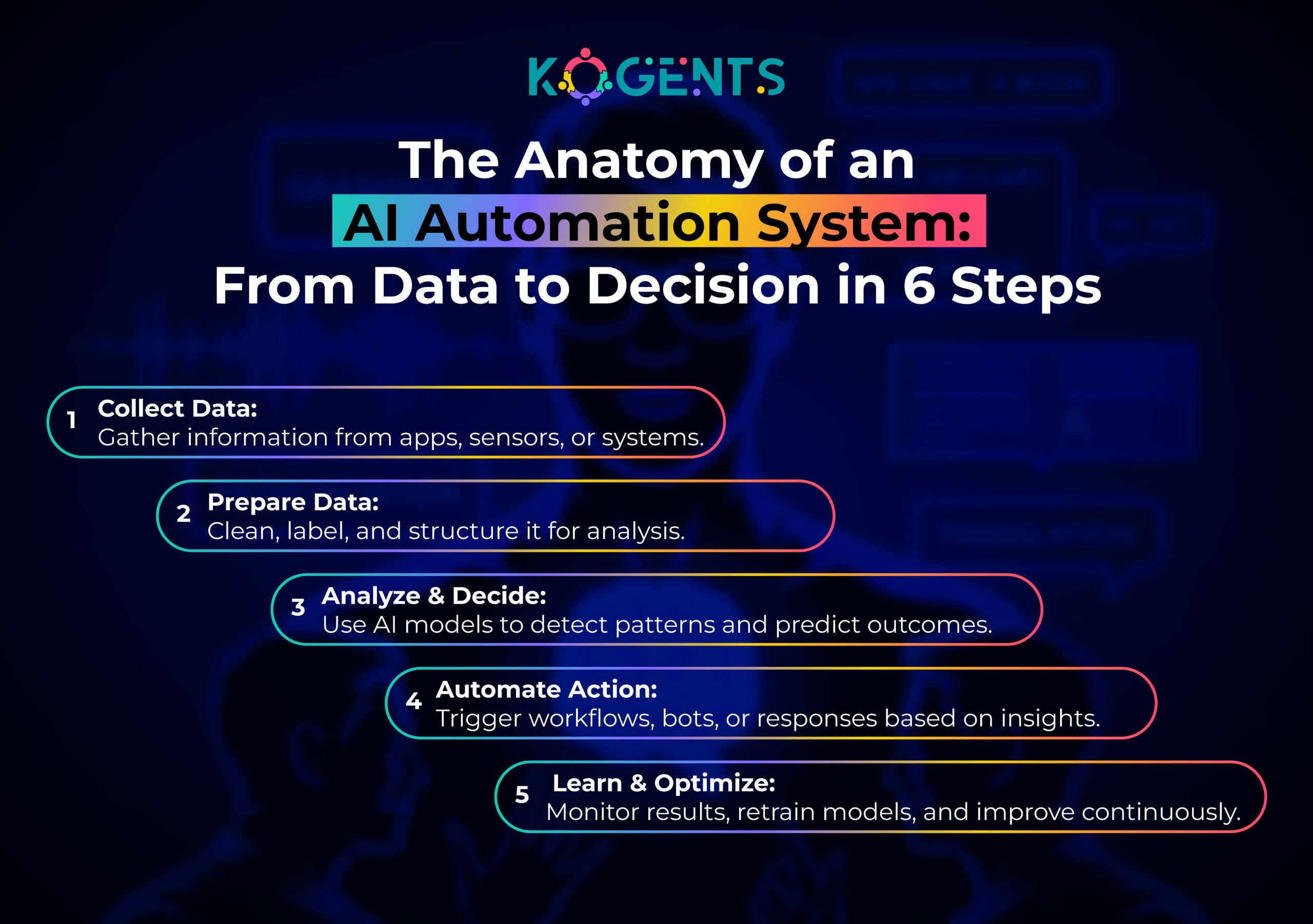
What Happens? Automate with AI agents and know that they predict and resolve incidents automatically, fixing issues, rerouting traffic, and alerting teams before downtime occurs.
You might be part of this when: You’re using a SaaS product that “unexpectedly” recovered from an outage quickly because the vendor used AIOps.
- Finance & Accounting Automation – Expense, Invoice &preempted
Finance is another area where AI process automation use cases are becoming sophisticated.
Beyond simple ledger postings and reconciliations, AI now helps with expense processing, forecasting, risk analysis, and audit workflows.
Example: The academic study mentioned earlier (corporate expense processing and) showed that generative AI + IDP achieved an 80% reduction in processing time for paper receipts.
You may already see this when: AI-powered finance automation that captures expenses, generates reports, and processes invoices end-to-end, no manual effort needed.
9. Compliance, Risk & Fraud Detection
In industries such as banking, insurance, healthcare, and telecom, cognitive automation via AI is used to detect fraud, monitor risk, and ensure regulatory compliance.
This is a rich set of AI workflow automation examples that highlight the strategic value of AI beyond cost-cutting.
Why does this matter?
- High stakes: regulatory fines, financial crimes, reputational risk.
- Value: faster detection, fewer false positives, and scalability.
- Represents a true shift from rule-based controls to pattern-based intelligence process automation.
10. Smart Back-Office Task Automation (Internal Ops)
Often invisible to external customers but critical internally, back-office functions like procurement, HR service desk, onboarding, and facilities management are increasingly automated via AI-powered business automation examples.
Use case examples:
- Procurement systems use AI to auto-generate purchase orders when inventory hits thresholds, factoring demand in real time (see supply-chain example).
- HR service desk uses chatbots and AI to answer employee queries and trigger workflows (leave approvals, benefits enrolment).
- Facilities management uses AI to schedule cleaning, maintenance, and energy optimisation.
You might see this when: AI-driven workplace automation that validates requests, answers queries instantly, and anticipates needs like bookings and approvals automatically.
Key Table: Micro-Case Highlights: Real-World AI Automation Examples in Action
| Industry / Domain | AI Automation Example | Result / ROI Impact | Core AI Technologies Used |
| Banking & Financial Services | AI-powered virtual assistants streamline customer interactions and automate KYC verification. | Reduced average customer wait times by 60 %, improved the accuracy of data validation. | NLP · Machine Learning · RPA + AI integration · Chatbot frameworks |
| Automotive Manufacturing | Predictive maintenance systems analyze sensor data to forecast machine failures before they occur. | Cut unplanned downtime by 25 %, boosted equipment efficiency. | Predictive analytics · Machine learning models · IoT automation |
| Human Resources by / Enterprise Ops | HR chatbot + intelligent document processing automate query resolution and onboarding. | Handled 80 % of routine employee queries, freeing HR time by half. | Cognitive automation · Workflow optimization · NLP · BPA tools |
| Healthcare & Insurance | AI-driven claims automation + document understanding for medical billing and fraud detection. | Processed 100 M+ claims monthly, saved 15,000 hours per month, and achieved 99.5 % accuracy. | Intelligent process automation · Generati15,000· IDP · RPA |
Case Studies
Case Study A: Insurance Domain – AI-Enhanced Business Process Automation
In a research study titled “AI-Enhanced Business Process Automation: A Case Study in the Insurance Domain Using Object-Centric Process Mining”, the authors present how an insurance company deployed a large language model (LLM) to automate the identification of claim parts, a task previously manual and bottlenecked.
Outcome: Significant improvement in scalability and throughput. This illustrates how combining generative AI and process mining delivers intelligent automation with AI in claims processing.
Case Study B: Major Healthcare Billing & Claims Company
According to a recent news article, Omega Healthcare Management Services partnered with UiPath to deploy AI-powered document understanding across insurance billing and claims.
The company processed over 100 million transactions using automation, saved over 15,000 employee hours per month, reduced documentation time by 40% and cut turnaround time by 50% with 99.5% accuracy.
Insight: This is a concrete example of AI automation in business at scale, delivering ROI and freeing up human staff for higher-value work.
Conclusion
From customer-facing bots to behind-the-scenes expense processors, these ten AI automation examples demonstrate how pervasive and powerful intelligent automation has become.
They reveal a common pattern: combining machine learning automation, cognitive automation, business process automation (BPA), and RPA + AI integration into workflows that are faster, smarter, and more autonomous.
For you, the takeaway is clear: you’re likely already interacting with and benefiting from these systems.
The question isn’t whether AI automation will happen; it’s how you leverage it. Whether as a user, a manager, or a change-maker in your organisation, understanding these use cases and how they deliver value gives you an edge.
At Kogents.ai, we specialise in architecting and deploying AI-powered business automation solutions that unlock hidden value in your operations.
From identifying prime processes, selecting the right automation software, integrating workflow with AI, to scaling across the enterprise, our mission is to turn awareness into action.
Partner with the best agentic AI company to transform your workflows, accelerate your digital transformation, and stay ahead in the age of intelligent automation.
Let’s turn your next process into a brilliant automation story.
FAQs
What are common examples of AI automation in business?
Core examples include chatbots for customer service, predictive maintenance in manufacturing, lead-scoring in sales, intelligent document processing in finance/HR, supply-chain optimisation, and risk/fraud detection. These demonstrate AI workflow automation across functions.
How does AI automation differ from traditional automation or RPA?
Traditional automation or RPA focuses on rule-based, structured tasks (clicks, data entry). When you add machine learning automation, NLP, computer vision, and decision-making capabilities, you move into intelligent automation with AI, capable of handling unstructured data, learning from patterns, and adapting workflows.
Can smaller businesses leverage AI automation, or is it only for large enterprises?
Yes, many solutions now offer low-code or no-code platforms, AI-powered workflow automation, making adoption accessible to SMBs. The key is identifying high-volume, repetitive tasks ripe for automation and selecting the right toolset. (See use case: supply-chain for SMBs).
How does AI automation relate to hyperautomation?
Hyperautomation is a strategic approach that combines multiple technologies, RPA, AI, ML, analytics, and low-code, to automate as many end-to-end processes as possible. So AI automation examples often sit within a hyperautomation strategy.
How do I get started implementing AI automation in my business?
Start small with a pilot process that’s well-defined, measurable, and has a clear ROI. Choose a tool/platform, collect/clean your data, include human-in-the-loop for exceptions, monitor, and iterate. Scale once you prove value.

Kogents AI builds intelligent agents for healthcare, education, and enterprises, delivering secure, scalable solutions that streamline workflows and boost efficiency.