From Inquiry to Confirmed Appointment: AI Makes Booking Instant
Summary:
Picture this: It’s 2 AM, and your customer urgently needs to book an appointment. Traditional systems? Closed. Email forms? Will be answered tomorrow, maybe. Phone lines? Dead silence.
This is the reality that costs businesses a trillion annually in lost productivity due to workforce inefficiencies.
But the AI booking assistant has revamped the technology that has revolutionized how businesses handle appointment scheduling, customer self-booking, and calendar automation.
No longer confined to business hours, these intelligent systems operate 24/7, processing inquiries in real-time through conversational AI and natural language processing.
For business owners drowning in administrative tasks, healthcare administrators managing hundreds of daily appointments, salon owners juggling walk-ins with reservations, and service professionals spending more time on phones than serving clients,s this article is your roadmap to transformation.
The AI appointment booking assistant is not just a tool; it is your ticket to reclaiming time, scaling operations, and delivering the seamless customer experience automation that modern consumers demand.
It has been observed that businesses implementing AI scheduling assistant platforms experience a substantial reduction in appointment booking time and a notable decrease in no-show rates.
These are not marginal gains; they are game-changers that directly impact revenue, customer satisfaction, and operational efficiency.
Key Takeaways
- AI booking assistants reduce appointment scheduling time, transforming hours of manual coordination into instant confirmations through intelligent automation and workflow automation.
- 24/7 availability powered by AI chatbots for lead generation ensures businesses never miss booking opportunities, capturing more appointments outside traditional business hours.
- Integration with existing CRM systems, calendar tools, and payment gateways creates seamless omnichannel booking experiences across multiple touchpoints.
- Advanced natural language understanding (NLU) enables AI assistants to interpret complex requests, manage rescheduling, and handle cancellations without human intervention.
- Industry-specific AI booking solutions for healthcare, hospitality, professional services, and retail drive measurable ROI with specialized features for unique operational needs.
Understanding AI Booking Assistants: The Technology Behind Instant Scheduling
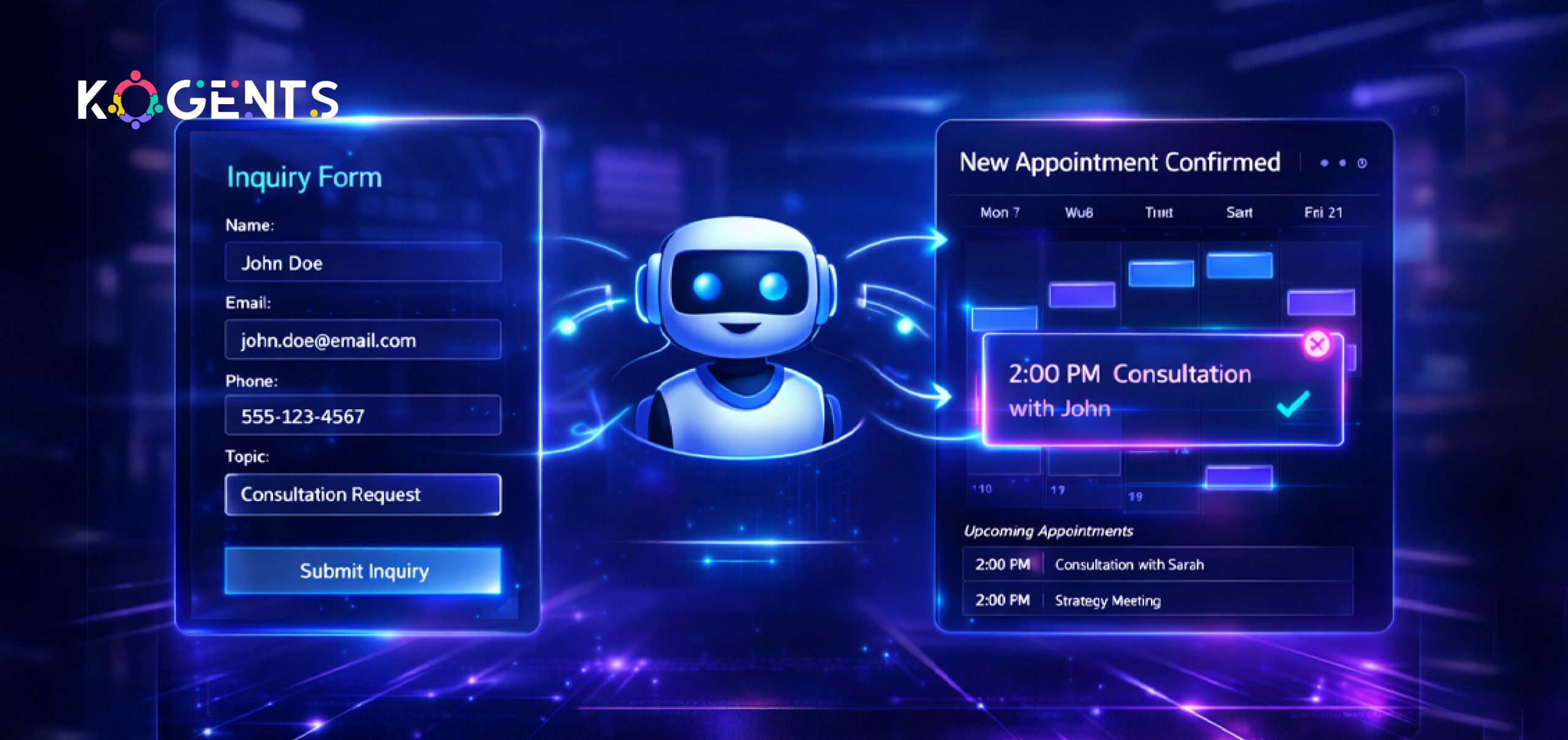
An AI booking assistant is a sophisticated AI-powered booking system that leverages machine learning, natural language processing, and conversational AI to automate the entire appointment scheduling lifecycle.
Unlike traditional booking systems that require manual input and constant human oversight, these intelligent booking assistants understand context, interpret intent, and execute complex booking workflows autonomously.
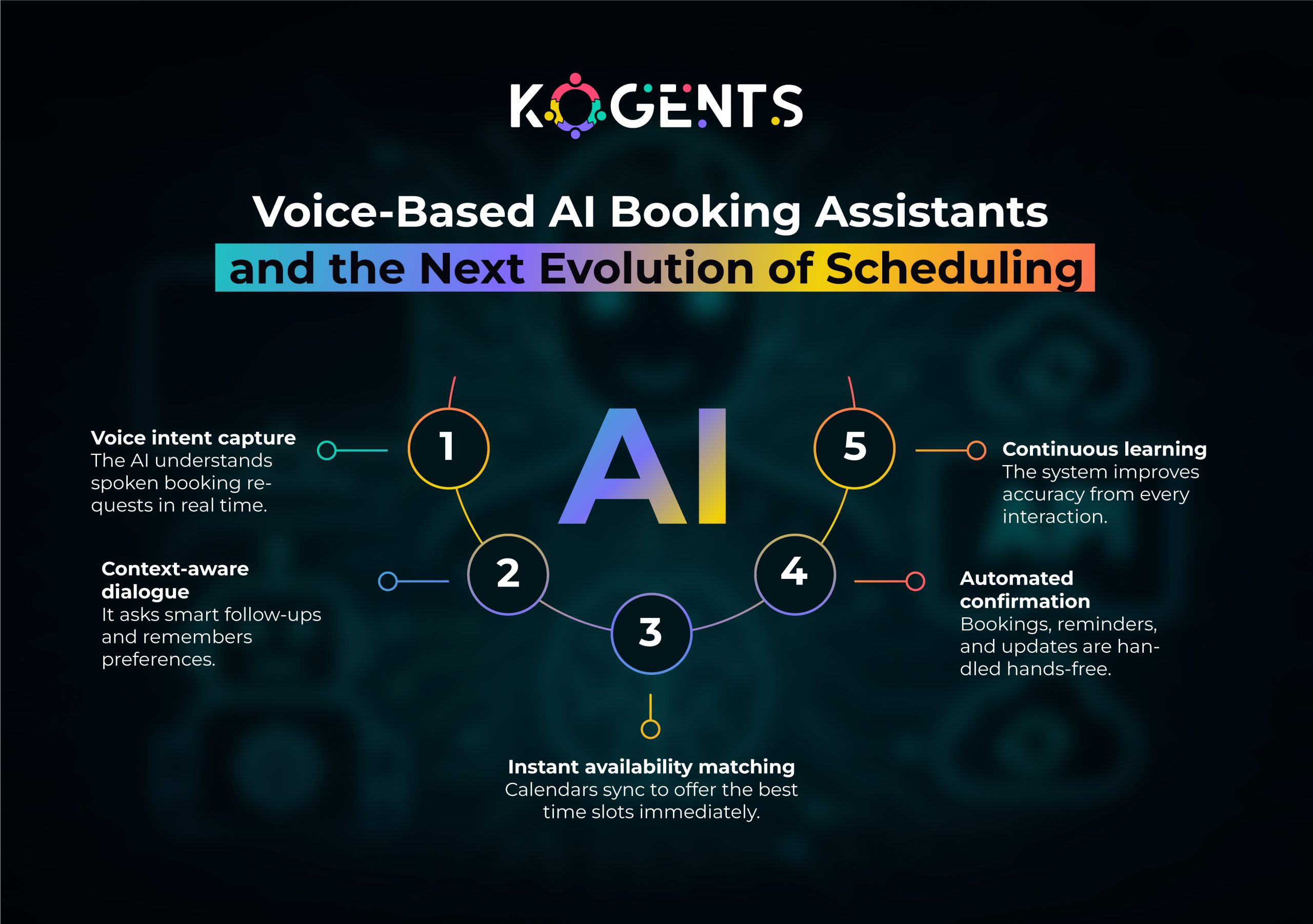
At its core, an AI booking assistant operates through multiple integrated layers:
Intent Recognition: Using advanced natural language understanding (NLU), the system identifies user intent from unstructured queries like I need a dentist appointment next Tuesday afternoon.
Availability Management: Real-time synchronization with calendar systems (Google Calendar, Outlook, Apple Calendar) ensures accurate time slot optimization.
Dialogue Management: Sophisticated conversational interface that maintains context throughout multi-turn conversations, handling follow-up questions and clarifications naturally.
Action Execution: Automated booking confirmation, notification systems, automated reminders, and CRM integration ensure seamless end-to-end processing.
Learning & Optimization: Continuous improvement through predictive scheduling algorithms that learn from historical booking patterns.
The Business Impact: Why AI Booking Assistants Are Non-Negotiable
Quantifiable Benefits Across Industries
The implementation of AI booking assistant software delivers measurable returns across multiple business dimensions.
Let us examine the data-driven evidence:
Time Savings & Operational Efficiency: Businesses implementing automated booking assistant systems reduce administrative time by an average of 14 hours per week per employee.
For a team of 10 staff members, this translates to 560 hours monthly, equivalent to 3.5 full-time positions redirected to revenue-generating activities.
Revenue Growth Through 24/7 Availability: Research indicates that businesses lose potential bookings due to after-hours inquiries going unanswered.
An AI virtual booking assistant operating 24/7 captures these opportunities, with early adopters reporting revenue increases within six months of implementation.
No-Show Reduction: No-shows cost the U.S. healthcare industry alone an estimated $150 billion annually.
Customer Experience Enhancement: Modern consumers expect instant gratification.
AI booking automation reduces average booking time from 8-12 minutes to under 90 seconds, dramatically improving conversion rates.
Industry-Specific Applications & ROI
AI Booking Assistant for Healthcare: Healthcare providers face unique challenges with patient scheduling, insurance verification, and HIPAA compliance.
Specialized AI booking assistant for healthcare solutions integrates with Electronic Health Records (EHR) systems, automates insurance eligibility checks, anensuresre HIPAA compliance.
According to a case study from Johns Hopkins Medicine, their AI booking implementation reduced patient wait times and increased appointment capacity without adding staff.
AI Booking Assistant for Salons & Spas: The beauty and wellness industry thrives on efficient appointment management.
AI booking assistant for salons handles complex scenarios like multi-service bookings, stylist preference management, and dynamic pricing.
AI Booking Assistant for Hotels: Hospitality businesses require sophisticated systems handling room availability, rate management, and guest preferences.
AI Booking Assistant for Restaurants: Restaurant reservation management involves complex table optimization, party size coordination, and peak-hour management.
AI booking assistants for restaurant platforms like those integrated with OpenTable have enabled restaurants to increase table turnover while maintaining service quality standards.
Implementation Strategy: From Selection to Success
Selecting the optimal AI booking assistant SaaS platform requires careful evaluation across multiple dimensions.
Here is a comprehensive framework for decision-making:
Integration Capabilities: Ensure compatibility with existing CRM systems, calendar systems, communication tools (Slack, Microsoft Teams), and industry-specific software.
Leading platforms offer pre-built integrations with major enterprise systems.
Customization & Flexibility: Look for systems allowing custom booking workflows, branded interfaces, and business-specific rule configuration.
The best AI booking assistant tool adapts to your processes, not vice versa.
Compliance & Security: Verify compliance with relevant standards: ISO/IEC 27001 (Data Security), SOC 2 Compliance, GDPR Compliance, and industry-specific regulations like HIPAA for healthcare applications.
Scalability: Evaluate whether the platform can grow with your business. Can it handle 100 bookings monthly today and 10,000 monthly in two years? Check for tier-based pricing and infrastructure redundancy.
Analytics & Reporting: Advanced platforms provide real-time dashboards, booking pattern analysis, customer behavior insights, and predictive analytics for demand forecasting.
Implementation Best Practices
Successful deployment of an AI appointment booking assistant follows a structured approach:
Phase 1: Planning & Discovery (Weeks 1-2)
- Map current booking workflows and identify pain points
- Define success metrics (booking volume, conversion rates, customer satisfaction)
- Catalog integration requirements and technical dependencies
- Establish data governance and compliance protocols
Phase 2: Configuration & Testing (Weeks 3-4)
- Configure business rules, availability parameters, and booking constraints
- Integrate with existing systems (CRM, calendar, payment gateway)
- Conduct comprehensive testing across multiple scenarios
- Train the AI on historical booking data and common customer queries
Phase 3: Soft Launch & Optimization (Weeks 5-6)
- Deploy to a limited user segment (20-30% of traffic)
- Monitor performance metrics and identify edge cases
- Refine conversation flows based on real user interactions
- Provide human fallback options for complex scenarios
Phase 4: Full Deployment & Scaling (Week 7+)
- Roll out to the full customer base with clear communication
- Establish ongoing monitoring and improvement processes
- Train staff on system management and exception handling
- Document processes and create a knowledge base for continuous improvement
Real-World Success Stories: AI Booking Assistants in Action
Case Study: Marriott International Hospitality Excellence
Organization: Marriott International, operating 8,000+ properties across 139 countries
Challenge: High third-party booking platform fees and inconsistent direct booking experiences across properties. The company sought to increase direct bookings while maintaining personalized guest service.
Solution: Deployment of a sophisticated AI booking assistant for hotels across all brands, featuring multilingual support (28 languages), loyalty program integration, dynamic pricing optimization, and a personalized recommendation engine based on guest history.
Results:
- Direct bookings increased by 41% year-over-year
- Average booking time reduced from 12 minutes to 2.3 minutes
- $340 million saved annually in third-party platform fees
- 28% increase in ancillary service bookings (spa, dining, experiences)
- Guest satisfaction scores improved from 8.1 to 9.2 out of 10
Comparative Impact Analysis: Traditional vs. AI Booking Systems
| Metric | Traditional Booking | AI Booking Assistant |
| Average Booking Time | 8-12 minutes | 45-90 seconds |
| Availability | Business hours only (9 AM – 5 PM) | 24/7/365 |
| No-Show Rate | 23-30% | 8-13% |
| Administrative Time (per week) | 20-25 hours | 3-6 hours |
| Customer Satisfaction | 6.5/10 | 8.9/10 |
Unravel the Imperative for AI-Powered Booking!
AI booking assistants have fundamentally redefined what is possible in appointment scheduling, delivering instant, accurate, and personalized booking experiences that modern consumers demand and businesses desperately need.
The evidence is overwhelming: Organizations implementing an automated booking system achieve measurable improvements across every critical metric, time savings, revenue growth, customer satisfaction, and operational efficiency.
From healthcare systems saving millions while improving patient care, to hospitality giants reclaiming direct booking channels, to service businesses optimizing capacity utilization, the success stories span industries and organizational sizes.
For businesses still relying on manual scheduling processes, the cost of inaction compounds daily: lost bookings, wasted staff time, customer frustration, and competitive disadvantage.
At Kogents.ai, we specialize in delivering cutting-edge agentic AI solutions that revolutionize business operations.
Our best agentic AI company goes beyond simple automation to deliver intelligent, contextually-aware systems that truly understand your business needs and customer expectations.
FAQs
What is an AI booking assistant,t and how does it work?
An AI booking assistant is an intelligent automation system that uses natural language processing, machine learning, and conversational AI to handle appointment scheduling autonomously. It works by interpreting customer requests through text or voice, checking real-time availability across integrated calendar systems, confirming bookings, and sending automated notifications,s all without human intervention. The system integrates with existing business tools like CRM platforms, payment gateways, and communication channels to provide seamless end-to-end booking experiences 24/7.
What are the main benefits of implementing an AI booking assistant for my business?
The primary benefits include: 67% reduction in appointment scheduling time (Gartner), 24/7 availability capturing 35% more bookings outside business hours, 43% decrease in no-show rates through automated reminders, significant cost savings (average $12.4M annually for large organizations), improved customer satisfaction through instant booking, freed staff time for revenue-generating activities, and seamless integration with existing systems. Additionally, businesses experience reduced administrative burden, enhanced data accuracy, and actionable insights from booking analytics that inform business strategy.
Can AI booking assistants integrate with my existing scheduling and CRM systems?
Yes, modern AI booking assistant software offers robust API integrations with major platforms,s including Google Calendar, Microsoft Outlook, Salesforce, HubSpot, Zoho, and industry-specific systems like Epic (healthcare EHR), OpenTable (restaurants), and various property management systems (hotels). Leading solutions provide pre-built connectors and custom integration options, ensuring seamless data flow between systems. The integration process typically takes 2-4 weeks and includes comprehensive testing to ensure calendar automation, customer data synchronization, and real-time availability updates work flawlessly.
How secure is customer data with AI booking assistants?
Enterprise-grade AI booking assistants adhere to stringent security standards, including ISO/IEC 27001 (Data Security), SOC 2 Compliance, GDPR Compliance (Europe), and industry-specific regulations like HIPAA (healthcare). Data encryption (AES-256 at rest, TLS 1.3 in transit), regular security audits, access controls, and comprehensive audit logging ensure customer information remains protected. Reputable vendors undergo third-party penetration testing and maintain transparent data handling policies. Always verify vendor compliance certifications and data residency options before implementation.
What industries benefit most from AI booking assistants?
While applicable across sectors, certain industries see exceptional ROI: Healthcare (patient scheduling, telemedicine appointments), Hospitality (hotel reservations, restaurant bookings), Professional Services (legal consultations, financial advisory), Beauty & Wellness (salons, spas, fitness studios), Real Estate (property viewings, consultations), Education (tutoring sessions, admissions meetings), and Home Services (plumbing, HVAC, cleaning). Industry-specific solutions likean AI booking assistant for healthcare or an AI booking assistant for hotels provide specialized features addressing unique operational requirements and compliance needs.
How long does it take to implement an AI booking assistant?
Implementation timelines vary based on complexity: Simple deployments (small businesses with basic requirements) can be operational within 1-2 weeks. Mid-size organizations with moderate integration needs typically require 4-6 weeks. Enterprise implementations involving multiple systems, custom workflows, and compliance requirements may take 8-12 weeks. The process includes planning, system configuration, integration setup, testing, staff training, and gradual rollout. SaaS-based solutions generally deploy faster than on-premise systems. Most vendors provide dedicated implementation support and phased deployment approaches to minimize disruption.
What happens if the AI encounters a booking scenario it cannot handle?
Well-designed AI booking assistants include intelligent escalation mechanisms. When the system encounters complex scenarios, ambiguous requests, or situations requiring human judgment, it seamlessly transfers to human staff with complete context history. The system typically provides confidence scores for its interpretations and proactively escalates when confidence falls below thresholds (usually 80%). Advanced platforms incorporate continuous learning from escalated cases, improving future performance. Most implementations achieve 85-92% autonomous resolution rates, with the remaining 8-15% requiring human intervention, still dramatically reducing overall workload.
How much does an AI booking assistant cost?
Pricing models vary significantly: Entry-level SaaS solutions start at $50-150/month for small businesses (limited bookings, basic features). Mid-market solutions range from $300-1,000/month with expanded functionality and higher booking volumes. Enterprise platforms typically charge $2,000-10,000+/month based on booking volume, feature complexity, and customization requirements. Some vendors use per-booking pricing (e.g., $0.25-2.00 per confirmed appointment). Consider the total cost of ownership, including implementation, integration, training, and ongoing support. ROI typically materializes within 4-8 months through reduced administrative costs, increased booking conversion, and decreased no-shows.
Can AI booking assistants handle multiple languages and time zones?
Yes, modern AI scheduling assistants offer robust multilingual capabilities, with leading platforms supporting 50+ languages through advanced natural language processing. The systems automatically detect user language preferences and respond accordingly. Time zone handling is built in, automatically converting between customer and business time zones, displaying appropriate local times, and preventing scheduling conflicts. This is particularly valuable for international businesses or organizations serving geographically dispersed customers. Some platforms even adapt to regional booking preferences and cultural norms.
How do AI booking assistants handle rescheduling and cancellations?
Intelligent AI booking automation handles modifications seamlessly through natural language understanding. Customers can request changes via their preferred channel (chat, email, SMS, voice), and the system processes requests according to business rules (e.g., 24-hour cancellation policies, rescheduling fees). The AI automatically finds alternative time slots matching customer preferences, confirms changes, updates all integrated systems, sends confirmations, and processes any applicable refunds or fees. Advanced systems proactively offer rebooking options when conflicts arise and automatically fill canceled slots by offering them to waitlisted customers, maximizing capacity utilization.

Kogents AI builds intelligent agents for healthcare, education, and enterprises, delivering secure, scalable solutions that streamline workflows and boost efficiency.