How AI Hiring Helps Companies Retain Top Talent
Summary:
A recruiter opens the dashboard before the first coffee is finished. There are resumes waiting. A hiring manager has sent three follow-up messages. A strong candidate from last month has gone quiet. Another applicant asked for an update yesterday, and no one has replied yet.
Nothing looks broken from the outside. The jobs are posted. The ATS is running. The team is working hard.
But inside the funnel, talent is leaking.
This is where AI in recruitment becomes more than another tool. Used well, it gives hiring teams memory, speed, structure, and follow-through, without removing the human judgment that makes hiring feel personal and fair. The real problem is not that recruiters are lazy or candidates are impatient. The problem is that the hiring system asks humans to remember too much, chase too many threads, and make sense of fragmented information that lives across email, spreadsheets, calendars, ATS notes, chat messages, and interview feedback.
Key Takeaways
- Hiring teams do not just need more applicants. They need a smarter way to remember, re-engage, and evaluate talent.
- AI works best when it removes manual friction, not human responsibility.
- The strongest recruiting systems combine candidate memory, structured screening, fast communication, and human oversight.
- The future of hiring is not fully automated recruiting. It is better human decision-making supported by intelligent workflows.
What Is AI in Recruitment?
AI in recruitment is the use of artificial intelligence to support hiring tasks such as resume review, candidate matching, interview scheduling, applicant communication, talent rediscovery, and workflow automation. It helps recruiters handle repetitive work faster while keeping humans responsible for strategy, relationship-building, and final decisions.
That definition matters because too many teams still treat AI as either a magic filter or a threat. It is neither. An ai recruiting assistant is useful when it helps the team see what they already have, respond faster, and make cleaner decisions. It becomes risky when leaders treat it as a black box that replaces context, fairness, or judgment.
Recruiting has always been human. People still choose people. But the work around that choice has become heavier. More applicants. More channels. More internal stakeholders. More pressure from finance to reduce hiring costs. More candidates expecting fast communication because every other digital experience in their life already feels immediate.
SHRM reported that recruiting is the HR practice area organizations most often use AI to support, with 51% using AI for recruiting efforts. That matters because the shift is no longer theoretical. It is already changing how hiring teams source, screen, communicate, and organize their pipelines.
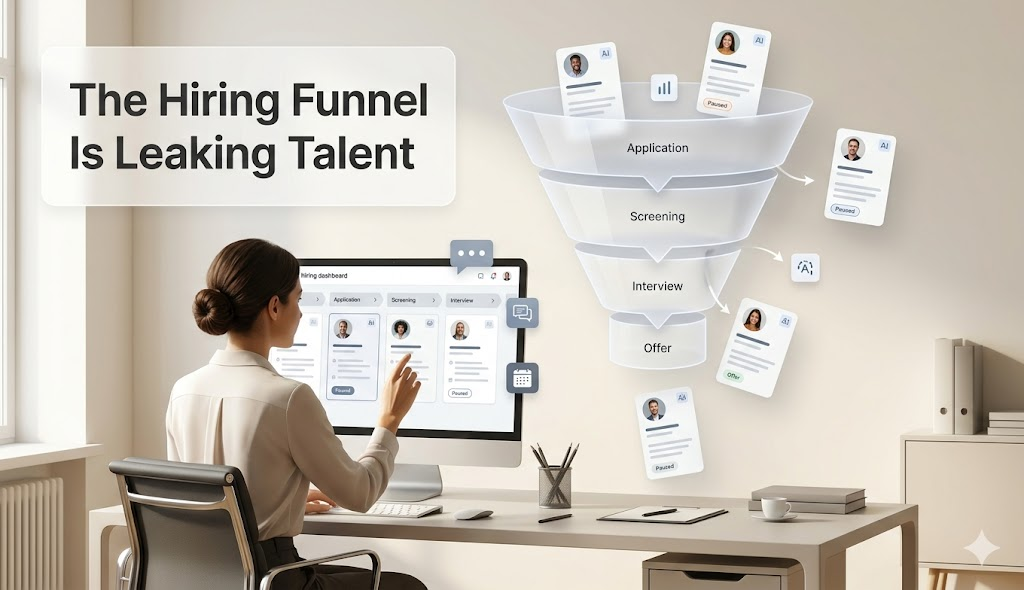
Why Does the Hiring Funnel Bleed Talent?
The hiring funnel bleeds talent when interested, qualified people enter the process and then disappear because the system does not move quickly, clearly, or intelligently enough.
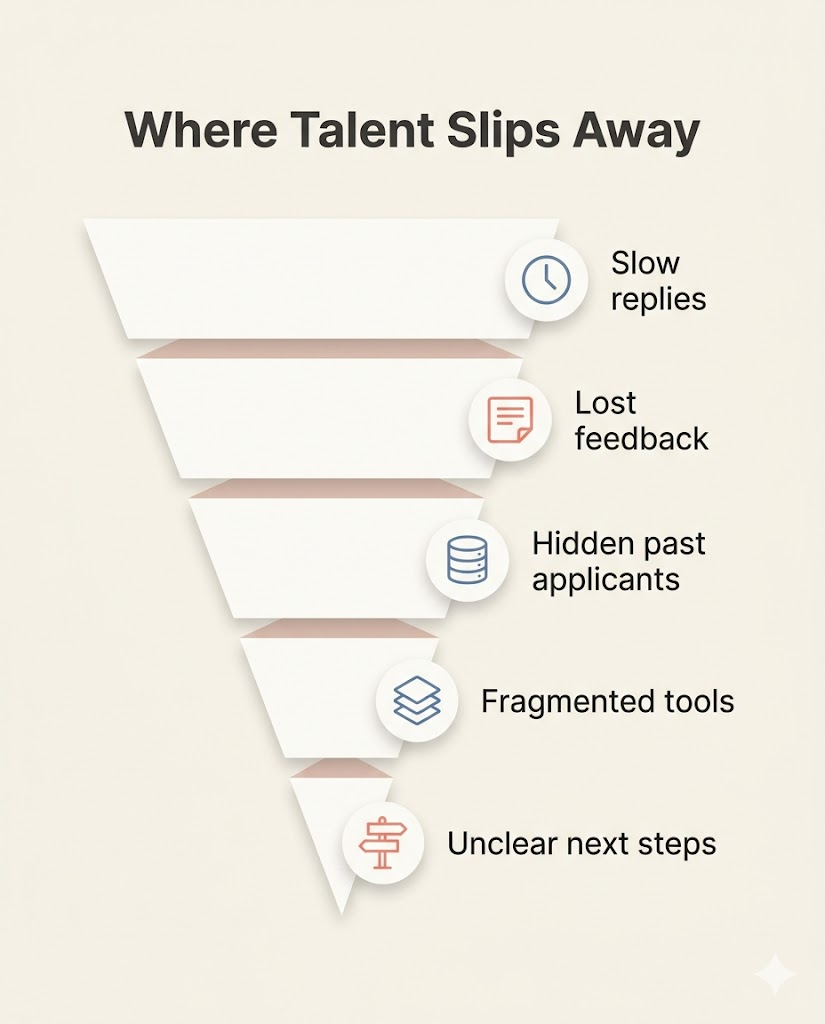
Sometimes the leak is obvious. A candidate waits too long after applying. A recruiter forgets to follow up. An interview note is buried in a Slack thread. A hiring manager gives feedback too late.
Other times, the leak is quiet. A strong silver-medalist candidate from a previous role is never recontacted. Someone who visited the careers page twice never receives a relevant message. A former applicant with newly relevant experience stays hidden in the ATS because no one has time to search old records.
That is the expensive part: many companies are not just failing to find new talent. They are forgetting the talent they already found.
What Most Companies Get Wrong About Hiring Automation
The common mistake is trying to automate a broken process exactly as it exists.
A team with scattered notes, vague scorecards, inconsistent communication, and weak handoffs may buy AI candidate screening and expect the whole funnel to improve. But automation does not automatically create clarity. It can make messy processes move faster, which means mistakes scale faster too.
The smarter question is not, “Which tool should replace this manual task?”
The smarter question is, “Which part of the hiring experience should become clearer, faster, and more reliable?”
That is the difference between buying software and redesigning the hiring engine.
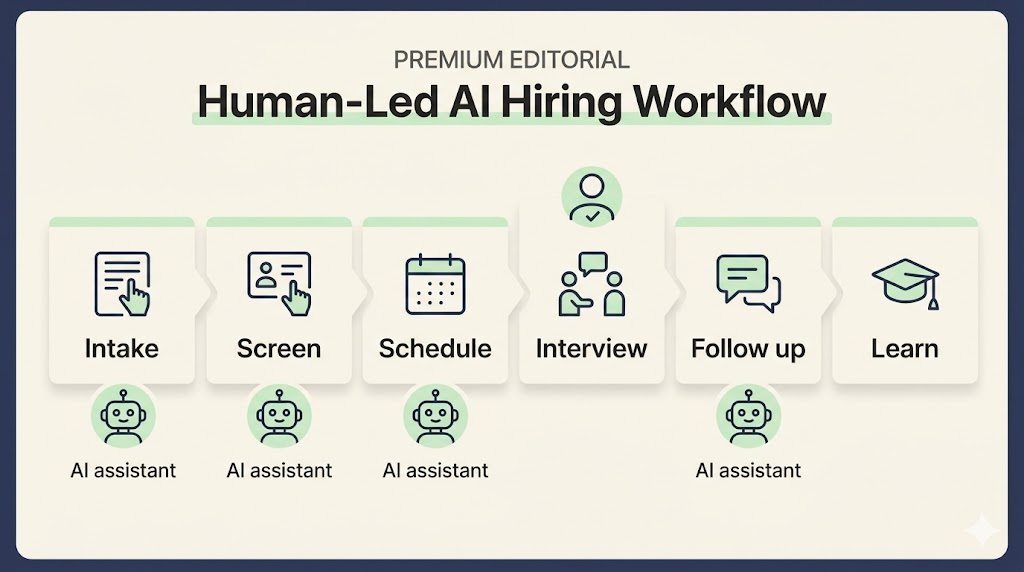
For leaders researching how AI is used in recruitment, the practical answer is simple: AI is most useful when it acts as a connective layer. It can identify matches, summarize candidate context, route applicants to the right stage, schedule interviews, send updates, trigger follow-ups, and surface talent that would otherwise stay buried. But the company still needs clear criteria, accountable owners, and a human review model.
The 5 Lever Framework for Fixing the Funnel
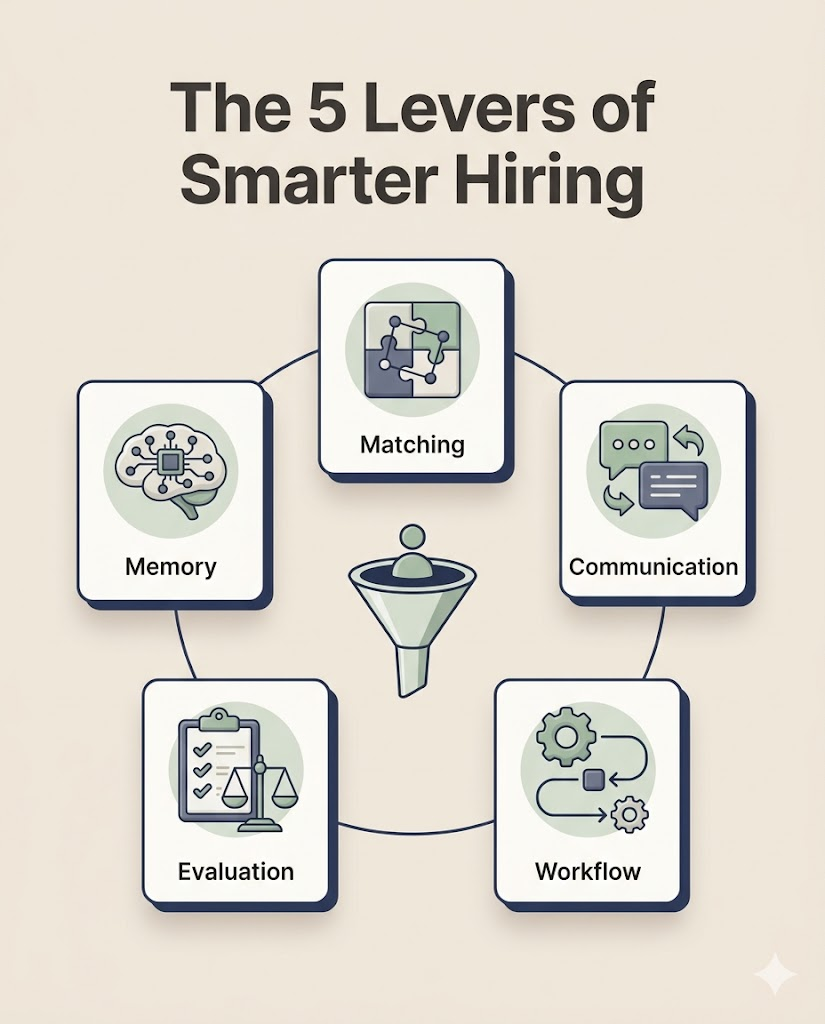
A better hiring funnel does not start with “more automation.” It starts with five levers that remove friction without making candidates feel processed.
1. Memory
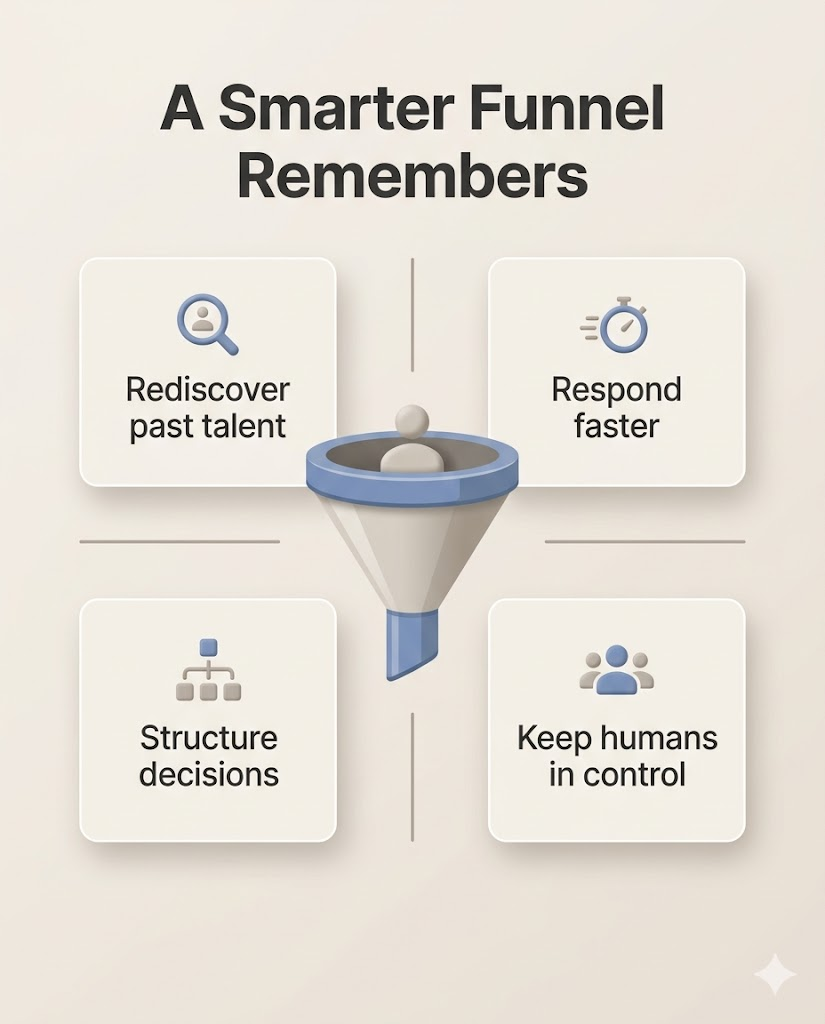
A hiring system should remember past applicants, silver medalists, former employees, event leads, referrals, and candidates who were not ready at the time.
This is where AI can change the economics of recruiting. The team does not have to start from scratch every time a role opens. It can rediscover relevant talent already sitting inside the business.
2. Matching
Matching should go beyond exact keyword overlap. A candidate may not use the same phrase as the job description, but the underlying skill may still fit. Modern AI can help recruiters see transferable experience, adjacent skills, and contextual relevance.
3. Communication
Candidates should not have to guess what happened. AI can support timely updates, reminders, interview logistics, and status communication. The tone still needs to feel human, but the consistency can be automated.
4. Evaluation
AI can organize evidence, summarize profiles, highlight gaps, and support structured screening. Humans should still own sensitive judgments, culture fit discussions, offer decisions, and final accountability.
5. Workflow
Recruiting does not happen in one place. It touches calendars, email, ATS records, interview notes, hiring managers, job boards, CRM systems, and internal chats. AI becomes powerful when it connects those pieces into one working flow.
How Should AI Candidate Screening Actually Work?
AI candidate screening should help recruiters review candidates consistently, not blindly reject people. The best setup uses AI to organize evidence, compare role requirements, flag potential matches, and explain why a candidate may fit, while humans review the context before making decisions.
This is especially important now because resumes are changing. Candidates can polish resumes faster than ever. Some may tailor every line to the job description. Others may use phrasing that sounds impressive but does not prove capability. A basic keyword screen can be fooled, and a rushed human review can miss nuance.
That is why strong screening should be layered.
A practical screening flow looks like this:
- Parse the resume and profile into structured fields.
- Compare the candidate against role-specific criteria.
- Look for transferable skills, not just exact keywords.
- Add other signals such as screening questions, portfolio evidence, or structured interview notes.
- Let a human review the recommendation before advancing or rejecting.
The point is not to make hiring colder. The point is to reduce randomness.
A recruiter should not have to choose between speed and fairness. A hiring manager should not receive a pile of profiles with no explanation. A candidate should not be dismissed because their resume used a different phrase than the job description.
Where AI Helps Most Across the Hiring Funnel
| Hiring stage | What AI can support | What humans should still own | Common mistake |
| Sourcing | Rediscovering past candidates and identifying relevant profiles | Talent strategy and relationship building | Chasing new candidates while ignoring existing talent pools |
| Screening | Structuring resume data and highlighting role fit | Final judgment on context, potential, and fairness | Treating AI scores as final decisions |
| Scheduling | Coordinating availability and reminders | Handling sensitive timing issues | Automating without clear candidate communication |
| Interviews | Summarizing notes and organizing feedback | Asking better questions and reading nuance | Letting feedback stay vague or scattered |
| Follow-up | Sending timely updates and next steps | Personal outreach for high-value candidates | Leaving candidates in silence |
| Reporting | Finding bottlenecks and workflow gaps | Deciding what to change operationally | Measuring activity instead of funnel health |
For teams evaluating AI resume screening software, this table is the key. Screening is only one piece of the funnel. If the system screens faster but scheduling is slow, feedback is vague, and past candidates are forgotten, the funnel still bleeds talent.
What Should Stay Human?
Hiring is not only a data problem. It is a trust problem.
Candidates want clarity. Hiring managers want confidence. Recruiters want fewer bottlenecks. Finance wants discipline. Leaders want better hires without endless headcount increases.
AI can help with all of that, but only when the human role becomes sharper.
Humans should own:
- Final hiring decisions
- Sensitive candidate conversations
- Compensation and offer strategy
- Culture, motivation, and team fit discussions
- Bias review and process governance
- Employer brand voice and candidate empathy
This is where many companies lose the plot. They look at AI and imagine a fully autonomous hiring machine. That may sound efficient, but hiring without human control can feel opaque and impersonal. It can also create risk when no one can explain how a decision was made.
A healthy model keeps AI close to the workflow and humans close to the judgment.
William Gibson is often credited with saying, “The future is already here. It’s just not evenly distributed.” That line fits recruiting perfectly. Some teams are already using AI to connect workflows and improve candidate experience. Others are still asking recruiters to patch together spreadsheets, inboxes, and memory.
Do This, Not That
Do use AI to help recruiters see the full candidate picture.
Do not use AI as a silent rejection machine.
Do use AI to speed up communication.
Do not let automated messages feel cold, vague, or evasive.
Do use AI to rediscover past candidates.
Do not treat every new opening as a brand-new search.
Do use AI to structure screening evidence.
Do not assume a score is the same thing as a decision.
Do use AI to connect tools.
Do not add another disconnected platform to an already fragmented stack.
A Familiar Scenario: The Almost-Hire Who Comes Back
Picture a mid-sized SaaS company hiring for a customer success manager. The team posts the role, receives a wave of applications, and starts screening from zero.
But inside the ATS, there is a candidate from a previous hiring round. She reached the final stage for a similar role months earlier. She had the right customer-facing experience, strong communication, and a thoughtful interview. At the time, the timing was wrong. The company moved forward with someone else.
In the old process, she stays buried.
In a smarter process, the system remembers her. When the new role opens, AI identifies her as relevant, surfaces the previous notes, shows why she fits the new role, and prompts the recruiter to reach out with a personal message.
That is not replacing recruiting. That is giving recruiting a memory.
This is also where the search for the best AI recruiting software 2026 should become more practical. The best option is not always the flashiest interface. It is the platform that helps the team reduce forgotten candidates, slow communication, scattered feedback, and manual coordination.
How to Start Without Overcomplicating It
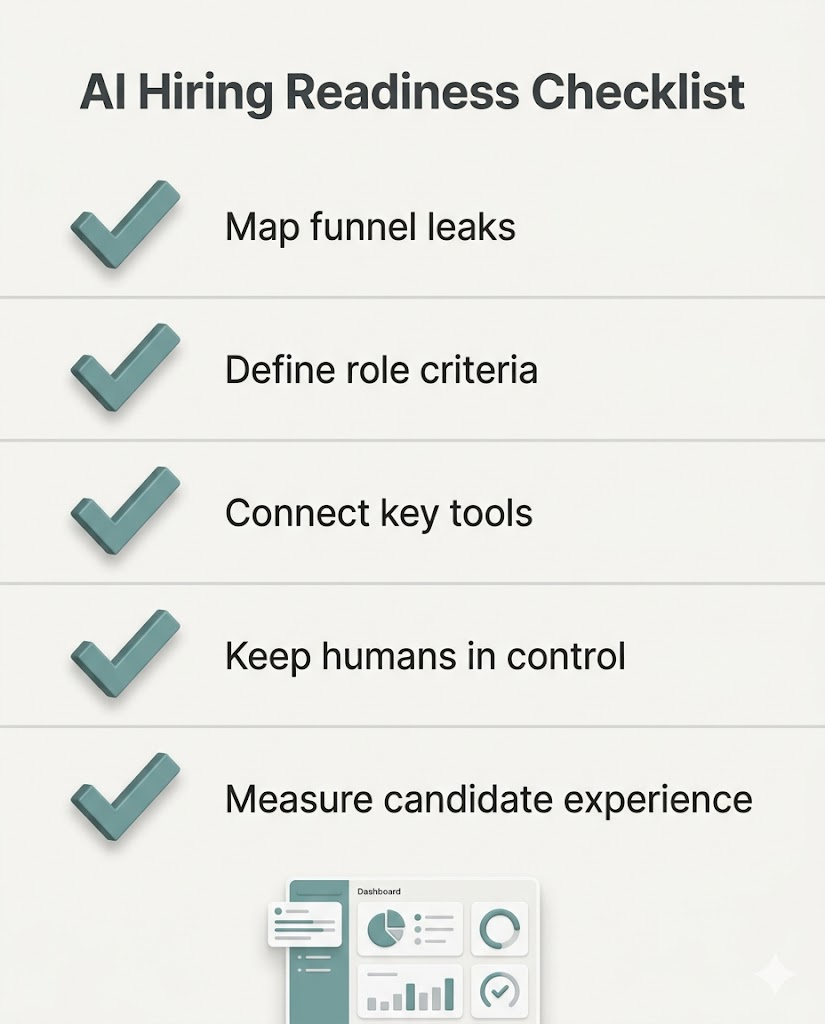
Leaders do not need to rebuild the entire hiring operation in one move. The better path is to start with the most painful leak.
A simple rollout can look like this:
- Choose one high-impact role type.
- Map the funnel from application to offer.
- Identify where candidates slow down, drop off, or disappear.
- Define what AI should handle and what humans must own.
- Test the workflow, review results, and adjust before expanding.
This is not about chasing novelty. It is about building a cleaner operating rhythm.
For a 50 to 500 employee company, that rhythm matters. These companies are often big enough to feel enterprise hiring complexity but not big enough to throw endless recruiter headcount at the problem. Every bottleneck hurts. Every missed candidate matters. Every delayed follow-up can push talent toward a competitor.
AI helps when it gives the team leverage.
Not by removing care.
By making care easier to deliver consistently.
The New Role of the Recruiter
The recruiter’s job is not shrinking. It is changing.
When AI handles more of the repetitive work, recruiters can spend more time on work that actually needs human intelligence: understanding hiring manager needs, building trust with candidates, interpreting motivation, challenging unclear requirements, and helping leaders make better decisions.
That shift is important because hiring teams are not only filling seats. They are shaping the company’s future capacity.
The best recruiters will become workflow designers, candidate advocates, talent advisors, and quality controllers. They will know when to trust automation and when to slow down. They will ask better questions because they will spend less time hunting for basic information.
That is the optimistic version of AI in hiring: not fewer humans, but better use of human attention.
Conclusion: The Funnel Does Not Need More Noise. It Needs Memory.
The hiring funnel is not bleeding talent because teams do not care. It is bleeding talent because the work has outgrown the old operating model.
Candidates move fast. Hiring managers are busy. Recruiters are stretched. Tools are fragmented. Past talent is forgotten. Feedback gets lost. Follow-up becomes inconsistent.
AI in recruitment quietly fixes the funnel when it gives teams memory, matching, communication, evaluation support, and connected workflows without taking humans out of the moments where trust matters most.
For teams ready to connect recruiting conversations, support tasks, bookings, CRM updates, candidate communication, and follow-up workflows in one practical AI agent system, Kogents AI can help. Contact [email protected] or +12672489454 to explore how AI agents can support hiring and business operations with speed, structure, and human control.
Audio Summary (Separate Voice Version)
Hiring teams are not losing talent because they lack effort. They are losing talent because old workflows make it too easy to forget candidates, delay follow-up, and scatter feedback across disconnected tools. AI can help by giving the hiring funnel memory, speed, and structure while keeping recruiters in control of the human decisions. The goal is not to replace recruiting judgment, but to make great recruiting easier to deliver every day.
FAQ
What makes a good AI hiring workflow?
A good AI hiring workflow connects candidate data, communication, screening, scheduling, and follow-up in one clear process. It should support recruiters, not hide decisions from them.
What are the best practices for using AI in recruiting?
Start with one hiring bottleneck, define clear role criteria, keep humans involved in decisions, and review AI outputs regularly for quality, fairness, and clarity.
What AI hiring trends should talent leaders watch?
The most useful trends are talent rediscovery, conversational AI, workflow automation, structured screening, and better integration between ATS, CRM, calendar, and communication tools.
How to use AI without making hiring feel impersonal?
Use AI for speed, reminders, summaries, and routing. Keep personal recruiter outreach for sensitive moments, high-value candidates, interviews, rejections, and offers.
When to hire an AI recruiting automation partner?
Hire a partner when the team is losing time to repetitive tasks, missing follow-ups, struggling with fragmented tools, or repeatedly starting each search from scratch.
What services should an AI recruiting automation platform provide?
It should support candidate communication, screening workflows, booking automation, CRM or ATS updates, follow-up sequences, internal task routing, and reporting.
Is custom AI better than a basic recruiting chatbot?
Custom AI is better when the hiring workflow has specific role types, approval steps, compliance needs, brand voice rules, or multiple tools that need to work together.
What is the cost of waiting too long to improve the hiring funnel?
The cost is not just slow hiring. It includes lost candidates, recruiter burnout, weaker candidate experience, duplicated work, and missed opportunities inside existing talent pools

Kogents AI builds intelligent agents for healthcare, education, and enterprises, delivering secure, scalable solutions that streamline workflows and boost efficiency.