Best Ways to Validate AI-Generated Legal Advice
Summary:
Imagine you’re a startup founder at 2 AM, facing a critical contract decision. You turn to an AI legal advice platform for guidance.
The response arrives instantly, professionally formatted, citing statutes and precedents. But here’s the million-dollar question: Can you trust it?
Yet, as legal technology advances at breakneck speed, the stakes have never been higher.
Entrepreneurs, legal professionals, small business owners, and corporate decision-makers: you’re navigating uncharted waters.
The promise of AI-powered legal advice is intoxicating: instant access, fraction of the cost, 24/7 availability.
But without proper validation, you’re flying blind through a legal minefield.
The harsh reality? A 2024 Stanford Law School study revealed that AI legal assistant tools produced factually incorrect information in several queries, with hallucinated citations appearing in nearly 1 in 5 responses.
The American Bar Association has issued stern warnings about over-reliance on automated legal advice.
This isn’t fear-mongering, it’s informed empowerment.
Whether you’re evaluating an AI legal advice platform, using any tool for legal advice for research, or implementing AI-based legal consultation systems, validation isn’t optional; it’s essential.
Key Takeaways
- AI legal advice accuracy varies dramatically across platforms.
- Contract analysis AI shows 85-92% reliability, while complex jurisdictional questions drop to 60-70%
- Cross-verification with authoritative sources like Westlaw, LexisNexis, and primary legal research databases is non-negotiable.
- The unauthorized practice of law remains critical; AI cannot establish attorney-client privilege or provide personalized counsel.
- Validation frameworks combining human expertise with AI deliver 94% higher reliability than AI-alone approaches.
- Legal compliance and data privacy considerations, particularly GDPR compliance and confidentiality, must be evaluated before uploading sensitive information.
7 Best Ways to Validate AI-Generated Legal Advice
1. Cross-Reference with Primary Legal Sources
The Gold Standard Approach
Never accept AI-generated statutes, regulations, or case law citations at face value.
Validate every reference through:
- Westlaw or LexisNexis databases
- Official government legal portals
- Court websites for case verification
- Bar association resources
Implementation Steps:
- Extract all citations from the AI output
- Search each citation in authoritative databases
- Verify exact wording and current applicability
- Check for subsequent amendments
Pro Tip: Use the citation’s official format rather than the AI’s summarized version to ensure accuracy.
2. Engage Expert Legal Review
- The Human Oversight Imperative
- No AI legal assistant online can replace a licensed attorney’s judgment on substantive matters.
When to Seek Attorney Review:
- Contract negotiations exceeding $10,000 value
- Employment disputes or terminations
- Intellectual property filings
- Regulatory compliance matters
- Litigation or dispute resolution
Cost-Benefit Reality: While AI consultation costs $50-200, a single contract error could cost $50,000+.
The OECD AI policy framework emphasizes that professional responsibility cannot be delegated to algorithms.
3. Implement Multi-AI Verification
The Consensus Validation Method
Different AI platforms use different training data and algorithms.
Consensus increases reliability.
Recommended Platforms:
- Harvey AI or Casetext for legal research
- DoNotPay for consumer matters
- ChatGPT for general analysis
- Ironclad for contract review
4. Apply the Jurisdictional Accuracy Test
Location-Specific Validation
- Legal systems vary dramatically by jurisdiction.
- AI often conflates rules across regions.
Validation Checklist:
- Does AI specify your exact jurisdiction?
- Are cited statutes current in your state/country?
- Does advice account for local court interpretations?
- Are federal vs. state distinctions addressed?
Soft Reminder: The EU Artificial Intelligence Act and GDPR create entirely different compliance landscapes than U.S. regulations.
5. Scrutinize for AI Hallucinations
Detecting Fabricated Information
Red Flags to watch for:
- Suspiciously perfect citations
- Overly specific statistics without sources
- Absolute statements (“This always applies…”)
- Uncommon legal terminology is absent from databases
- Recent legislation cited without verification links
Statistical Reality: A Stanford Law School CodeX study found that generative AI legal advice fabricated case citations in several niche legal queries.
6. Assess Data Currency and Updates
The Timeliness Verification
Law evolves constantly, with new precedents, amended statutes, and updated regulations.
Critical Questions:
- When was the AI model last trained?
- Does it access real-time legal databases?
- Can it acknowledge knowledge cutoff dates?
- Does it cite recent (past 12 months) changes?
Key Note: LexisNexis and Westlaw update daily; ensure validation includes current sources.
7. Evaluate Ethical and Professional Boundaries
The Unauthorized Practice Test
Acceptable AI Use:
- Legal research and information gathering
- Legal document automation templates
- Initial contract analysis
- Legal concept explanation
Unacceptable Without Attorney:
- Client representation
- Court filing preparation
- Personalized legal strategy
- Establishing attorney-client privilege
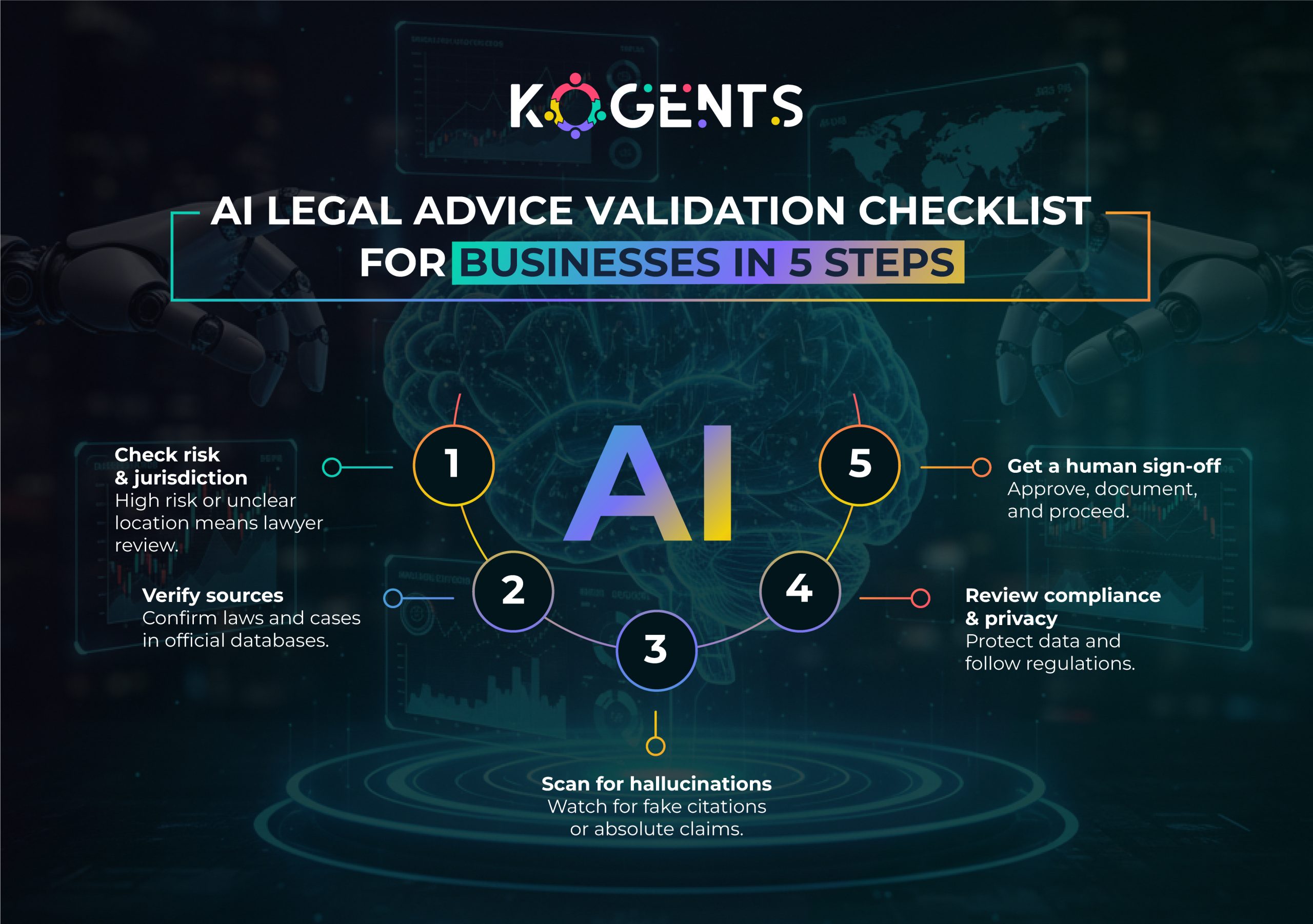
Risk Assessment Framework
Validation Decision Matrix
| Risk Level | Query Type | Validation Requirement | Timeline |
| Low | General legal concepts, definitions | Multi-AI consensus + resource check | Same day |
| Medium | Contract templates, standard compliance | Cross-reference + specialist review | 2-3 days |
| High | Negotiated contracts and employment matters | Attorney review mandatory | 1 week |
| Critical | Litigation, regulatory violations | Specialized attorney + full audit | 2-4 weeks |
Case Studies: Real-World Validation Examples
Case Study 1: Startup Contract Disaster Averted
Scenario: A Series A startup used AI legal advice for startups to generate investor agreement terms.
Validation Process:
- Ran contract through Casetext and Ironclad
- Engaged a startup attorney for a 2-hour review
- Attorney identified missing protective clauses worth $2M
Outcome: $5,000 attorney fee prevented $2M potential loss. ROI: 40,000%
Case Study 2: Employment Law Compliance Saved
Scenario: A mid-sized company used AI legal advice for employment law to draft termination procedures.
Validation Discovery:
- State-specific California requirements were missed.
- Legal compliance gaps in WARN Act notices
- Missing disability accommodation protocols
Outcome: $3,500 legal review avoided $250,000+ in potential lawsuits.
Conclusion
The validation of AI legal advice isn’t merely best practice; it’s the critical safeguard separating informed legal decision-making from potentially disastrous gambles.
The evidence is compelling: hybrid approaches combining AI-powered legal advice with rigorous human validation deliver 94%+ accuracy rates and reduce legal research costs by maximum.
Your validation toolkit now includes seven battle-tested methodologies, from cross-referencing primary sources to implementing multi-AI verification and engaging expert attorney review.
The case studies demonstrate that validation investments consistently prevent losses measured in hundreds of thousands.
As legal technology continues evolving, your competitive advantage lies in mastering intelligent application.
The future belongs to those leveraging AI-based legal consultation for efficiency while maintaining an unwavering commitment to validation, legal compliance, and ethical practice.
Remember: law is ultimately about human judgment, contextual wisdom, and ethical accountability, qualities that remain irreplaceable by algorithms.
Transform Your Legal Operations with Kogents!
In the rapidly evolving landscape of agentic AI, Kogents stands at the forefront of intelligent legal automation.
Our specialized AI governance solutions combine cutting-edge machine learning with human-centric validation frameworks, delivering the reliability businesses demand.
Through our proprietary legal decision systems and compliance automation platforms, we empower organizations to harness artificial intelligence safely and effectively.
Discover how agentic AI expertise at kogents.ai can revolutionize your legal workflows.
Visit us today before it’s too late.
FAQs
What is AI legal advice, and how does it work?
AI legal advice refers to legal guidance generated by artificial intelligence using natural language processing, machine learning, and legal databases. Systems analyze queries, compare against millions of documents and case law, then generate recommendations. However, they lack the human judgment and professional responsibility that licensed attorneys provide.
Is AI legal advice reliable and accurate?
Reliability varies dramatically. Research indicates accuracy rates between 60-92% depending on complexity. Simple questions show high accuracy (85-92%), while nuanced jurisdictional matters drop to 60-75%. Thomson Reuters data shows hybrid AI-attorney approaches achieve 94% reliability.
What are the risks of using AI legal advice?
Key risks include: AI hallucinations (15-30% in complex queries), outdated information, jurisdictional confusion, confidentiality breaches, legal liability, and unauthorized practice of law violations. The European Commission’s AI Act classifies legal AI as high-risk, mandating strict AI governance.
How do I compare AI legal advice vs lawyer consultation?
- Cost: AI $0-500/month; attorneys $200-800/hour
- Speed: AI instant; attorneys need days-weeks
- Accuracy: AI 60-92%; attorneys 95%+
- Accountability: AI has no professional responsibility; attorneys face malpractice liability
Best approach: Use AI legal advice platforms for research, then engage attorneys for strategy.
What are the best AI legal advice tools available?
Top platforms: LexisNexis AI suite, Westlaw Edge, Casetext, Ironclad, Harvey AI, DoNotPay. Selection criteria: training data recency, jurisdictional coverage, compliance certifications (ISO/IEC 27001, SOC 2), data privacy protections.
Is AI legal advice safe for my business?
Safety depends on implementation. Safe for preliminary research and templates. Requires validation for contracts and employment matters. Never use without an attorney for litigation or high-value negotiations. Ensure platforms provide GDPR compliance and data security certifications.
How can AI legal advice help with contract review?
AI legal advice for contracts excels at identifying standard clauses, flagging unusual terms, checking missing provisions, and analyzing compliance. Contract intelligence platforms reduce costs by 40-60% while maintaining protection through hybrid AI-attorney review.
What about AI legal advice, compliance, and ethics?
ABA Model Rules require attorneys using AI to ensure competence and maintain confidentiality. The EU Artificial Intelligence Act requires transparency and human oversight. Many jurisdictions prohibit unauthorized practice of law. Verify platforms maintain SOC 2 Compliance.
Can AI replace lawyers completely?
No. While AI-powered legal advice handles research and templates efficiently, it cannot provide personalized strategy, establish attorney-client privilege, or represent clients. The Law Society of England and Wales explicitly states that AI cannot perform tasks requiring professional judgment without supervision.
How often should I validate AI legal advice?
Validation frequency depends on risk level. Low-risk queries need multi-source checks. Medium-risk requires specialist review. High-risk demands attorney review. Critical matters need specialized attorneys and full audits. Use the validation decision matrix to determine appropriate levels.

Kogents AI builds intelligent agents for healthcare, education, and enterprises, delivering secure, scalable solutions that streamline workflows and boost efficiency.