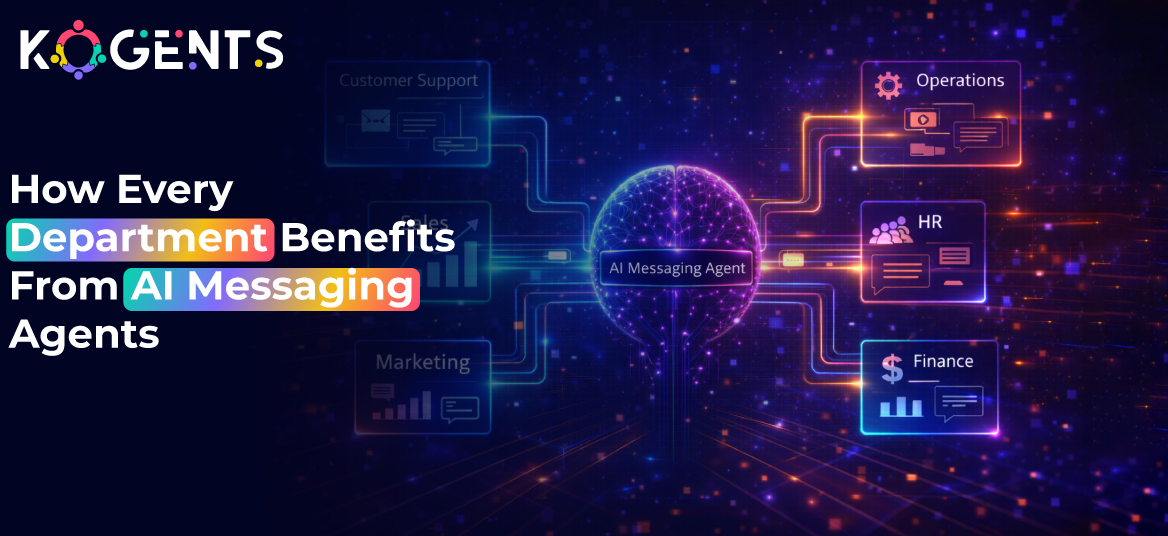
How Every Department Benefits From AI Messaging Agents
Summary:
Do you know that every business conversation triggers a decision?
A customer asking a question is deciding whether to trust you.
A lead requesting information is deciding whether to buy.
An employee seeking clarity is deciding whether they can move forward efficiently.
Yet most organizations still rely on fragmented, manual, and slow messaging systems that were never designed for scale.
This is where AI messaging agents fundamentally change how enterprises operate.
Unlike scripted chat tools, AI-powered messaging agents act as intelligent, autonomous communication partners.
They understand intent, retain context, execute workflows, and operate across departments without breaking continuity.
They do not simply reply; they orchestrate conversations that drive outcomes.
For executives, they unlock efficiency and growth.
For teams, they eliminate bottlenecks.
For customers and employees, they deliver seamless experiences.
This blog explores how AI messaging agents benefit every department and why enterprises are moving beyond basic chat automation.
Key Takeaways
- AI reply generator scales conversations without scaling headcount
- Every department benefits, not just customer support
- Conversational AI agents reduce delays and errors
- Omnichannel messaging improves consistency and trust
- Agentic AI platforms outperform static chat automation
What Are AI Messaging Agents?
AI messaging agents are autonomous conversational systems powered by conversational AI, natural language processing, and large language models that manage human conversations across messaging platforms.
Unlike traditional chatbots, intelligent messaging agents:
- Understand context and intent
- Handle multi-step conversations
- Trigger business workflows
- Learn from interactions
- Operate across omnichannel messaging
They function as AI communication agents capable of real-time decision making, escalation, and coordination across systems.
Unveil How AI Messaging Agents Work?
Modern AI-powered messaging agents operate through layered intelligence:
- Input processing through NLP pipelines
- Intent recognition and classification
- Context retention across sessions
- Dialogue management and decision logic
- Response generation using LLMs
- Workflow automation across CRMs and internal tools
- Human in the loop escalation when required
This enables automated conversations that feel natural, accurate, and goal-driven.
Why AI Messaging Agents Are Enterprise Critical
Organizations using AI for customer interactions can reduce service costs to the maximum while improving satisfaction.
These figures highlight why enterprise AI messaging agents are no longer optional; they are operational infrastructure.
The Hidden Cost of Human-Only Messaging
Many enterprises underestimate the cost of manual communication.
According to Forrester, employees spend nearly 20 percent of their workweek searching for information or responding to repetitive questions.
Without automated messaging agents, organizations face:
- Slower response times
- Missed revenue opportunities
- Burnout across support teams
- Inconsistent customer engagement
AI messaging agents for businesses convert unstructured conversations into structured, actionable workflows.
AI Messaging Agents as a System of Intelligence
The biggest shift in enterprise AI is this:
AI messaging agents are no longer tools.
They are systems of intelligence.
Modern conversational AI agents:
- Coordinate across CRM, ERP, HRIS, and ticketing systems
- Use prompt engineering to maintain brand tone
- Support human-in-the-loop oversight
- Improve through feedback loops
- Enable AI agent orchestration across departments
Messaging becomes a strategic operating layer rather than a support function.
Governance, Security, and Trust
Enterprise adoption depends on trust.
Leading enterprise AI messaging agents include:
- Role-based access controls
- Secure data handling
- Conversation auditing
- Compliance alignment
- Transparent escalation logic
The best agentic AI company, Kogents embed governance directly into agentic workflows, ensuring AI-driven conversations remain secure and policy-aligned.
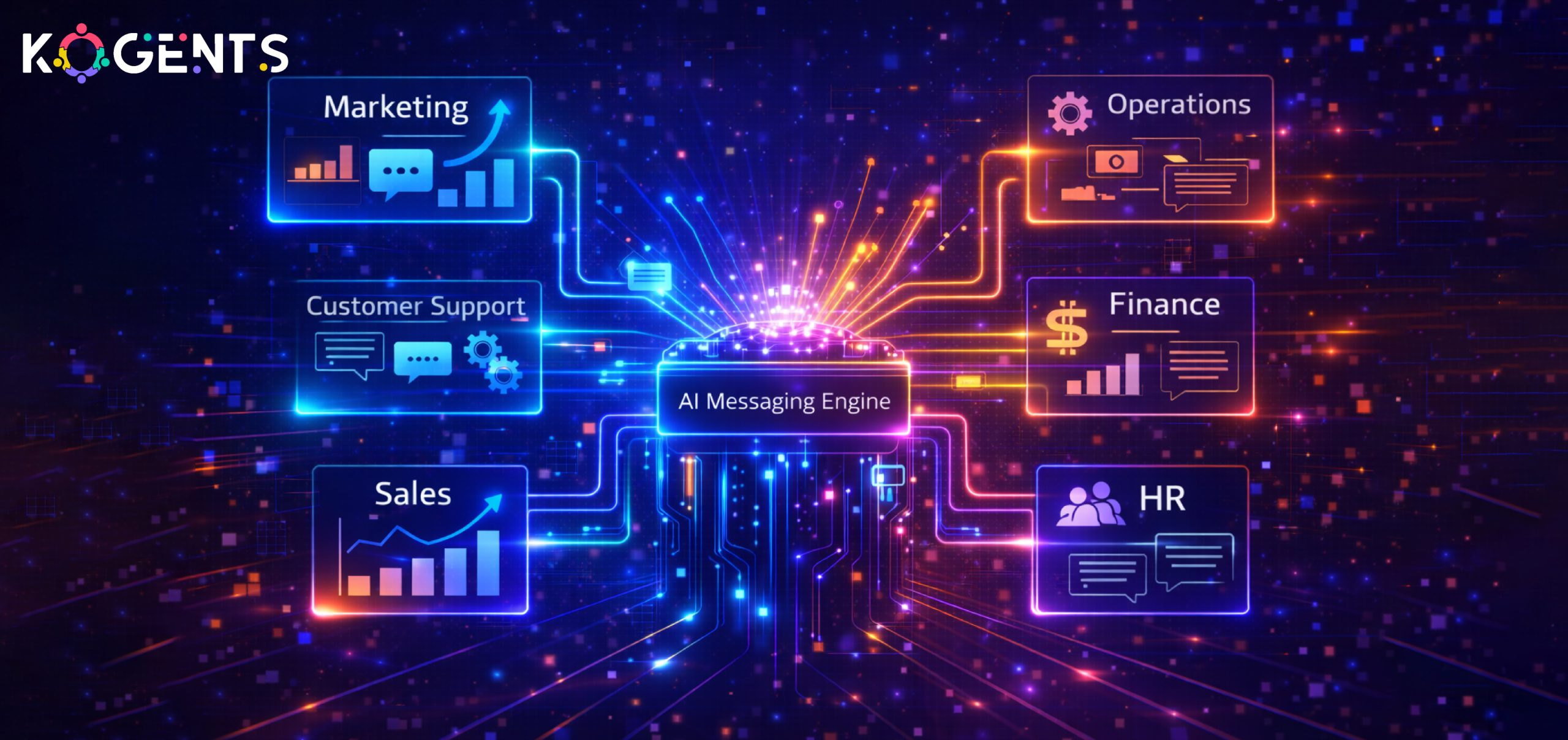
Department-by-Department Benefits of AI Messaging Agents
Customer Support
AI messaging agents for customer support provide 24/7 assistance, reduce ticket volumes, and improve resolution speed.
Sales
AI messaging agents for sales automation qualify leads, respond instantly, and update CRMs automatically.
Harvard Business Review shows responding within five minutes improves conversion likelihood by 100x.
Marketing
Marketing teams use brand voice in automated messages to deliver personalized conversational campaigns that increase engagement and response rates.
Human Resources
AI chat agents automate onboarding, answer policy questions, and reduce HR ticket volumes.
Operations
Autonomous messaging agents streamline workflows, incident reporting, and internal coordination.
IT
IT teams deploy AI assistants for password resets, ticket routing, and system updates.
Finance
AI communication agents handle invoice inquiries, payment reminders, and policy explanations securely.
Product
Product teams use conversational interfaces to collect feedback, analyze sentiment, and guide roadmap decisions.
Enterprise Impact Table
| Department | Challenge | How AI Messaging Agents Help |
| Support | Ticket overload | Automated conversations |
| Sales | Slow response | Instant lead qualification |
| Marketing | Low engagement | Personalized AI messaging |
| HR | Repetitive queries | Self-service agents |
| IT | Support backlog | Automated troubleshooting |
| Finance | Manual inquiries | Secure AI communication |
Used Cases/Real World Cases
Case Study 1: Global Retail Enterprise Scaling Customer Support
A global retail brand operating across North America and Europe implemented AI messaging agents for customer support across web chat, WhatsApp, and SMS to handle order tracking, returns, and product inquiries.
Before deployment, the support team struggled with seasonal spikes and inconsistent response times. After implementing AI-powered messaging agents integrated with their CRM and order management systems, the company achieved:
- 40 percent reduction in support ticket volume within six months
- 25 percent increase in customer satisfaction scores
- Faster resolution through intent recognition and automated workflows
The AI agents handled repetitive inquiries autonomously while escalating complex issues to human agents, creating a balanced human-in-the-loop model.
Case Study 2: B2B SaaS Company Accelerating Sales Qualification
A mid-market B2B SaaS provider deployed AI messaging agents for sales automation to manage inbound website traffic and product inquiries.
Previously, leads waited hours for responses, leading to drop-offs. With conversational AI agents qualifying leads in real time and booking meetings automatically, the company saw:
- 3x increase in sales qualified leads
- 22 percent reduction in average sales cycle length
- Improved CRM accuracy through automated data capture
Note: By responding instantly and asking intelligent follow-up questions, the AI communication agents significantly improved pipeline velocity.
Case Study 3: Enterprise HR Transformation for Employee Experience
A multinational enterprise with over 15,000 employees deployed AI chat agents to support HR inquiries related to benefits, policies, onboarding, and leave management.
The HR team faced constant ticket overload and delayed response times. After rolling out intelligent messaging agents integrated with HRIS platforms:
- 60 percent reduction in HR ticket volume
- Faster onboarding completion for new hires
- Improved employee satisfaction and self-service adoption
The AI agents provided consistent answers while routing sensitive cases to HR professionals when necessary.
Case Study 4: Telecommunications Provider Optimizing Omnichannel Support
A global telecommunications provider implemented AI messaging agents for omnichannel communication across WhatsApp, SMS, and web chat to reduce call center dependency.
Using AI-driven conversations and intent-based routing, the organization achieved:
- 45 percent reduction in call center volume
- 35 percent faster average resolution times
- Improved consistency across messaging platforms
This shift allowed human agents to focus on high-value interactions rather than repetitive inquiries.
Case Study 5: Financial Services Institution Enhancing Onboarding and Compliance
A financial services firm deployed AI messaging agents for businesses to automate customer onboarding, documentation reminders, and policy explanations.
By embedding governance and compliance rules into autonomous messaging agents, the firm achieved:
- 30 percent reduction in onboarding time
- Higher compliance accuracy through standardized responses
- Reduced operational risk and manual follow-ups
Reminder: The AI agents ensured consistent messaging while maintaining strict security controls.
AI Messaging Agents vs Traditional Chatbots
Traditional chatbots rely on scripts.
AI messaging agents rely on intelligence.
They differ in:
- Context awareness
- Autonomous decision making
- Workflow execution
- Learning capability
- Omnichannel continuity
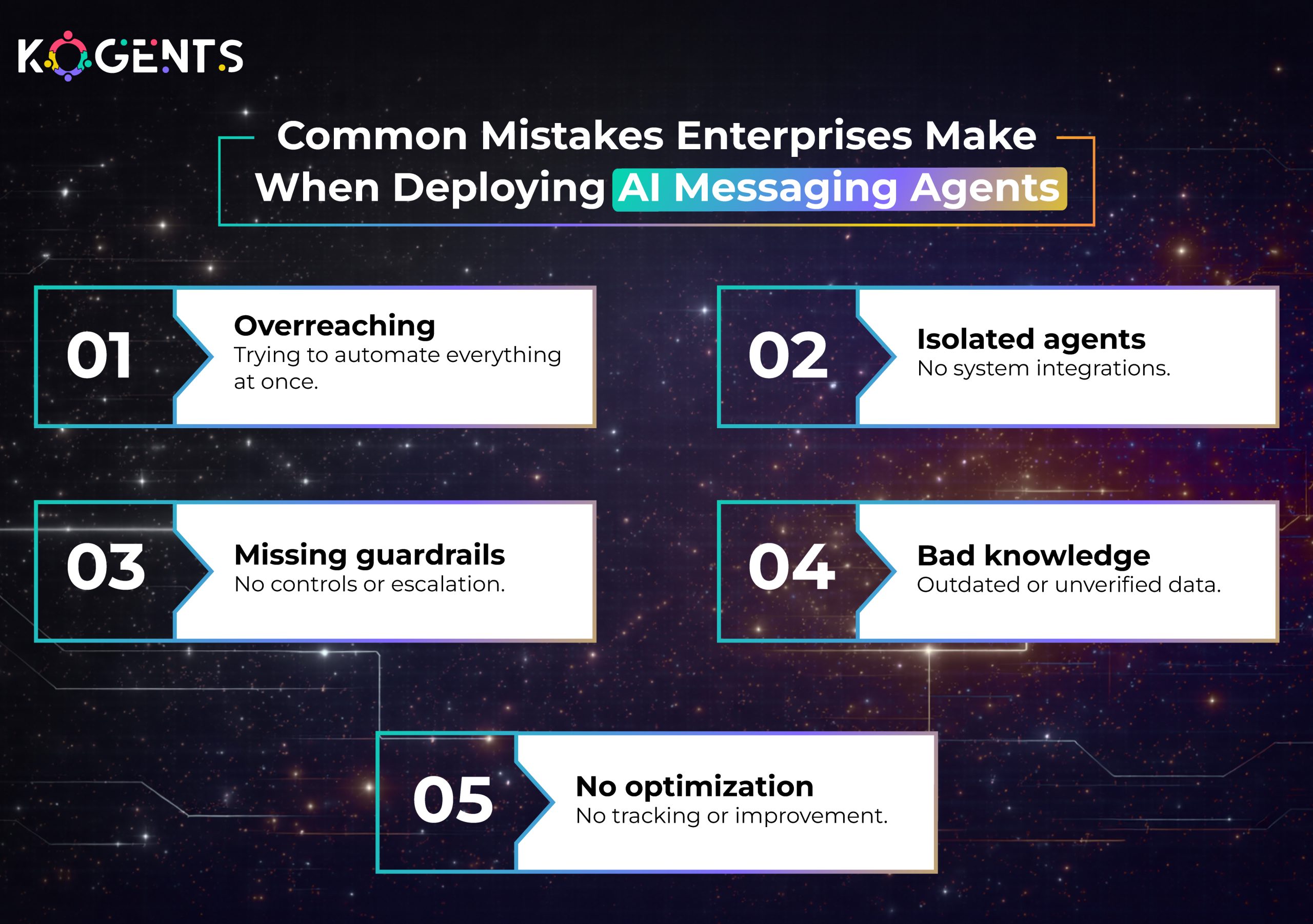
Best Practices for Implementation
- Start with high-volume use cases
- Integrate CRMs and internal systems
- Maintain human in the loop oversight
- Continuously optimize conversational flows
- Prioritize security and compliance
Choose Us: Conversations Are the New Competitive Edge!
Every department communicates.
Every conversation creates impact.
Organizations that deploy AI messaging agents gain faster decisions, better experiences, and scalable intelligence.
If your goal is efficiency, growth, and long-term advantage, the path forward is clear.
Partner with Kogents.ai and move beyond automation into true agentic AI, where conversations become outcomes.
FAQs
What are AI messaging agents, and why are they different from chatbots
AI messaging agents are autonomous systems that manage conversations using conversational AI, natural language processing, and large language models. Unlike chatbots, they understand context, manage multi-step interactions, and trigger real business workflows. They adapt dynamically rather than following fixed scripts. This makes them suitable for enterprise-scale operations.
How do AI messaging agents work in real business environments
They process incoming messages through NLP pipelines to detect intent and sentiment. Based on context, they generate responses using LLMs and execute actions such as updating CRMs or routing tickets. When confidence thresholds are low, human-in-the-loop escalation ensures accuracy. This creates reliable, automated conversations.
What are the key benefits of AI messaging agents for enterprises
Enterprises benefit from faster response times, lower operational costs, and improved customer engagement. AI messaging agents scale communication without increasing headcount and ensure consistency across channels. They also provide actionable insights through conversation analytics. This turns messaging into a strategic advantage.
AI messaging agents vs traditional chatbots: what is the real difference
Traditional chatbots rely on predefined rules and limited decision trees. AI-powered messaging agents understand intent, retain memory, and adapt to complex scenarios. They can orchestrate workflows, learn from interactions, and operate across departments. This makes them far more effective for enterprise use cases.
What are the best AI messaging agent platforms for enterprises
The best platforms focus on AI agent orchestration, security, scalability, and deep system integration. They support omnichannel messaging, governance controls, and analytics. Enterprise platforms go beyond chat to enable autonomous ddecision-making This is where agentic AI solutions stand out.
How is AI messaging agents’ pricing typically structured
Pricing usually depends on conversation volume, number of channels, automation complexity, and enterprise features. Some platforms charge per interaction, while others offerusage-basedd or subscription models. Advanced features like analytics and governance may add cost. Enterprises should evaluate ROI rather than just pricing.
How do organizations successfully implement AI messaging agents?
Successful implementation starts with high volume, repetitive use cases such as support or lead qualification. Integration with existing systems like CRMs is essential. Continuous optimization of conversational flows improves performance over time. Governance and monitoring ensure long-term trust.
Are AI messaging agents secure and compliant for enterprise use?
Yes, enterprise-grade AI messaging agents include role-based access, secure data handling, and conversation auditing. Compliance requirements can be embedded into workflows. Human oversight ensures sensitive cases are handled appropriately. Security and trust are central to adoption.
How do AI messaging agents support omnichannel communication?
They maintain conversation context across WhatsApp, SMS, web chat, and internal platforms. This allows users to switch channels without repeating information. Omnichannel messaging improves experience consistency. It also increases engagement and response rates.
Why are AI messaging agents critical for future business growth?
As communication volumes increase, manual systems cannot scale efficiently. AI messaging agents enable businesses to respond faster, personalize interactions, and automate decisions. They turn conversations into outcomes. This makes them essential for long-term competitiveness.

Kogents AI builds intelligent agents for healthcare, education, and enterprises, delivering secure, scalable solutions that streamline workflows and boost efficiency.