How to Train An AI On Firm-Specific Playbooks
Summary:
Ever pondered why your firm’s playbooks are sitting on untapped AI gold? Well, every enterprise leader, operations manager, and decision-maker faces the same challenge: your organization has spent decades building playbooks and institutional knowledge, yet only a fraction gets consistently applied across teams.
Your firm’s playbooks, governing compliance, sales methodologies, customer service, or technical troubleshooting, represent structured knowledge waiting to be unlocked through AI model training.
Generic AI models can’t capture your firm’s unique methodologies or proprietary frameworks.
Training AI models on firm-specific playbooks transforms competitive advantage into a business imperative.
Imagine an AI that embodies your company’s collective wisdom, guiding new employees with veteran precision, scaling expert decision-making globally, and ensuring compliance every time.
This guide delivers actionable frameworks for artificial intelligence model training that truly understand your business, from data preprocessing to deployment.
Key Takeaways
- Structured Playbook Data Is the Competitive Moat – Converting proprietary playbooks into structured, machine-readable data creates defensible AI advantages that generic models cannot replicate.
- Hybrid Training Delivers Optimal Results – Combining foundation models with targeted fine-tuning cuts training time by 60–80% while preserving accuracy and domain specificity.
- Quality Trumps Quantity – 500–2,000 high-quality, decision-centric datasets outperform millions of generic samples when training playbook-driven AI.
- Continuous Learning Is Essential – Automated retraining with human-in-the-loop feedback keeps AI aligned with evolving regulations and operational playbooks.
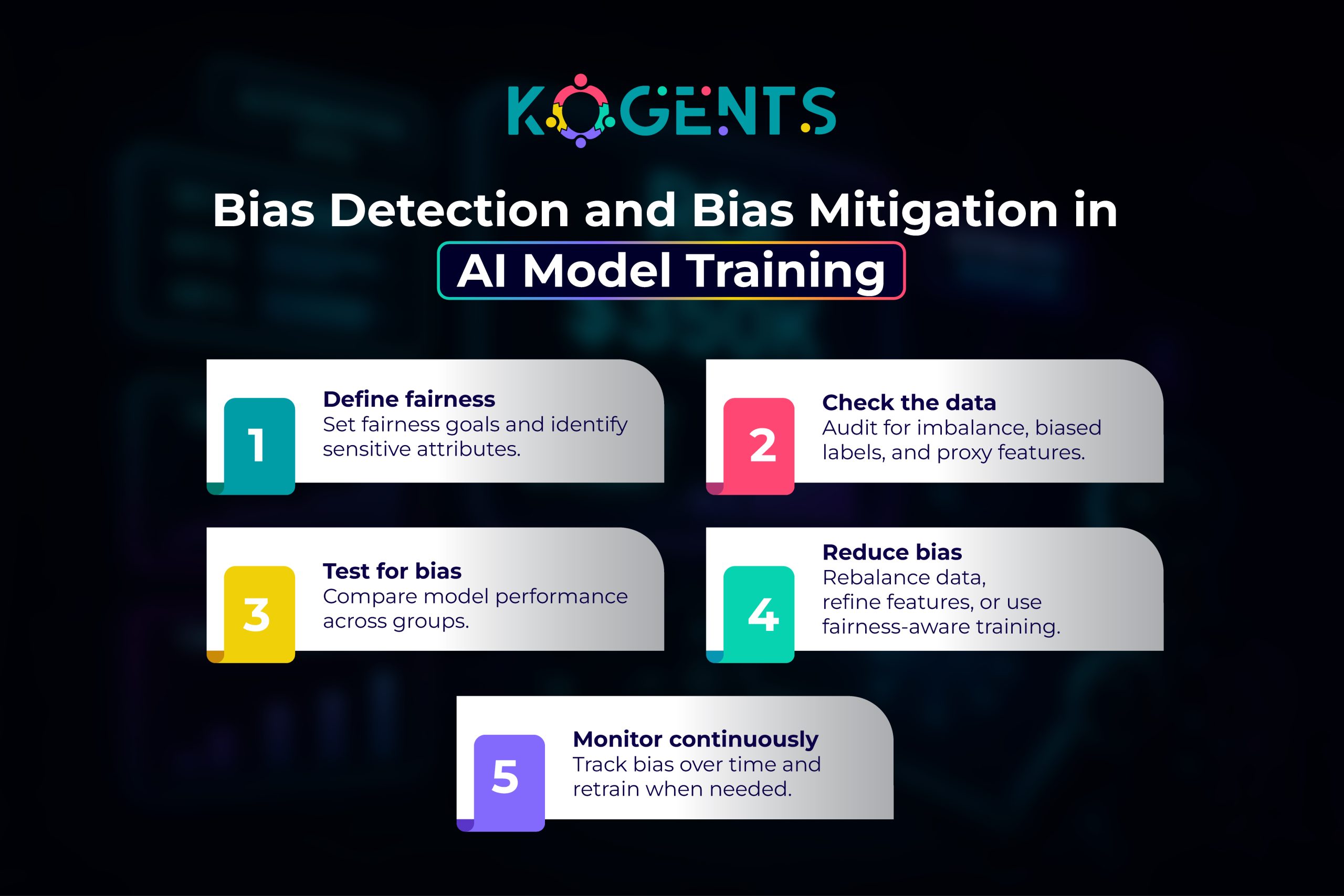
- Explainability Drives Adoption – Explainable AI that traces outputs to playbook logic, with bias and variance monitoring, is critical for compliance, trust, and executive approval.
Understanding AI Model Training for Enterprise Playbooks
It teaches systems to recognize patterns and make decisions based on examples.
For firm playbooks, this means converting institutional knowledge into neural networks that replicate expert judgment.
What Makes Playbook Training Different?
Unlike consumer AI trained on internet data, training AI models for playbooks requires specialization in:
- Proprietary methodologies refined through operational experience
- Industry-specific terminology that generic models misinterpret
- Contextual decision trees with multiple interrelated factors
- Compliance frameworks requiring perfect interpretation
The AI Model Training Lifecycle
Phase 1: Knowledge Extraction
Transform playbooks to get AI agents’ benefits from documents into machine-processable formats through data preprocessing:
- Document parsing extracts procedures and decision criteria using natural language processing
- Knowledge graph construction maps relationships between procedures
- An annotation where experts tag decision points and success criteria as labeled datasets
Phase 2: Model Selection
Choose from three approaches:
Fine-tuning Foundation Models – Start with GPT-4 or Claude, specialize in your playbooks. Requires 500-2,000 examples, 2-4 weeks, costs $500-$5,000.
Custom Development – Build specialized neural networks using TensorFlow or PyTorch. Requires 5,000-50,000 examples, 2-6 months, costs $50,000-$500,000+.
Retrieval-Augmented Generation – Combine a vector database with a generative model. Minimal training, 1-2 weeks, costs $200-$1,000.
Phase 3: Training Execution
Execute through training epochs using supervised learning:
- Backpropagation and gradient descent optimize model parameters
- Hyperparameter tuning adjusts learning rates and batch sizes
- Loss functions measure prediction accuracy
- Validation and testing ensure generalization beyond training data
Phase 4: Deployment
Move to production with MLOps pipelines:
- Model versioning tracks changes
- Performance monitoring detects drift
- Continuous learning incorporates feedback
- A/B testing validates improvements
Playbok AI Training Approaches Comparison
| Criteria | Fine-Tuning Foundation Models | Custom Development | RAG Systems |
| Training Data | 500-2,000 examples | 5,000-50,000 examples | Minimal |
| Time to Production | 2-4 weeks | 2-6 months | 1-2 weeks |
| Cost Range | $500-$5,000 | $50,000-$500,000+ | $200-$1,000 |
| Accuracy Potential | 90-95% | 92-98% | 85-92% |
| Explainability | Medium – requires attention mechanisms | Low-Medium – black box default | High – direct playbook citations |
| Handling Updates | Retraining required (2-8 hours) | Full retraining (days/weeks) | Immediate – update database only |
| Best For | Balanced speed/accuracy needs | Maximum customization/control | Rapid deployment, frequent changes |
| Infrastructure | AWS SageMaker, Google Vertex AI | TensorFlow, PyTorch clusters | Pinecone, Weaviate + LLM API |
Step-by-Step Training Process
Step 1: Playbook Digitization (2-4 weeks)
Convert playbooks to machine-readable formats through semantic parsing, metadata tagging, and knowledge graph creation covering 50-100 documents.
Step 2: Data Preparation
Create training datasets with 500-1,000 instances per category, annotate decision patterns, include negative examples, and validate with 2-3 experts.
Step 3: Training Execution
Configure hyperparameters (learning rate 1e-5 to 1e-3, batch size 8-32), run training loops, monitor loss functions, and apply regularization to prevent overfitting.
Step 4: Evaluation
Test using:
- Accuracy (target >90%)
- F1 score (target >0.85)
- Compliance rate (target 100%)
- Expert review of 100 predictions
Step 5: Deployment
Package with Docker, create API endpoints, optimize with quantization, and implement monitoring for model convergence drift.
Real-World Case Studies
Case Study 1: J.P. Morgan COIN Platform
Challenge: 12,000 annual commercial loans requiring 360,000 lawyer hours for playbook-based review.
Solution: Trained machine learning models on 12 years of data with 50,000+ annotated contract clauses using supervised AI model training.
Results: Reduced review from 360,000 hours to seconds, 95% compliance accuracy, $250M+ annual savings.
Case Study 2: IBM Watson Clinical Trials
Challenge: IBM did matching cancer patients to complex trial protocols spanning thousands of pages.
Solution: Transfer learning on Watson’s medical knowledge, fine-tuning on 300+ trial protocols with reinforcement learning from oncologist feedback.
Results: 96% concordance with experts, reduced matching from hours to minutes, identified opportunities for 30% more patients.
Case Study 3: Siemens Manufacturing AI
Challenge: 10,000-page troubleshooting playbooks, 6-12 month technician training in Siemens, and costly downtime.
Solution: Multi-modal training combining textual playbooks with sensor data using PyTorch and knowledge graphs.
Results: 35% faster repairs, 4-month training (vs 9 months), 92% first-time fix rate, $180M annual savings.
Challenges and Solutions
Limited Training Data
Solution: Data augmentation, transfer learning from foundation models, and few-shot learning techniques.
Playbook Ambiguity
Solution: Knowledge reconciliation through expert reviews, confidence scoring, and semantic analysis with NLP tools.
Regulatory Requirements
Solution: Explainable AI with attention mechanisms, audit trails, hybrid machine learning, plus rule-based guardrails.
Maintaining Relevance
Solution: Automated model retraining pipelines, continuous learning, drift detection, and version compatibility tracking.
Legacy Integration
Solution: API-first architecture, microservices deployment, gradual introduction, hybrid human-AI workflows.
Future of Playbook-Driven AI
Self-Supervised Learning
Self-supervised learning reduces dependency on labeled datasets by learning from unlabeled data.
Stanford AI Index Report shows these approaches achieve a maximum of supervised performance with less labeled data.
Multimodal Understanding
Future models process text, diagrams, videos, and sensor data simultaneously.
Google DeepMind research shows multimodal approaches outperform text-only on complex reasoning.
Automated Knowledge Extraction
Natural language processing advances automate playbook structuring.
MIT CSAIL demonstrates automated knowledge graph construction, achieving 85% expert-level accuracy.
Continuous Learning
Reinforcement learning enables systems to incorporate feedback without formal retraining cycles, critical for rapidly evolving environments.
Federated Learning
Federated learning enables collaborative training without sharing proprietary data.
Google AI research shows 90-95% of centralized performance while maintaining complete privacy.
Conclusion
AI model training on firm-specific playbooks delivers measurable ROI: 40-60% reductions in training time, 35-50% compliance improvements, and millions in efficiency gains.
Success requires cross-functional collaboration between AI engineers, subject matter experts, and business leaders to ensure training datasets reflect organizational wisdom and model optimization aligns with priorities.
Organizations implementing playbook AI scale expertise exponentially, maintain global consistency, and adapt rapidly to changes.
Those delaying risk institutional knowledge loss while competitors leverage AI for superior outcomes.
Partner with Kogents for Agentic AI Excellence
Kogents.ai transforms firm playbooks into intelligent, autonomous systems through specialized agentic AI platforms.
Our expertise in deep learning model training, NLP, and MLOps enables seamless playbook integration.
With proven implementations across finance, healthcare, and manufacturing, we deliver measurable ROI through reduced costs, improved compliance, and accelerated competency.
Discover how our agentic AI is the best agentic AI company here.
FAQs
What is AI model training, and how does it apply to firm-specific playbooks?
AI model training teaches systems to recognize patterns and make decisions by exposing them to example data. For playbooks, this means feeding SOPs and decision frameworks into machine learning algorithms so AI replicates expert judgment. The process converts playbooks into labeled datasets, selects neural network architectures, and uses supervised learning to teach which procedures apply in scenarios. Unlike generic AI, playbook-specific training captures unique terminology, methodologies, and compliance requirements.
How much training data is needed to train an AI model on company playbooks?
Requirements vary by approach. Fine-tuning foundation models needs 500-2,000 annotated examples per major category. Custom development requires 5,000-50,000 examples. RAG approaches need minimal training data—just playbook documents. Stanford AI Lab research shows 1,000 expert-annotated examples outperform 10,000 inconsistent ones by 3-5x. Focus on quality labeled datasets validated by experts.
What’s the difference between fine-tuning foundation models versus building custom AI models?
Fine-tuning specializes pre-trained models (GPT-4, Claude) on your playbooks through transfer learning—faster deployment (2-4 weeks), lower data needs (500-2,000 examples), moderate costs ($500-$5,000). Custom development builds neural networks from scratch using TensorFlow/PyTorch—complete control but requires more data (5,000-50,000), longer timelines (2-6 months), higher costs ($50,000-$500,000+). Fine-tuned models achieve 90-95% accuracy versus 92-98% for custom; marginal gains rarely justify additional investment.
How do you ensure AI models stay current as playbooks evolve?
Implement model retraining pipelines: (1) Version control tracking playbook-model associations, (2) Automated triggers using MLOps tools like MLflow, (3) Drift detection monitoring accuracy degradation, (4) Human-in-the-loop feedback capturing corrections, (5) Scheduled retraining quarterly or biannually. Fine-tuning requires 2-8 hours for updates. RAG systems update immediately by refreshing databases. Gartner shows automated retraining maintains 90%+ accuracy versus 60-70% for manual management.
What infrastructure is required for enterprise AI model training?
Cloud platforms like AWS SageMaker, Google Vertex AI, and Azure AI provide managed GPU resources ($500-$5,000 per run). On-premises deployment needs NVIDIA GPU clusters ($50,000-$500,000 initial investment). Supporting infrastructure includes distributed training orchestration (Kubeflow, MLflow), version control, and monitoring. RAG implementations need vector databases (Pinecone, Weaviate) and foundation model API access. Many adopt hybrid approaches: cloud prototyping, on-premises production.
How do you measure the success and accuracy of trained AI models?
Quantitative metrics: (1) Accuracy >90% for deployment, (2) Precision/Recall F1 score >0.85, (3) Compliance rate 100% for regulated procedures, (4) Inference latency <2 seconds. Qualitative evaluation: Expert review of 100+ predictions, edge case testing, and explainability audits. Business outcomes: time-to-competency reduction, escalation rates, compliance violations, efficiency gains. McKinsey shows successful implementations demonstrate 40-60% efficiency improvements within 6 months.
What are the costs associated with training AI on company playbooks?
Development costs: Data preparation $20,000-$100,000, fine-tuning $5,000-$50,000 versus custom development $50,000-$500,000, infrastructure $500-$5,000 per cloud run or $50,000-$500,000 on-premises. Ongoing costs: Compute $1,000-$10,000 monthly, quarterly retraining $2,000-$20,000, maintenance $50,000-$200,000 annually. IBM shows a typical ROI within 12-18 months. Budget $100,000-$500,000 first-year with 40-60% reduction in subsequent years.
How does transfer learning reduce training time and data requirements?
Transfer learning starts with foundation models trained on general knowledge, then specializes in your procedures. This reduces training data by 60-80% (from 50,000+ to 500-2,000 examples) and training time from weeks to hours. Fine-tuning updates final layers with playbook examples while freezing base model parameters. Stanford AI Index shows transfer learning achieves 85-95% of custom performance with 10-20% of resources. Organizations report 2-4 week timelines versus 2-6 months for custom development.
What role does explainable AI play in playbook-based systems?
Explainable AI (XAI) enables models to cite playbook sections, explain logic, and trace recommendations to sources. Implementation uses: (1) Attention mechanisms showing focused sections, (2) Citation systems referencing procedure IDs, (3) Confidence scoring flagging ambiguity, (4) Decision tree visualization mapping logic paths. Benefits include trust building, error detection, training acceleration, and continuous improvement. Gartner shows XAI achieves 30% higher adoption and 25% fewer errors versus black-box approaches.
Can AI models handle exceptions and edge cases in playbooks?
Effective systems handle exceptions through: (1) Exception labeling in training datasets, (2) Confidence thresholds requesting human review below 85-90%, (3) Multi-class classification including “escalate” outputs, (4) Reinforcement learning from corrections. Best practices dedicate 10-15% of training data to edge cases. Hybrid architectures combining machine learning with rule-based guardrails prevent compliance violations. IBM Watson implementations achieve 90-95% standard accuracy while correctly escalating 85-90% of exceptions.

Kogents AI builds intelligent agents for healthcare, education, and enterprises, delivering secure, scalable solutions that streamline workflows and boost efficiency.