AI-Powered Tools for Education: Case Studies That Prove the Impact on Learning Performance
Summary:
Imagine a classroom where each student receives a bespoke learning path, one that knows what they understand, what they struggle with, and what they’re ready to learn next?
That isn’t science fiction anymore: it’s happening thanks to AI-Powered Tools for Education.
Whether it’s AI-powered educational tools that scan homework in seconds or smart education tools using AI that produce customised study guides, the classroom is evolving at a rapid pace.
In this post, we unveil how artificial intelligence tools for education are not just promising; they are delivering measurable improvements in learning performance.
From education tools powered by AI that lighten a teacher’s workload to AI tools for teaching and learning that boost student outcomes, you’ll get a deep dive into who’s doing what, how it works, and why it matters.
Get ready to explore how AI agents for higher education and AI-powered tools are reshaping learning, and how you (educator, policy-maker, or edtech entrepreneur) can ride the wave.
Key Takeaways
- Student outcomes improve when AI tools are deployed thoughtfully.
- Teacher workload drops on repetitive tasks, freeing up time for high-impact teaching.
- Personalised learning becomes scalable with adaptive platforms.
- Ethics, data privacy, and teacher readiness are non-negotiable for success.
- ROI is real, but it demands change management, infrastructure, and ongoing training.
The Rise of AI in Education: Context & Definitions
The market for AI in education is predicted to cross USD 20 billion by 2027.
When we say AI-Powered Tools for Education, we mean platforms, applications, or systems built on artificial intelligence (AI) or machine learning (ML) that support teaching and learning, assessment, feedback, curriculum design, student engagement, analytics, and more.
Why now? The EdTech inflection point
The world of education is facing multiple pressures: increasing class sizes, teacher burnout, diverse student needs (including special education and accessibility), and rising expectations for measurable outcomes.
Into this enters the wave of AI: from machine learning in education to intelligent tutoring systems that personalise instruction.
Over 99% of 509 US higher-education institutions said that AI in education and learning will be instrumental for competitiveness in the next three years.
| Attention Reminder: Want to learn key terminologies related to education and learning? Click here for more information. |
How AI Tools Improve Learning Performance?
Personalised learning and adaptive systems
One of the most powerful advantages of AI tools in education is personalised learning technologies.
- Rather than the “one-size-fits-all” classroom, adaptive platforms adjust at the individual level.
- For instance, by continuously assessing responses, they can redirect a student to remedial practice or accelerate to advanced topics.
Reminder: Such systems support student-centred learning and cater to diverse learning speeds and styles.
Intelligent tutoring systems (ITS)
- An ITS acts like a one-on-one tutor that adapts to student needs.
- It uses machine learning in education and may provide scaffolding, hints, diagnostics, and even motivation.
Example: research shows that an LLM-powered tutoring system (Physics-STAR) improved scores and efficiency among high-school physics students.
Automated assessment & educator support
It relieves teachers from repetitive grading and free up time for pedagogical work.
One study found that an AI tool reduced teachers’ grading time by 70%.
Beyond that, teacher workload reduction means educators can spend more time on mentoring, planning, and interacting, higher-value tasks.
Engagement and analytics
- Student engagement is increasingly monitored via student engagement analytics enabled by AI.
- Platforms track interactions, time-on-task, hint requests, mistakes, and can alert teachers or automatically adjust content.
- This data-driven instruction helps identify who is falling behind early, enabling timely interventions.
Content creation, feedback & generative AI
- With generative AI in classrooms, tools can now create custom study guides, generate questions, summarise content, and even craft lesson plans.
- Teachers can utilise an AI lesson-plan generator or smart content creation to reduce prep time while maintaining alignment with learning objectives.
- Additionally, AI-enabled feedback for teachers means that AI can flag student misconceptions or repetitive errors.
Accessibility & inclusivity
AI tools in ai in elementary education also support inclusive education: features like speech-to-text, language translation, computer vision for visually impaired students, and adaptive content for special education.
Key Point: These digital learning platforms powered by AI support equity and widen the access gap.
Case Studies: Real-World Evidence of Impact
Here are several credible AI in education examples aligned with the topic.
Case Study 1: Virtual TA at Georgia Tech
- At the Georgia Institute of Technology, the team deployed an AI assistant called “Jill Watson” (built on IBM Watson) within a large online master’s course.
- The issue: large class sizes meant delayed responses to student queries.
- The AI was trained on past forum postings (~40,000 posts) and handled routine questions.
- This relieved human TAs and improved responsiveness.
Impact: Faster student query responses; teachers could focus on complex issues.
Takeaway: Scalable support using an AI virtual teaching assistant works especially in large classes.
Case Study 2: Early-Risk Identification at Ivy Tech
At Ivy Tech Community College in Indiana, an AI-driven pilot program analysed student data in their first two weeks to identify students at risk of failing.
Then, targeted interventions were given.
Impact: Strong retention improvement, timely support.
Takeaway: Predictive analytics can transform student support and boost performance.
Case Study 3: Accessibility for the Visually Impaired at the University of Alicante
At the University of Alicante in Spain, an AI-powered application called “Help Me See” used computer vision + ML to assist visually impaired students on campus, narrating objects, texts, and aiding navigation.
Impact: Enhances accessibility and inclusion through AI tools in education.
Takeaway: AI in education is not just for advanced students, but also for special-education contexts.
Case Study 4: Feedback Automation & Special Ed at Canterbury High School
At Canterbury High School (UK), teachers implemented an AI-powered feedback system to analyse student-written assignments, give grammar and content relevance suggestions, and personalise feedback.
They also used adaptive platforms in special-ed contexts with engagement analytics.
Impact: Faster feedback, higher engagement, particularly in special education segments.
Takeaway: Automating routine feedback enables richer human-teacher interactions and supports inclusive learning.
Case Study 5: LLM-Powered Physics Tutoring – Physics-STAR
In an experimental study, a Large Language Model (LLM) powered tutoring system called Physics‑STAR was used for high-school physics education.
Compared to traditional teacher-led lectures and generic LLM tutoring, Physics-STAR improved students’ average scores significantly (complex information problem scores doubled) and improved efficiency by ~5.95%.
Impact: Demonstrates how cutting-edge AI tools (LLM-based) can deliver meaningful performance gains even in concept-heavy subjects.
Takeaway: AI tools for teaching and learning aren’t just assistants; they can challenge traditional models when well-designed.
Table: Metrics Across Case Studies
| Case Study | Tool / Approach | Target Population | Key Metric(s) | Outcome |
| Georgia Tech virtual TA | “Jill Watson” answering forum Qs | Large online master’s class | Response time to student queries | Reduced human-TA load, faster feedback |
| Ivy Tech risk-identification | AI analytics on early-term data | Community college students | % of flagged students improving grade | ~98% improved to ≥ C (≈3,000 students) |
| Univ. of Alicante accessibility | Computer vision app for the visually impaired | Visually-impaired campus students | Accessibility & independence metrics | Improved inclusion & learning access |
| Canterbury High School feedback automation | AI feedback + adaptive learning | K-12, including special ed | Feedback turnaround time, engagement | Faster feedback, higher engagement |
| Physics-STAR LLM tutoring | LLM-powered one-to-one system | High-school physics students | Score improvement, efficiency | Scores on complex problems doubled, efficiency +5.95% |
Implementation Considerations & Challenges
Ethical AI, data privacy & bias
- While the upside is clear, the implementation of AI in educational tools and platforms demands rigorous attention to ethics.
- Issues include bias in AI (especially in special-ed or underserved populations), student data privacy, transparency of AI models, and assurances of fairness.
Example: as noted by Walden, AI can inadvertently perpetuate bias or isolate students.
Human-in-the-loop & teacher readiness
- The best results occur when AI complements, rather than replaces, the teacher.
- A virtual teaching assistant is no replacement for human judgment, especially for socio-emotional support or complex reasoning.
Key Note: Training teachers on how to integrate AI, interpret analytics dashboard data, and design interventions remains essential.
Infrastructure, cost, equity & access
- Deploying a cloud-based AI education platform or digital learning platforms requires reliable internet, hardware, and support, which may be unevenly distributed across regions.
- Equity concerns arise when some students have access and others do not.
Measuring ROI and outcomes
- Institutions must track not just usage but outcomes: student performance, retention, grade improvement, engagement analytics, and teacher workload reduction.
- Without measurement, it’s hard to justify investment.
Future Trends of AI Tools in Education
Generative AI & content creation
- They will increasingly create customised study materials, simulate real-world scenarios, generate new formative assessments, and support flipped-classroom models.
- AI-driven lesson-plan generator tools will emerge to help teachers design adaptive curricula.
Virtual teaching assistants & smart education tools
- Expect more widespread deployment of virtual teaching assistants, chatbots, and voice-activated learning aids.
- Smart education tools using AI will monitor student mood, attention, and even emotional engagement to prompt personalised intervention.
Integration with LMS, blended & flipped learning.
- AI will embed more deeply into learning management systems (LMS), supporting blended learning, flipped classroom dynamics, real-time assessment, and scaffolding.
- The synergy between human-led instruction and AI-enabled platforms will become the norm.
Equity, global access & inclusive design
- AI tools must be designed for all learners, including multilingual, special-needs, and underserved populations.
- The push for accessibility in education via AI will accelerate: speech-to-text, translation, and adaptive formats.
Policy, ethics, and digital citizenship
As adoption grows, regulatory frameworks will emerge addressing AI in education, academic integrity, student data rights, and transparency of algorithms.
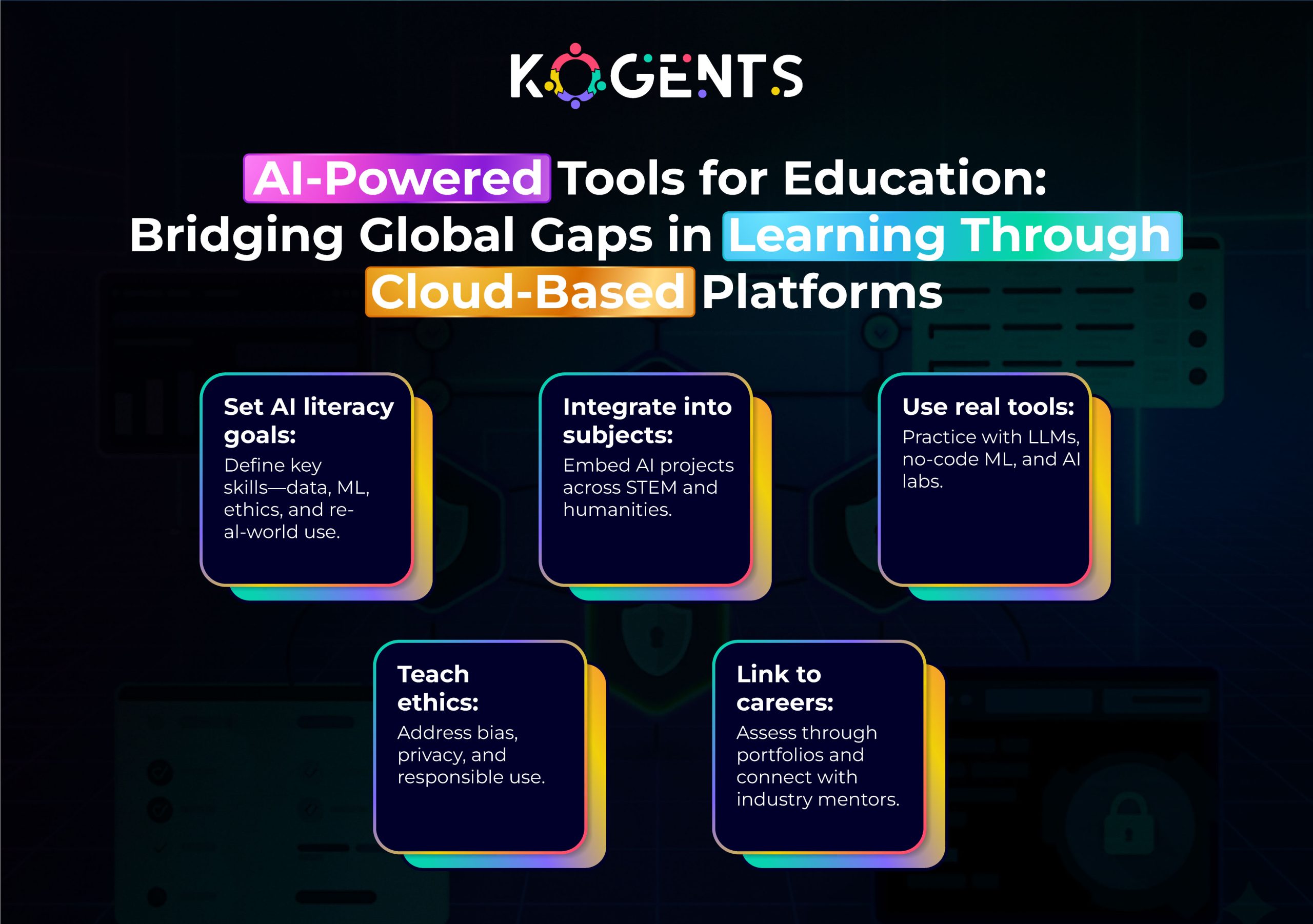
Educators will need AI literacy, and students will need to develop digital-AI-ethics skills.
Last Words!
The era of AI-powered tools for education is here, driving real transformation in teaching and learning.
These tools boost performance, cut workloads, personalise learning, and expand inclusion. Success comes from pairing AI adoption with pedagogy, training, and ethics.
Kogents.ai helps schools and EdTech leaders evaluate, implement, and scale AI education tools.
From teacher training to data-driven dashboards, we ensure the right fit and measurable impact.
Empower your institution’s future, partner with Kogents.ai today.
FAQs
What are AI-powered educational tools, and how do they differ from traditional EdTech?
AI-powered educational tools are platforms or applications enhanced by artificial intelligence, such as machine-learning algorithms, natural-language processing, or generative models, that adapt to student behaviour, personalise feedback, provide predictive analytics, and dynamically support teaching and learning. In contrast, traditional EdTech may add digital delivery of content but lacks the adaptive-intelligence layer.
How do AI education tools improve teaching and learning?
They provide personalised learning technologies (adaptive learning), intelligent tutoring systems, real-time analytics for teachers, automated assessment tools, and reduce teacher workload so educators can focus more on high-impact instruction. They enhance student engagement, feedback speed, and data-driven instruction.
What are some artificial intelligence tools for education that have been proven effective?
Examples include tools like the virtual TA at Georgia Tech, predictive analytics at Ivy Tech, AI-powered accessibility apps at the University of Alicante, and LLM-tutoring systems like Physics-STAR. These demonstrate measurable impact on response time, grade improvement, retention, and special-education inclusion.
What challenges exist when choosing education tools powered by AI for a school or district?
Challenges include ensuring data privacy and ethics, avoiding algorithmic bias, training teachers to use the tool, equipping infrastructure (hardware, internet), ensuring equitable access, aligning to curriculum, measuring ROI, and including human oversight (human-in-the-loop) rather than fully automatic systems.
Are AI tools for teaching and learning suitable for K-12 as well as higher education?
Yes, many implementations are across K-12 and higher ed. For example, K-12 schools have used AI-feedback systems and adaptive learning platforms; higher education uses large data sets, predictive analytics, and LLM-tutoring. The key is alignment with age-group, pedagogical goals, and teacher readiness.
What metrics should schools monitor when deploying AI tools in education technology (EdTech)?
Metrics include student performance (grades, mastery), retention/attrition rates, student engagement (time-on-task, hint requests), teacher workload time saved, number of interventions triggered, accessibility improvements, feedback-turnaround time, cost-benefit / ROI.
How do generative AI tools for education fit into classroom workflows?
They can create customised content (quizzes, study guides, summaries), support students with conversational assistants, help teachers with lesson-plan generation, adapt to student writing and provide feedback, and support flipped-classroom models. They supplement rather than replace instruction.
What about ethics, bias, and student privacy when using AI in educational tools and platforms?
These are major concerns. AI tools may embed bias (e.g., favouring certain demographics), could misuse student data, risk reducing human interaction, or be used for cheating. Institutions must ensure transparent policy, human-in-the-loop oversight, and equitable design.
How can educators choose the right smart education tools using AI for their context?
They should assess: alignment with curriculum, evidence of impact (case studies, metrics), teacher training and support, data-privacy safeguards, cost and infrastructure requirements, scalability and equity, integration with existing systems (LMS, blended learning), a clear implementation plan, and evaluation metrics.

Kogents AI builds intelligent agents for healthcare, education, and enterprises, delivering secure, scalable solutions that streamline workflows and boost efficiency.