AI Tools for Students Helping Non-Native Speakers Master Academic English
Summary:
Imagine walking into a study session where your notes are already summarised, your essay outline practically writes itself, and your grammar errors vanish before your professor even sees them.
That’s the power of AI tools for students, smart companions that turn stress into structure and confusion into clarity.
Whether you’re a non-native English speaker trying to master academic writing or a busy student juggling multiple assignments, these tools act as your personal tutors, editors, and planners, all rolled into one.
From AI writing assistants that help you think and write like a scholar, to AI automated teaching tools that automate note-taking, time-management, and research, artificial intelligence is transforming how students learn and communicate.
And the best part? You can now find out exactly which tools suit your learning style.
At the end of this blog, take our quick “Find Your Perfect AI Study Companion” quiz, a one-minute interactive tool that builds your personalised AI study stack based on your academic goals and habits.
Key Takeaways
- AI study tools are not just shortcuts; they can serve as personalised learning assistants that adapt to non-native speakers’ needs.
- AI writing tools for students, especially those offering grammar, vocabulary, and structural feedback, help bridge the gap in academic English proficiency.
- Real-world research shows non-native speakers adopt AI writing tools at higher rates, making this a key opportunity for language support.
- Ethical usage, academic integrity, and equitable access are vital, as these tools gain traction, institutions must put frameworks in place.
- The future of AI productivity tools for students and AI tutoring for students will increasingly focus on multilingual support, real-time feedback, context-aware writing help, and inclusive design.
Why AI Tools for Students Matter in this Context?
When we talk about “AI tools for students”, we refer to software and platforms that use artificial intelligence-driven capabilities (often via machine learning for education, natural language processing tools, or AI-powered learning) to assist students in tasks like writing, research, studying, time management, and communication.
Thus, as students, especially non-native speakers, increasingly confront the demands of academic English, AI for students and AI writing tools become not just helpful but potentially transformative.
How do These Tools Address Pain Points?
- They provide real-time feedback on grammar, syntax, vocabulary and coherence, reducing the language barrier and allowing students to focus on content.
- They offer flashcard learning paths and adapt to the student’s level, writing style, errors, and progress, thereby supporting gradual language acquisition.
- They support productivity and revision cycles by saving time on mechanical corrections, enabling more focus on higher‐order thinking, revision, and content.
- They enable multilingual support and translators, which is especially relevant for non-native speakers tackling English academic tasks.
- They act as scaffolding tools, enabling students to gradually internalise academic English conventions while doing real tasks.
Major Categories of AI Tools That Help Non-Native Speakers with Academic English
Here’s a breakdown of the tool categories and their relevance:
Writing & Research Tools
- AI essay writers and academic writing AI: These help with idea generation, structuring, revision, and editing.
- Grammar checkers, style enhancers: For example, tools that catch non-native speaker errors, suggest revisions, and enrich vocabulary.
- Citation generators, summarisation tools, literature-review assistants: Essential for academic writing.
Study & Productivity Tools
- AI time management apps, student productivity apps: They help organise essay deadlines, revision schedules, and manage multiple tasks.
- Study-assistant AI: Offers customised quizzes, flashcards, revision prompts, and summarisation of readings.
- These support non-native English speakers by allowing more efficient use of time when writing in English becomes more effortful.
Learning & Tutoring Tools
- AI tutoring tools, adaptive learning platforms, personalised instruction: These explain concepts, provide interactive drills, and adapt to users’ language level.
- Language-learning augmented with AI: Helps non-native speakers build their English proficiency not only in general but in academic contexts.
Collaboration & Communication Tools
- AI note-taking tools, meeting summarisers, group-study assistants: When non-native speakers attend lectures, seminars, they benefit from tools that summarise speech into notes, highlight vocabulary, etc.
- AI chatbots for learning: Offer a low-anxiety environment to ask questions in England ish, practise writing, and receive feedback.
Ethical, Safety & Academic Integrity Tools
- Tools that detect plagiarism, ensure academic honesty: For non-native speakers, using AI responsibly is a high barrier to avoiding academic integrity issues.
- Institutional frameworks and policies for AI in education.
In-depth Tool Features and How They Help
Let’s analyse specific features of these tools and how they address key language barrier issues for non-native speakers.
Grammar & Syntax Correction
For non-native English speakers, common errors include subject-verb agreement, article usage, verb tenses, word order, and syntax awkwardness.
Example: A tool highlights suggests “The study was conducted”, explains passive construction, and offers alternative phrasing.
Benefit: Students spend less time hunting down grammar mistakes and more time refining content.
Vocabulary Enrichment & Word-Choice Support
- Academic English requires precise vocabulary, discipline-specific lexicon, avoidance of informal language, and avoidance of repetitive wording.
- AI writing tools provide suggestions: synonyms, word-choice alternatives, avoid clichés, and suggest more formal registers.
Benefit: Non-native speakers broaden their lexical range, reduce L1 interference, and produce more polished writing.
Content Generation, Structuring & Scaffolding
- One of the high barriers for non-native speakers is structuring an academic essay: how to frame an introduction, link the literature review to the methodology, craft a discussion, and conclude.
- Tools offering omini-lessons, structuring help, and paragraph-by-paragraph scaffolding assist here.
For example, AI can propose:
- Introduction paragraph (problem, gap, purpose)
- Literature review headings
- Methodology headings
- Discussion prompts
Real-Time e Feedback & Iteration
Instead of waiting for teacher feedback, AI tools offer instant suggestions, edits, and rewrites. For non-native speakers, the immediate response loop accelerates learning.
Examples: flagging vague phrases, prompting a more formal tone, and identifying coherence breaks.
Benefit: Continuous revision becomes manageable and less burdensome, supporting language development alongside content learning.
Adaptive Learning & Personalisation
AI systems can track a student’s recurrent mistakes (e.g., article misuse, preposition errors), vocabulary gaps, writing style weaknesses, and then tailor exercises or suggestions accordingly.
Benefit: Non-native speakers receive support at their level, rather than and one-size-fits-all approach.
Note-Taking, Translation & Multilingual Support
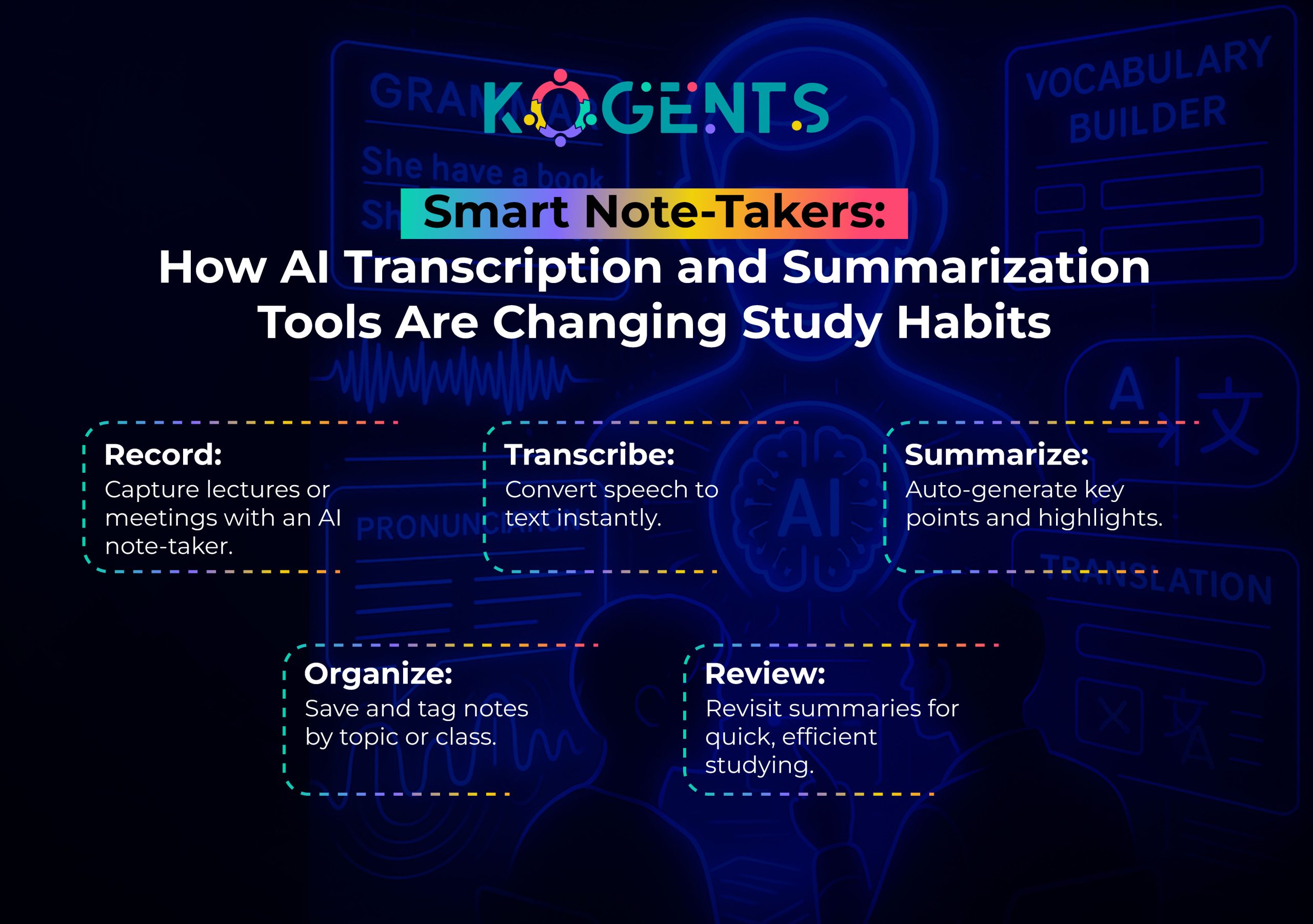
For non-native speakers, lectures, readings and discussions in English can be overwhelming. AI note-taking tools, summarisation tools (reduce complexity), and translation support are key.
Example: an AI teaching assistant pro transcribes a lecture, highlights key vocabulary, and provides a summary in simpler English.
Benefit: Reduces cognitive load, frees up energy for critical thinking and writing tasks.
Comparative Table of Top AI Tools for Students (Non-Native English Focus)
Case Studies: Real-World Examples
Case Study 1: Generative AI in University English Courses
A study at a Korean university incorporated a generative-AI-based instruction model in general English courses for EFL (English as a Foreign Language) learners (n = 89).
Results: learners exposed to AI showed higher motivation, increased interest, and confidence, compared to traditional instruction.
Key lessons: Students viewed the AI as a learning partner that, with teacher guidance, enhanced their writing, revision, and academic English fluency.
Case Study 2: Paraphrasing Tools & Non-Native Speakers
Researchers working with non-native English speaker students (NNES) found that paraphrasing tools augmented with “information aids” (contextual cues, explanations of suggestions) improved efficiency, confidence, and trust.
Outcome: Comparing original and AI-suggested phrasing with clear explanations helped students think critically, retain improvements, and master academic English.
Case Study 3: Understanding AI Tool Usage Patterns in Academic Writing
A cross-journal study analysed 8,859 articles with 168 AI-usage declarations: 77% were non-native English speakers using generative AI (eg, for academic writing).
Improving readability (51%) and grammar checking (22%) were the primary uses.
Lessons: Non-native speakers lead in using AI writing tools for readability and grammar, highlighting the need for supportive policies and informed institutional adoption.
Future Trends: Where “AI Tools for Students” Are Heading in the Context of Academic English?
- Multilingual prompt support: Tools will increasingly support prompting in a student’s native language and output academic paraphrasing tools. Search on multilingual prompting for non-native English learners in coding contexts.
- More discipline-specific academic English AI modules: Tailored to e.g., economics, engineering, humanities, with vocabulary lists, genre conventions, writing styles.
- Real-time classroom AI tutoring: AI assistants integrated into lectures, seminars, providing immediate support in academic English breakout groups.
- Deeper analytics: AI will track not just grammar but rhetorical moves, coherence, argument strength, and discipline fit.
- Institutional frameworks for AI-literacy: Educators and students will need formal training in “how to use AI responsibly”, especially for non-native speakers who are already heavy adopters.
- Free and accessible tools: Growth of free AI tools for students will increase, lowering barriers for non-native speakers globally.
- Enhanced feedback loops: AI will transition from single-use suggestions to full revision cycles, reflecting student progress over time.
Wrapping Up!
In the EdTech industry, AI tools for students have become essential allies for non-native English speakers mastering academic English.
By using AI-powered learning and natural language processing tools, students turn language barriers into opportunities for confident, high-quality writing.
At Kogents.ai, we empower learners with smart, ethical AI solutions to write, revise, and publish with excellence, because with the right tools, every student can thrive globally.
FAQs
What are the best AI tools for students who are non-native English speakers?
The best tools are those that focus on academic writing — for example, grammar-editors like Grammarly, paraphrasing tools with explanations (see research), and generative AI that helps structure essays. The key is choosing a tool designed for academic English, not just general writing. Combine that with a study-assistant tool and a note-taking tool for full support.
Can AI study tools replace human tutors for non-native English-speaking students?
Not entirely. While AI can supplement human instruction, provide immediate feedback, and scaffold language, human tutors remain critical for deeper feedback, subject-specific advice, and mentoring. The optimal approach is hybrid: human + AI.
How does AI note-taking or summarisation help non-native speakers studying in English?
These tools reduce cognitive load by transcribing lectures, summarising readings, highlighting vocabulary, and enabling better comprehension of English-medium content. This lets students focus more on analysis and writing rather than transcription.
What’s the difference between AI learning tools and AI writing tools for students?
AI writing tools for students are those specifically targeting writing tasks, grammar, structure, drafting, and revising. AI learning tools have a broader scope, including tutoring, adaptive learning, study planning, comprehension support, time management, and productivity. Both categories overlap but address different phases of learning.
What should institutions consider when integrating AI tools for education for non-native speakers?
Key considerations: equity of access, training for students and educators, clear policies on AI use (academic integrity), aligning tool-use with pedagogy, ensuring language support is integrated, and monitoring usage and outcomes. Institutions must also focus on non-native English speakers’ needs specifically.
Are there risks in using AI productivity tools for students when writing academic English?
Yes. Risks include over-dependence on AI, reduced development of language proficiency, misuse (plagiarism or academic misconduct), inappropriate suggestions lacking discipline-specific nuance, and equity/access issues. It’s essential to use AI tools as assistance rather than a substitute.

Kogents AI builds intelligent agents for healthcare, education, and enterprises, delivering secure, scalable solutions that streamline workflows and boost efficiency.