From Pilot to Proof: Institutions That Achieved Breakthroughs with AI Tools for Teachers
Summary:
Imagine a world where your planning time is cut in half, your assessments are auto-scored, and you can instantly see which students are at risk, yet you’re still the captain of the classroom.
That’s the promise of AI tools for teachers: a new wave of educational AI tools for teachers, from generative lesson-planning to AI assessment tools for teachers, are shifting the role of the educator from lone content-creator to strategic learning partner.
But many schools started small, with pilots. The real test? When those pilots turn into proof: when institutions go beyond “let’s test it” to “we’ve changed how we teach”.
In this long-form article, we’ll explore how select institutions have made that leap, deploying AI teaching assistant tools, teacher AI assistant software, classroom AI tools for teachers, and more, and achieved measurable breakthroughs.
If you’re curious about the best AI tools for teachers 2025, or wondering how AI-automated teaching might reshape planning, assessment, or classroom management, this post is for you.
Key Takeaways
- Teacher agency matters: Success came when teachers were part of designing the AI toolkits for teachers.
- Data-driven feedback loops: Learning analytics and dashboards made adoption stick.
- Pilots with clear metrics: Institutions that defined outcomes ahead of time moved from pilot to scale.
- Ethics and human-in-the-loop frameworks were essential to maintain trust.
- Infrastructure + PD = success: Without professional development and infrastructure, many promising projects stalled.
Before–After–Bridge: What Happens When Teachers Adopt AI?
| Task | Before AI Tools | After AI Integration | Bridge (What Made It Work) |
| Lesson Planning | 3–4 hours crafting resources manually | 20 minutes using AI lesson-planning tools for teachers | Generative AI trained on curriculum standards + teacher input |
| Grading & Feedback | Late-night paper piles and manual rubrics | Instant rubric-based feedback via AI assessment tools for teachers | Transparent, teacher-verified algorithms ensuring fairness |
| Differentiation | One-size-fits-all worksheets | Adaptive, personalized materials from AI for special education modules | Learning analytics insights linked to student profiles |
| Classroom Management | Manual tracking of participation & behavior | AI classroom management dashboards visualize engagement in real time | Teacher dashboard AI synced with LMS data |
| Professional Development | Sporadic workshops | Continuous AI literacy for teachers micro-coaching | Integrated educator productivity software and peer dashboards |
Why Teachers Are Turning to Artificial Intelligence Tools for Teachers?
The Teacher Workload Challenge
- Teachers today face immense demands: lesson planning, grading, providing feedback, differentiating instruction, managing classroom behaviour, collaborating with families, and more.
- A key barrier to teacher effectiveness is time.
- When we talk about teacher productivity AI tools, we’re referring to solutions that help reduce the administrative burden, freeing up time for actual teaching and student interaction.
What “Teacher Productivity AI Tools” Bring to the Classroom?
- Generative AI in classroom settings enables the creation of lesson-plan drafts, resources, and personalized student support.
- AI teaching assistant pro can suggest activities, generate differentiated tasks, or align with standards.
- AI assessment tools for teachers can provide automatic grading or feedback for objective tasks, freeing up time to focus on higher-order student work.
- Learning analytics dashboards and teacher dashboard AI give real-time insights into student performance: which students are struggling, who skipped work, and which interventions are working.
From Pilot to Proof: The Change in Mindset
- Many schools have experimented with educator productivity software and AI teaching tools.
- The shift from pilot to proof happens when the tool becomes a sustainable part of teacher workflow, when it’s not just “let’s try it for a month”, but “we changed our process and got outcomes”.
- This path involves aligning with digital pedagogy, managing change, and building teacher confidence in AI teaching assistant tools rather than seeing them as a threat.
Institutional Breakthrough Case Studies
Here are four rich AI in education examples showing how institutions have used AI tools for teachers, moved from experimentation to implementation, and achieved measurable results.
Case Study A: Large Urban K-12 School District
A large U.S. school district introduced AI assessment tools for teachers to help with formative feedback.
Partnering with a vendor, the district piloted an AI-powered writing feedback engine for grades 6-8.
Results showed students who received multiple iterations of AI-guided feedback improved their final drafts by 30%.
The district then scaled the tool to 14 schools, built a teacher-PD program on AI literacy for teachers, created a teacher dashboard AI to track progress, and integrated the tool into the district’s curriculum planning cycle.
Teachers reported lower workload and higher student engagement.
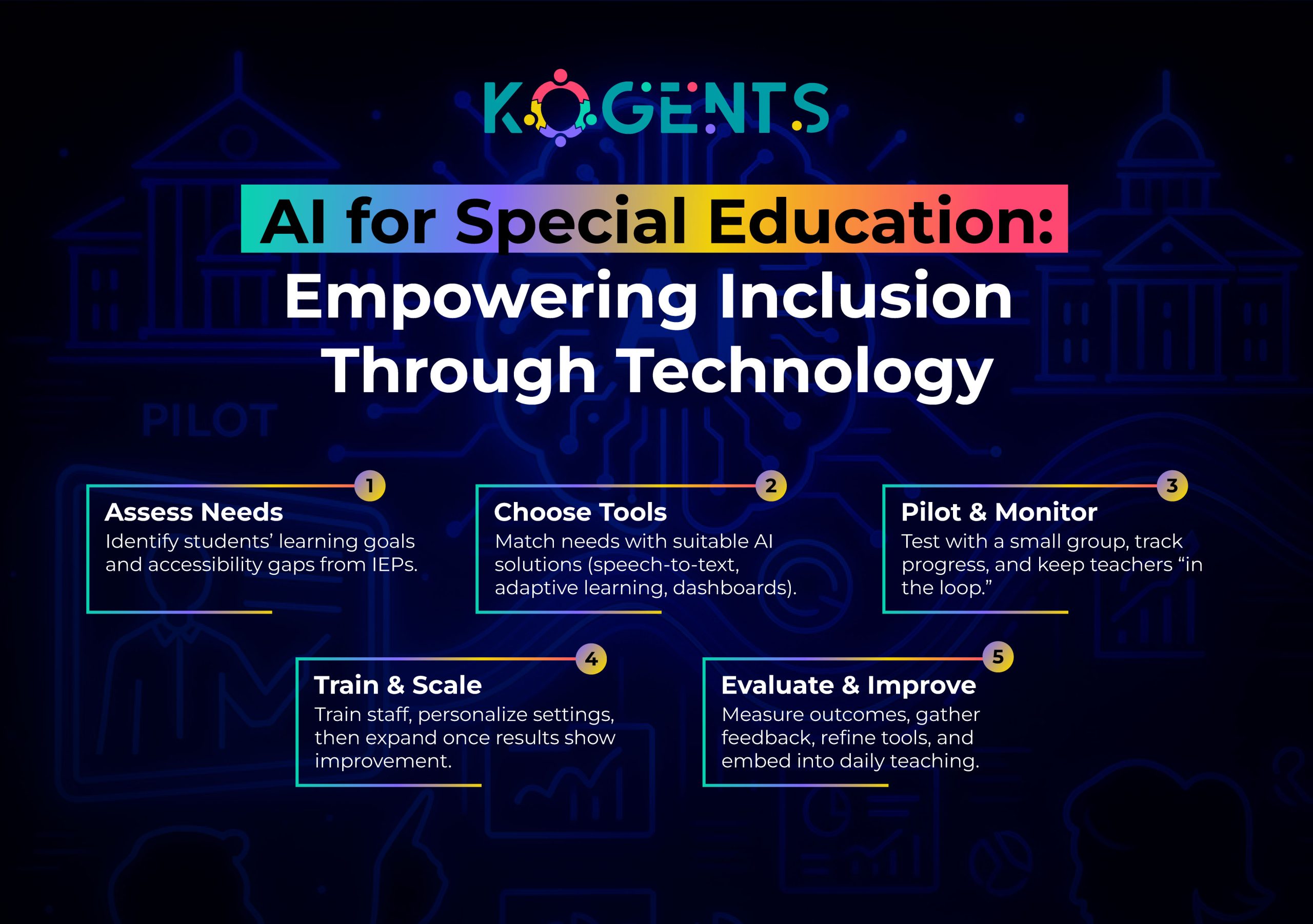
Case Study B: Special-Education Focused Institution and AI for Special Education
An inclusive school worked with a vendor to deploy AI tools for special education teachers and AI teaching tools to produce differentiated materials and voice-input assistive technologies.
After a successful pilot, the school embedded the tool into its Individualized Education Programme (IEP) process, enabling paraprofessionals and teachers to generate tailored tasks, monitor student progress via analytics, and free up time for human-led interventions.
Teachers reported increased student engagement and reduced planning time.
Case Study D: International Pilot (Global South / Developing Context)
While the context is different (infrastructure and teacher training pose challenges), it points to how educational AI tools for teachers can support underserved areas.
What Worked: Key Enablers of Success?
From these case studies, we can draw major enablers that aided the move from pilot to proof.
Leadership and Vision
When institutional leaders embraced the idea of AI teacher tools not as gimmicks but as enablers of pedagogy, they provided funding, created strategic roadmaps, and integrated the tools into teacher planning cycles.
The U.S. DOE report emphasises involving teachers, policy-makers, researchers, and tech providers.
Teacher Training and Professional Development (AI Literacy for Teachers)
A recurring theme: teachers need training in teacher professional development AI, not just on how to use the tool, but why it matters.
Workshops help them understand generative AI in the classroom, automated grading, teacher-student interaction AI, and how to maintain pedagogy integrity.
The international report interviewing teachers underscores this.
Data Analytics & Feedback Loops
The availability of real-time dashboards, data on student engagement, and feedback loops for teachers allowed schools to monitor impact, refine use, and embed the tools into workflow.
Note: Teacher dashboard AI and learning analytics matter.
Human-in-the-Loop and Teacher Agency
Key to teacher acceptance was the concept of human-in-the-loop AI in education. Instead of replacing teachers, tools supported them.
Example: an ITS designed with teachers in the design process increased usability and adoption.
Challenges and Lessons Learned
Even successful deployments had hurdles; understanding and addressing these helps any institution.
Ethical AI in Education, Data Privacy, and Teacher Autonomy
- Using AI assessment tools for teachers or AI teaching assistant tools raises questions: Who owns the data? How are decisions made?
- Are teachers reduced to monitors of AI outputs?
Implementation Pitfalls (Technology, Infrastructure, Teacher Buy-In)
- In lower-resource contexts, infrastructure gaps (internet, devices), digital literacy, and teacher resistance can slow or derail progress.
- The Indonesian study flagged these issues.
Sustaining Momentum Beyond the Pilot
- Too many pilots fade away because they are isolated, unsupported, or not scaled.
- Success requires embedding tools into systems, budgeting for maintenance, and aligning with strategic goals.
- Without follow-through, the proof never materialises.
Mini Self-Quiz: What Kind of AI-Ready Teacher Are You?
Take this quick 1-minute quiz to find out your teaching style in the age of AI tools for educators, and discover how you can integrate artificial intelligence into your classroom more effectively.
1. When you plan lessons, do you prefer:
A. Designing everything yourself
B. Using AI lesson-planning tools for teachers for inspiration
C. Letting the AI draft and you refine
2. Your grading style:
A. Manual and meticulous
B. Assisted by AI assessment tools for teachers
C. Fully automated, then teacher-verified
3. Your biggest teaching challenge:
A. Time
B. Engagement
C. Personalization
Your Result!
If you scored mostly A’s → You’re the Traditionalist Innovator, start small with teacher AI assistant software. Try tools that simplify grading or plan lessons without losing your personal touch.
If you scored mostly B’s → You’re the Balanced Integrator — you blend human insight with AI teacher tools in the classroom, using AI for efficiency while keeping student interaction at the core.
If you scored mostly C’s → You’re the AI-Forward Educator, consider exploring generative AI tools for teachers or AI dashboards for real-time analytics to personalize learning at scale.
Closing Remarks!
From pilot to proof, deploying AI tools for teachers means transforming practice, not just adding tech.
When educators align human insight with AI, teaching evolves: engagement rises, outcomes improve, and burnout falls.
At Kogents.ai, we make “human + AI” real with top artificial intelligence tools for teachers, training, and support. We turn pilots into sustainable, scalable success, always centered on students.
Ready to move from exploration to implementation? Visit kogents.ai.
The 5-Day AI Teacher Challenge
Moving from pilot to proof begins with experimentation. Here’s a 5-Day AI Challenge to help any educator start implementing AI tools for teachers immediately.
| Day | Action | Goal / Outcome |
| Day 1 – Plan | Use a lesson-plan generator like TeacherMatic or MagicSchool to draft tomorrow’s class. | Experience generative AI in lesson design. |
| Day 2 – Assess | Try an AI assessment tool to grade a quiz or short assignment. | Observe time saved & consistency in feedback. |
| Day 3 – Personalize | Create differentiated materials using AI for special education features. | Test personalized learning benefits. |
| Day 4 – Engage | Use an AI classroom management or analytics dashboard. | Track student participation and energy. |
| Day 5 – Reflect | Journal insights: What changed? What freed time? What did students notice? | Turn reflection into institutional learning proof. |
Note: This simple challenge builds teacher digital tools literacy and helps participants measure real ROI, moving from “trying AI” to “proving AI.”
FAQs
What are the best AI tools for teachers in 2025?
There is no one-size-fits-all. The “best” AI tools for teachers depend on your goals: lesson-planning, automated grading, special-education support, and teacher productivity. Look for tools that integrate with your LMS, support teacher agency, offer analytics, and align with pedagogy rather than just automation.
How do AI tools help teachers in the classroom?
AI in education for teachers helps by automating routine tasks (e.g., attendance, grading), generating differentiated materials, providing real-time student insights via dashboards, enabling personalised learning, and freeing time for teachers to focus on student-teacher interaction and higher-order instruction.
How can I use AI tools for lesson planning?
With AI lesson-planning tools for teachers, you can input your curriculum goals and standards and let the system generate a draft plan, differentiated student tasks, aligned resources, and assessment suggestions. Teachers still review and adapt — the AI supports your workflow rather than replaces it.
How do teacher AI assistant software platforms support educators?
Teacher AI assistant software can act as a co-planner, grade tasks, highlight students needing intervention, provide question banks, suggest peer-collaboration opportunities, and manage administrative tasks — helping shift teachers from administrators to instructional coaches.
What about AI assessment tools for teachers — are they reliable?
AI assessment tools for teachers are increasingly sophisticated, especially for objective tasks (quizzes, multiple choice). For essay scoring and higher-order tasks, there is still a need for teacher oversight.
Does AI replace teachers?
No. The intent of AI teacher tools in the classroom is augmentation, not replacement. The teacher remains the pedagogical leader, designing, interpreting, human-connecting, and adapting. The AI handles supportive or repetitive tasks, enabling teachers to focus on what humans uniquely do: motivate, facilitate, and inspire.

Kogents AI builds intelligent agents for healthcare, education, and enterprises, delivering secure, scalable solutions that streamline workflows and boost efficiency.