Enhancing Apache Workflow Automation with AI Agents for Scalable Data Pipelines
Summary:
In the modern data economy, organizations no longer compete merely on data volume but on how intelligently and efficiently they orchestrate it.
Traditional pipelines struggle to keep pace with real-time ingestion, multi-cloud integrations, and complex analytics workflows.
This is where Apache Workflow Automation, powered by Apache Airflow, enters the stage.
But the next leap forward is not just in automation; it’s in autonomy. Imagine pipelines that reason, adapt, and self-heal.
By integrating AI agents into your Apache workflow orchestration, enterprises can create scalable data pipelines that dynamically optimize execution, balance workloads, and adapt in real time.
This blog explores how to elevate Apache workflow management beyond static scheduling. So, give it a quick read now!
Key Takeaways
- Apache Workflow Automation provides a programmable, extensible foundation for orchestrating complex, distributed data systems.
- AI agents enhance orchestration by enabling dynamic scaling, decision logic, and self-optimizing DAG execution.
- Intelligent automation reduces operational overhead and enables data pipelines that evolve autonomously with workload patterns.
- Optimizing the Airflow architecture, executors, task parallelism, caching, and adaptive scheduling ensures large-scale performance.
- When combined, workflow orchestration platform Apache Airflow and AI agents deliver truly scalable, self-healing data-engineering pipelines.
What to Know About Apache Workflow Automation?
Apache Workflow Automation refers to using Apache Airflow, an open-source workflow orchestration tool under the Apache Software Foundation, to define, schedule, and manage data-processing pipelines programmatically.
Instead of brittle cron jobs, Airflow represents workflows as Directed Acyclic Graphs (DAGs), where each node is a task and edges define dependencies.
Tasks are written in Python, making workflow as code, Apache Airflow a reality.
Core features include:
- Task dependency graph scheduling and retries
- Workflow orchestration service with metadata tracking
- Workflow monitoring and visualization (Tree View, Gantt Chart)
- Extensibility via operators, sensors, and hooks for hundreds of systems
- Executors like Celery Executor, Kubernetes Executor for distributed scale
Key Note: This design makes Airflow the backbone of enterprise low-code workflow automation, Apache Airflow, orchestrating ETL/ELT jobs, MLOps pipelines, and data workflows across heterogeneous environments.
Why Combine Apache Workflow Automation with AI Agents?
With the digital revolution, the evolution of data-pipeline orchestration, speed, and reliability are no longer the only differentiators.
The modern benchmark is adaptability, pipelines that learn, anticipate, and evolve.
This is precisely where blending Apache workflow automation (Airflow) with AI agents reshapes the paradigm, from reactive scheduling to proactive orchestration intelligence.
Intelligence Meets Orchestration
- Apache Airflow already acts as the backbone for workflow orchestration, managing dependencies, schedules, and retries through its Directed Acyclic Graph (DAG)-based engine.
- By layering AI agents on top, organizations can infuse cognitive automation into this deterministic framework.
Example: An AI agent evaluates data arrival patterns in an S3 bucket. If traffic spikes, it triggers extra ingestion tasks; if traffic is light, it defers processing, saving compute while maintaining SLAs.
Scaling Through Predictive Orchestration
The union of workflow orchestration platform Apache Airflow and AI-driven prediction enables scalable, elastic data pipelines.
How does predictive scaling work?
- AI agents continuously monitor task execution latency, CPU usage, and queue depth.
- They forecast upcoming load spikes using time-series models or reinforcement-learning agents.
- The agent then adjusts Airflow’s parallelism parameters, spins up KubernetesExecutor pods, or re-prioritizes DAG runs automatically.
From Automation to Autonomy
Traditional workflow automation stops at execution, but with AI agents, orchestration evolves toward autonomy:
- Self-healing pipelines – agents detect task anomalies (e.g., skewed partitions, failed APIs) and trigger compensating logic automatically.
- Dynamic branching – agents decide real-time DAG paths based on data conditions (e.g., route to anomaly-remediation DAG).
- Autonomous retraining workflows – if a model drifts, an agent triggers retraining DAGs, updates metadata, and redeploys.
Key Highlight: This “closed-loop orchestration” mimics DevOps observability patterns, effectively making Airflow part of an autonomous MLOps ecosystem.
Business & Operational Value
Combining AI agents with Apache workflow management delivers measurable business outcomes:
| Impact Area | Traditional Airflow | AI-Enhanced Airflow | Typical Improvement |
| Throughput | Manual scaling | Predictive scaling | +30 – 50 % task throughput |
| Failure Recovery | Manual retries | Automated self-healing | Mean-time-to-recover ↓ 40 % |
| Resource Efficiency | Fixed cluster size | Elastic resource scheduling | Cost ↓ 25 – 35 % |
| Decision Latency | Static DAGs | Dynamic DAG branching | Latency ↓ 45 % |
| Operational Load | Manual monitoring | Autonomous alerts | On-call load ↓ 60 % |
Enhanced Observability and Governance
- AI-driven orchestration doesn’t eliminate human oversight; it amplifies it.
- AI agents enrich workflow logging, alerting, and visualization by correlating telemetry across pipelines.
Example:
- Linking Airflow’s logs with agent-based anomaly scores highlights systemic issues.
- Natural-language-generated reports summarize DAG performance in plain English (“Yesterday’s data-load DAG failed due to schema mismatch; recovery initiated automatically”).
MLOps, DevOps, and DataOps Convergence
By introducing reasoning agents inside Airflow, teams achieve cross-disciplinary alignment, a goal shared by Microsoft workflow automation ecosystems that integrate DevOps and data pipelines for unified governance.
- MLOps: agents trigger model retraining and version rollbacks.
- DevOps: agents provision or decommission compute based on workload.
- DataOps: agents verify schema evolution and data-quality thresholds dynamically.
Leveraging AI Agents for Intelligent Scalability
Workflow automation AI agents can augment Airflow’s orchestration logic to make data pipelines self-aware.
- Adaptive Scheduling & Autoscaling: AI agents analyze historical run metrics (task duration, CPU, I/O) to predict load and adjust concurrency dynamically.
They can trigger KubernetesExecutor pod scaling or adjust parallelism variables in near-real time.
- Anomaly Detection & Self-Healing: An AI agent embedded in a DAG monitors task logs and runtime patterns.
Upon detecting anomalies (e.g., data skew, ETL lag), it can automatically:
- Retry with different parameters
- Trigger compensating tasks
- Alert operators or rollback dependent DAGs
- Smart Task Mapping and Dynamic Branching: Using Airflow’s dynamic task mapping (introduced in 2.3+), AI agents can decide at runtime how many parallel tasks to spawn.
For instance, if the dataset size > 1 TB, split into 10 parallel chunks; else run sequentially.
Bonus Point! This transforms static DAGs into adaptive DAGs, a true hallmark of AI-augmented Apache workflow automation.
- Data-Driven Workflow Optimization: Agents trained on pipeline telemetry can forecast failures, recommend DAG restructuring, or reorder task priorities for optimal throughput.
- Predictive Resource Allocation: AI-driven predictive scaling reduces cost while maintaining SLAs, particularly useful in cloud orchestration where compute costs can spike.
Architectural Blueprint: Scalable AI-Enhanced Apache Workflow
| Layer | Component | Enhancement | AI Agent Role |
| Ingestion | Kafka / S3 / API Feed | Parallelized data fetch | Monitor throughput & optimize pull rate |
| Transformation | Spark, Pandas, dbt | Dynamic partitioning | Recommend partition size, detect skew |
| Orchestration | Apache Airflow | DAG scheduling & retry | Predict failures, trigger branching |
| Compute | Kubernetes Executor | Autoscaled workers | Learn usage patterns & pre-warm pods |
| Monitoring | Prometheus / OpenLineage | Telemetry collection | Correlate failures with upstream events |
Cloud-Native Scaling
Modern deployments use AWS Managed Workflows for Apache Airflow (MWAA), Google Cloud Composer, or Astronomer Cloud to offload infrastructure.
AI agents integrate through APIs or in-DAG operators:
- Google’s new Generative AI Operators (TextEmbeddingModelGetEmbeddingsOperator, GenerativeModelGenerateContentOperator) enable text analysis and data enrichment directly within Airflow DAGs (Google Cloud, 2024).
- Astronomer AI SDK provides decorators like @task.llm and @task.agent, turning LLM calls into first-class Airflow tasks (Astronomer.io).
Architectural Patterns for Scalable Data-Pipelines Using Apache Workflow Automation + AI Agents
To build this intelligent stack, here are often‐used architectures and design patterns, along with a comparative table.
Typical Architecture
- Ingestion Layer – Data enters via batch or streaming (e.g., archive logs, API, event streaming).
- Pre-Processing / Transformation – Traditional ETL/ELT tasks: cleaning, staging, formatting.
- Agent Layer – Here the AI agent sits: dynamically examines data, enriches it (e.g., embeddings), triggers branching logic, detects anomalies, and decides on downstream tasks.
- Orchestration & Scheduling (Airflow) – The DAG ties together all steps: ingestion task → transform task → agent task → branch tasks → load or alert. Airflow handles scheduling, dependencies, retries, and monitoring.
- Output / Load / Serve – Data stored in warehouse, fed into ML models, dashboards, reports.
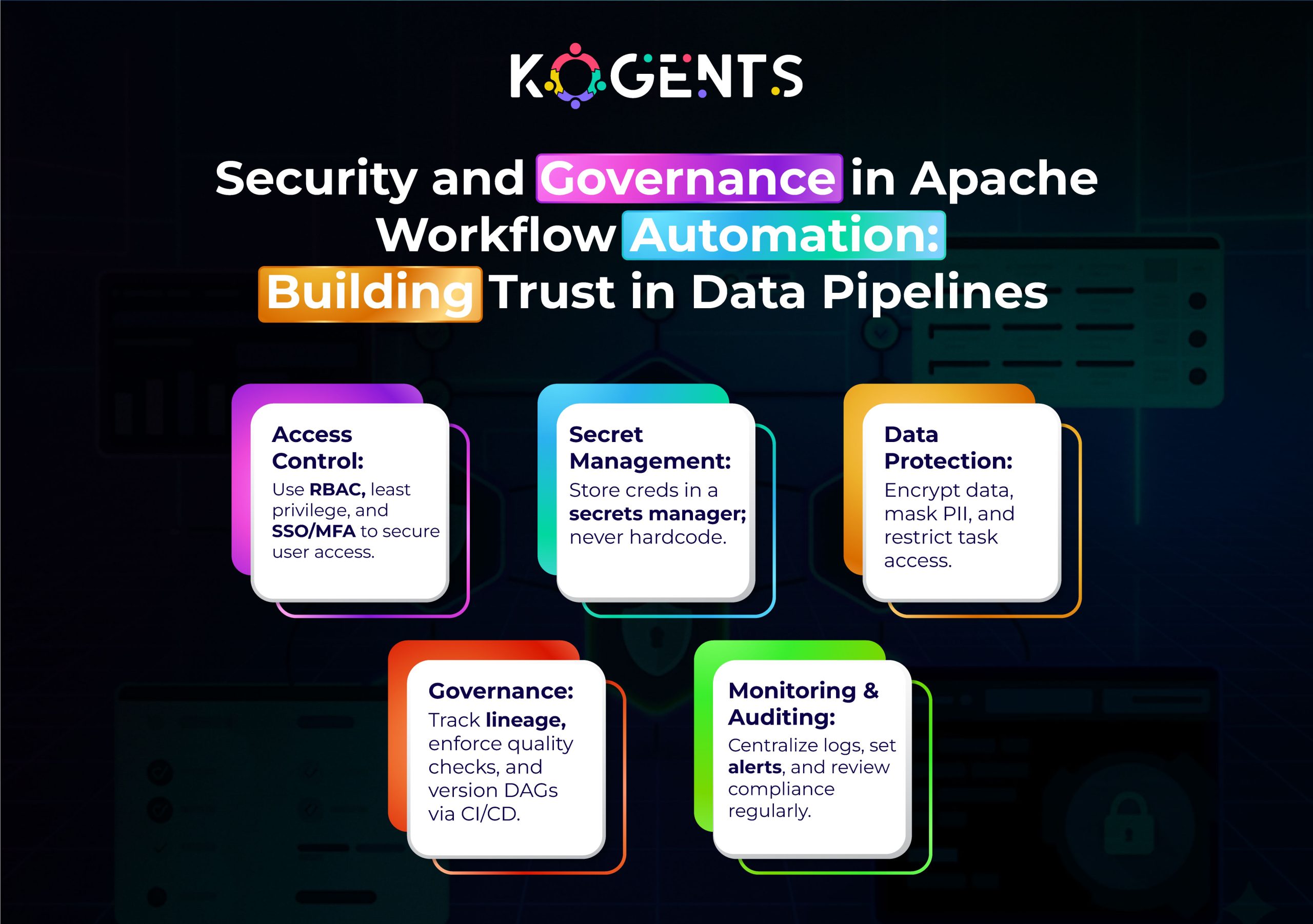
- Monitoring & Governance – Observability over tasks, logs, agent decisions, and version control.
- Scaling Infrastructure – Distributed executors, worker nodes, cloud integration, containerization.
Cloud vs On-Premises, Batch vs Streaming
- Batch workloads: Airflow excels because scheduling is well defined (daily/weekly).
- Streaming or event-driven workflows: Airflow can handle via sensors/triggers or Deferrable operators, then the agent logic can decide routing.
- Cloud deployment: Managed services like AWS Managed Workflows for Apache Airflow (MWAA) or Google Cloud Composer simplify infrastructure.
Example: The Google blog shows direct integration between Airflow and generative models via Vertex AI.
- On-premises: Full control; ensure you provision metadata DB, worker pool, message queue, and agents.
Case Studies
Case Study 1 – AirQo: Scaling Environmental Data Pipelines
AirQo (University of Makerere) implemented an AI-driven air-quality monitoring system using Apache Airflow to ingest and process millions of sensor records monthly.
- Challenge: Low-resource environments with frequent network interruptions.
- Solution: Modular Airflow ETL with retries and batch automation.
- Result: Scalable, fault-tolerant pipeline supporting 400+ sensors
Case Study 2 – Google Cloud: Generative AI Operators
Google added Airflow operators for Vertex AI models, allowing data engineers to embed text generation, embedding, and anomaly detection within workflows.
- Outcome: Reduced manual review time by 43 % in pilot pipelines.
- Lesson: AI agents extend Airflow beyond ETL, into intelligent data enrichment.
Conclusion
Apache workflow automation already offers a battle-tested foundation for ETL and ML orchestration.
By infusing AI agents into that framework, organizations unlock new capabilities: predictive scheduling, self-healing pipelines, and dynamic scaling.
The result is not just automation, but autonomous data engineering: pipelines that observe, learn, and optimize themselves.
At kogents.ai, we build intelligent workflow solutions that fuse Apache Airflow pipeline automation with AI-driven decision engines to deliver scalable, observable, and cost-efficient data operations.
FAQs
What is Apache workflow automation?
It refers to using an Apache-branded workflow engine (most commonly Apache Airflow) to programmatically author, schedule, monitor, and manage data-processing workflows, often using DAGs, Python code, and rich orchestration capabilities.
How does Apache Airflow workflow automation work?
You define workflows as DAGs in Python, schedule them (or trigger via sensors), Airflow’s scheduler dispatches tasks via executors to worker nodes, the metadata database tracks state, you monitor via UI, logs, and alerts capture failures and retries.
What is a DAG in Apache Airflow?
A DAG (Directed Acyclic Graph) is the blueprint of the workflow: it defines tasks, their dependencies, schedule interval, triggers, and execution semantics. It ensures tasks run in order without cycles.
How to schedule tasks in Apache Airflow orchestration?
In your DAG definition, you specify schedule_interval (e.g., ‘@daily’, ‘0 0 * * *’) and start_date, optionally with catchup=False. Airflow’s scheduler picks up DAGs at the next interval and triggers task instances if dependencies are met.
How to install Apache Airflow for workflow automation?
You can install via pip (pip install apache-airflow) or via Docker (docker pull apache/airflow, then docker-compose with the official YAML). Initialize the database (airflow db init), create an admin user, then start the webserver (airflow webserver –port 8080) and scheduler.
What is the cost of running Apache Airflow pipeline automation in production?
Costs vary: compute (worker nodes, executors), metadata DB, message queue, storage, and cloud infrastructure. If using a managed service (e.g., AWS MWAA, Google Cloud Composer), you also pay service fees. Monitoring usage and autoscaling helps optimize cost.

Kogents AI builds intelligent agents for healthcare, education, and enterprises, delivering secure, scalable solutions that streamline workflows and boost efficiency.