10 Business Processes You Can Fully Automate with AI Agents (and Save 40+ Hours/Month)
Summary:
Today, the mantra isn’t just “do more with less”, it’s “do smarter with less.”
Picture this: your team is spending dozens of hours each month clicking through routine approvals, fielding drone-like customer tickets, chasing down follow-ups, wrestling spreadsheets, or manually coordinating across tools.
Now imagine handing off a large chunk of that work to intelligent, autonomous systems, not mere macros or rigid scripts, but next-generation AI agents that reason, plan, act, and integrate across workflows.
That’s the promise when you automate with AI agents: freeing up 40 + hours every month, shifting human energy into high-value strategy and creativity, while your “digital workforce” hums quietly in the background.
In this post, we dig deep into how you can start automating with AI agents, uncover ten high-impact business processes ripe for transformation, show you exactly how to pull it off, and demonstrate how this isn’t pie-in-the-sky hype; it’s already real in enterprises today. Let’s get started.
Key Takeaways
- Automating with AI agents transcends traditional RPA: it uses autonomous agents, multi-agent systems, and advanced orchestration to handle complex tasks across systems.
- Ten processes from customer service triage to DevOps automation can realistically yield 40+ hours/month in savings when agent-driven workflow automation is applied.
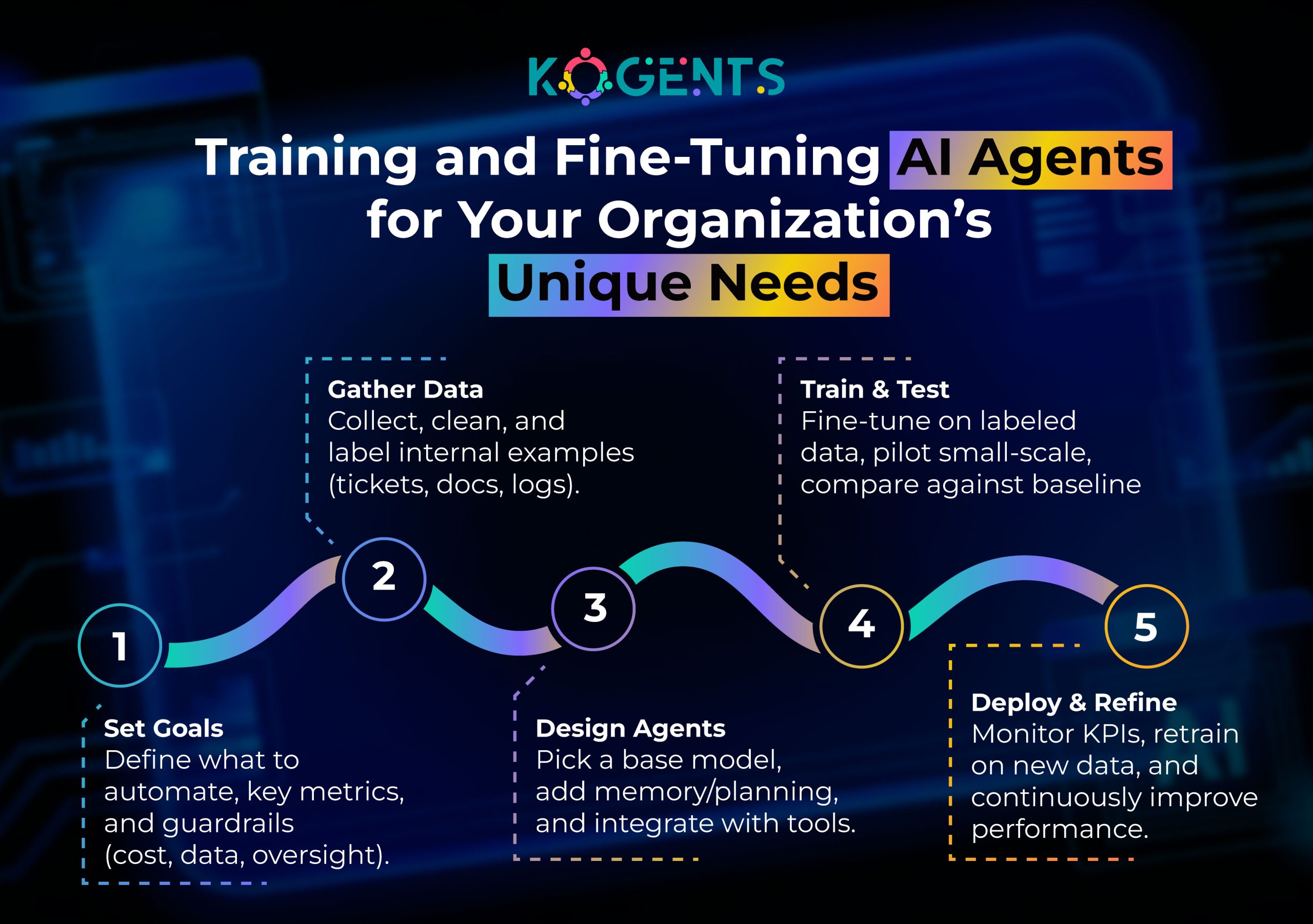
- Choosing the right processes, building the architecture (LLMs + memory/planning modules + tool integration), managing change, and human-agent collaboration are critical success factors.
- Governance, trustworthiness, and security are non-negotiable when deploying agentic AI for automation at scale.
- While the market opportunity is massive and growing fast, many firms still struggle with integration, ROI proof, and organizational readiness.
Why Automating with AI Agents Is a Game-Changer?
In the enterprise context, this means systems capable of doing more than “click this button and fill that form.”
They might decide which next system to talk to, escalate exceptions, ask for human input when they hit a wall, and learn over time.
In short, AI agent automation enables a digital workforce instead of just scripted bots.
How does AI agent automation differ from traditional automation / RPA?
Traditional automation (robotic process automation, RPA) is excellent at highly-structured, repetitive, stable tasks: “open application A → copy data → paste into application B”.
But the moment the UI changes, or the business context shifts, brittle scripts break.
By contrast, AI agents for business automation harness large language models (LLMs), planning and memory modules, tool integration, and orchestration to tackle dynamic, multi-step workflows, exceptions, cross-system coordination, and adaptivity.
According to research, “agentic automation empowers businesses to automate complex, multi-step tasks, dynamically adapt to real-time data, and make intelligent decisions without constant human intervention.”
Market momentum & business drivers
- A recent survey by IBM found that 86% of executives say that by 2027, AI agents will make process automation and workflow reinvention more effective.
- Meanwhile, the global market for agentic AI is expected to grow at a compound annual growth rate (CAGR) of ~43.8% from 2025–2034, reaching about US$196.6 billion by 2034.
Together, these indicators tell a clear story: if your enterprise is not exploring how to automate with AI agents, you risk falling behind.
AI Agent Architecture Components & Their Business Value
| Component | Description | Business Value | Real-World Example |
| LLM Core | Language model reasoning and task interpretation | Enables natural-language workflow commands | OpenAI GPT-5 |
| Memory Module | Retains context and history | Reduces re-training, enables continuity | Anthropic Claude Memory |
| Planning Module | Sequences actions and handles branches | Supports multi-step, dynamic automation | IBM Process Planner |
| Tool Integration Layer | Connects enterprise apps (CRM, ERP, ITSM) | Seamless cross-platform execution | Microsoft Power Automate |
| Orchestration Engine | Coordinates multiple agents | Manages complex workflows, ensures reliability | Salesforce Agentforce |
10 Business Processes You Can Fully Automate with AI Agents (and Save 40+ Hours/Month)
Below are ten high-impact AI automation platforms workflows where deploying AI-driven agent automation can deliver substantial time savings, improved quality, and scalability.
1. Customer-Service Ticket Triage & Resolution
Why does it fit? Customer-service teams often drown in high-volume, repetitive tickets (e.g., password resets, FAQs, basic queries).
These are ideal for automation with AI agents in workflow automation.
How to Implement?
- Deploy an agent that integrates with your ticketing system and reads incoming tickets.
- Use prompt engineering + LLM to classify tickets vs routing, to generate draft responses, and escalate complex cases.
- The agent maintains a memory of prior interactions and learns to improve triage accuracy (memory & planning modules).
- It may coordinate with other agents: e.g., one agent extracts key metadata, another fetches CRM data, and a third crafts a response.
Expected savings: Redirecting simple tickets to agents can free up 10-20 hours/week for a mid-sized team, easily achieving 40+ hours/month of freed human time.
2. Sales Lead Qualification & Outreach Follow-Up
Why does it fit? Sales teams often spend many hours sorting leads, sending follow-ups, and logging interactions.
Using AI agents to automate tasks in this domain can free up sales reps to focus on closing deals.
How to Implement?
- Deploy an agent that takes new inbound leads from CRM, retrieves relevant data (web/social, prior interactions), scores the lead, and drafts outreach email or chat messages.
- Another agent schedules follow-ups, logs outcomes, and triggers alerts for human sales-rep intervention when needed.
- The agentic workflow integrates with email tools, CRM, calendaring, and analytics dashboards.
Expected savings: For example, saving 4 hours/week per rep in lead triage and follow-up can add up to ~16 hours/month, multiply across reps to easily exceed 40 hours total.
3. Finance & Accounting Reconciliations and Expense Processing
Why is it suitable?: Finance functions are full of routine, data-heavy, multi-step workflows: invoice processing, expense claims, reconciliations, and audit logs.
These are prime for AI agent automation.
How to Implement?
- One agent pulls receipts and invoices via IDP/OCR, classifies items, and checks policy compliance.
- A second agent handles reconciliations between sub-ledgers, highlights mismatches, and either resolves simple exceptions or routes complex ones.
- A planning/decision-making agent might schedule reports, trigger accounting entries, and liaise with human approvers.
- Memory modules allow the agents to learn exceptions and reduce manual handovers over time.
Expected savings: Research shows up to ~80% reduction in processing time in such workflows when generative AI + automation agents are applied.
4. HR Onboarding, Offboarding & Internal Service Requests
Why it fits: HR teams field many repetitive requests: new hire accounts, access provisioning, policy acknowledgements, and exit processes. Here, AI agents for workflow automation shine.
How to Implement?
- An onboarding agent triggers from the HR system, provisions IT accounts via integrated tools, sends welcome emails, and schedules training.
- A service-request agent manages internal employee queries (e.g., benefits, leave requests), using NLP to answer or route.
- Offboarding agent revokes access, archives records, and triggers exit interviews.
Expected savings: For a team handling dozens of onboardings and service-desk tickets weekly, reclaiming 1-2 hours per event can reach 40+ hours/month across scale.
5. IT Operations & Help-Desk Management
Why it fits: IT operations receive many tickets, standard service requests, and incident triage, and often coordinate across systems.
Deploying agentic AI for automation helps reduce manual toil and improve response times.
How to Implement?
- Deploy an agent to ingest incidents, classify by severity, attempt resolution (e.g., password reset, system reboot), or escalate automatically.
- A multi-agent orchestration approach: one agent monitors system logs, another correlates alerts, third interacts with the user for context.
- Memory/planning modules retain past incident strategies, reduce repeated escalations.
Expected savings: Suppose a team logs 150 service tickets weekly, each taking ~20 minutes of manual set-up; if agents handle 50%, savings may exceed 25 hours/week (100 hours/month), thus easily surpassing the 40+ hours/month threshold.
6. Supply Chain Order-to-Cash Workflow Automation
Why it fits: Supply-chain processes, from order entry, inventory check, shipping, and invoicing, are ripe for automation with AI-driven agent automation due to their multi-step and cross-system nature.
How to Implement?
- Order-agent extracts, validates order data, checks inventory, and rigs fulfilment.
- Shipping agent coordinates logistics, updates ERP, and CRM.
- Billing agent generates invoice, confirms payment.
- The orchestration agent monitors the workflow, handles exceptions (e.g., backorders), and alerts humans.
7. Marketing Content Generation & Campaign Orchestration
Why it fits: Marketing teams juggle content creation, campaign scheduling, performance tracking, and coordination with sales.
Using AI agents in business automation enables a “mission control” style digital workforce.
How to Implement?
- A content agent drafts blog outlines, social posts, and email sequences using prompt engineering and LLMs.
- A campaign-orchestrator agent schedules posts, monitors performance, and triggers adaptations (e.g., higher budget on winning variant).
- Memory modules keep track of brand voice, campaign results to refine the next generation.
Expected savings: Writers and campaign managers may free up 10-15 hours/month per person; scaling across the team easily passes 40+ hours/month saved.
8. Compliance, Audit & Regulatory Reporting Workflows
Why it fits: Compliance and audit processes are often manual, repetitive, risk-sensitive, and require aggregation of data from multiple systems, perfect to choose AI Agents vs Virtual Assistants.
How to Implement:
- A data-ingestion agent collects required data from systems (ERP, CRM, logs).
- A reasoning/decision-making agent validates data against rules, detects anomalies, and generates report drafts.
- A governance agent tracks approvals, sends alerts for required human sign-off, and logs an audit trail.
- Software Development Lifecycle (DevOps) Automation
Why it fits: The software world is shifting fast toward “intelligent automation,” where autonomous AI agents handle tasks like code reviews, test automation, deployment, and monitoring, illustrating agentic AI for automation.
How to Implement?
- A coding-agent reviews pull requests, suggests fixes; a testing-agent generates tests, executes them.
- A pipeline agent monitors CI/CD, identifies failed builds, and triggers retries or rollback logic.
- A planning agent schedules sprints, coordinates cross-team tasks.
Expected savings: A study found that agentic DevOps agents in some firms resolve 37% of CI/CD pipeline errors without human help.
10. Knowledge Management & Internal Documentation Automation
Why it fits: Internal documentation often lags, is inconsistent, and employees spend time searching. With AI agents for workflow automation, you can build a smart knowledge digital workforce.
How to Implement:
- A knowledge-agent monitors updates across systems (Slack, Jira, Confluence), summarises changes, updates documentation automatically, tags and alerts users.
- A Q&A agent interacts with employees: “How do I set up X?” — uses memory of past documentation and context to answer or escalate to a human expert.
- Orchestration agent monitors for outdated content and triggers review workflows.
Case Studies
Case Study A: Finance Process Automation – “FinRobot”
In the arXiv paper “FinRobot: Generative Business Process AI Agents for ERP in Finance,” researchers deployed generative-AI-based business process agents (GBPAs) in a major financial institution.
Case Study B: Enterprise Survey – Adoption and Value of Agentic AI
According to PwC’s May 2025 survey of 300 executives, 79% of companies already use AI agents.
PwC noted that while adoption is widespread, most firms haven’t yet redesigned operations to harness agents’ full potential.

Conclusion
In modern business, automation alone isn’t enough; intelligent automation through AI agents is the new edge.
When you automate with AI agents, you gain a digital workforce that thinks, plans, and scales, freeing 40+ hours monthly per function.
Success lies in designing systems where agents collaborate, not replace, your people, driving quality and strategic growth.
Partner with the best agentic AI company, Kogents AI, to build your roadmap and scale smart automation today.
FAQs
How do AI agents differ from traditional automation bots or RPA?
Traditional automation (RPA) executes rule-based, highly structured tasks (e.g., “open application, click button, copy value”) and tends to break when processes or interfaces change. In contrast, AI agent automation uses reasoning, planning, tool integration, and adaptability. Agents can handle unstructured data, orchestrate across systems, adapt to exceptions, and dynamically plan workflows — making them suitable for more complex, less rigid processes.
Which business processes are best suited for AI-driven agent automation?
Processes that are high-volume, repetitive, multi-step, involve cross-system coordination, and still require human involvement for exceptions are excellent candidates. Examples include customer-service triage, sales lead outreach, finance reconciliations, HR onboarding, IT service desk, order-to-cash workflows, marketing campaign orchestration, compliance reporting, DevOps automation, and knowledge-management workflows (as described above).
How many hours/month can you realistically save by automating with AI agents?
While actual savings depend on process volume, complexity, and scale, conservative estimates suggest mid-sized functions can reclaim 40+ hours per month by automating one or more high-volume workflows.
What are the challenges and risks of deploying AI agents for automation?
Major challenges include: data-quality issues, integration complexity, lack of a clear business case, trust and governance deficits, human adoption resistance, security risks (agents accessing multiple systems), and the risk of over-promising.
Will automating with AI agents replace humans, and how should we think about human-agent collaboration?
The goal is not wholesale replacement of humans but augmentation. Agents take on repetitive, rule-driven, high-volume tasks so humans can focus on strategic, creative, relational work. Human-agent collaboration requires redesigning roles, training staff, defining escalation paths, and ensuring that humans are comfortable supervising, intervening, and collaborating with agents. Ensuring trust and transparency is critical.

Kogents AI builds intelligent agents for healthcare, education, and enterprises, delivering secure, scalable solutions that streamline workflows and boost efficiency.