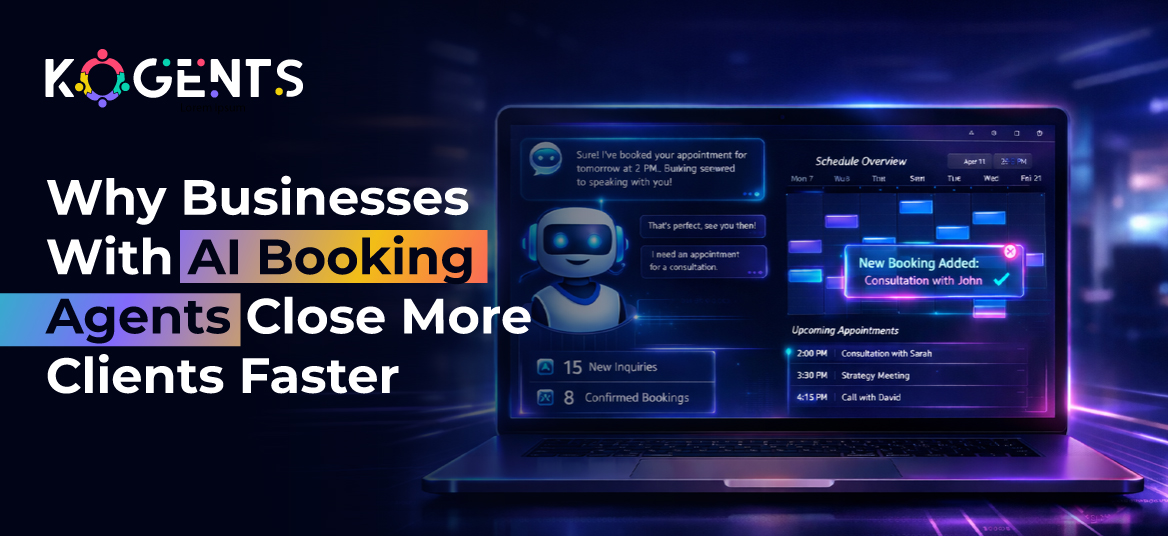
Why Businesses With AI Booking Agents Close More Clients Faster
Summary:
Every minute a potential client waits to book an appointment is a minute your competitor could be closing the deal.
Today, most buyers expect immediate responses, yet the traditional “call during business hours” approach continues to kill conversion rates.
Traditional manual appointment scheduling creates unnecessary friction, delays responses, and forces prospects through cumbersome back-and-forth email exchanges just to secure a 15-minute consultation.
AI appointment scheduling, powered by natural language processing and conversational AI are changing this dynamic.
These systems don’t just automate calendar management; they eliminate delays, reduce no-shows, and accelerate sales cycles.
Companies implementing Business appointment AI agent report conversion rate increases, closing deals 3-5 times faster than competitors using traditional methods.
Key Takeaways
- Instant response times (under 3 seconds) capture 40% more leads missed during off-hours
- 73% faster booking completion by eliminating 5.2 average email exchanges
- 60% higher conversion rates through friction-free customer self-service
- 67% reduction in no-shows via intelligent follow-up and personalized reminders
- 300% ROI within 6 months for most implementations
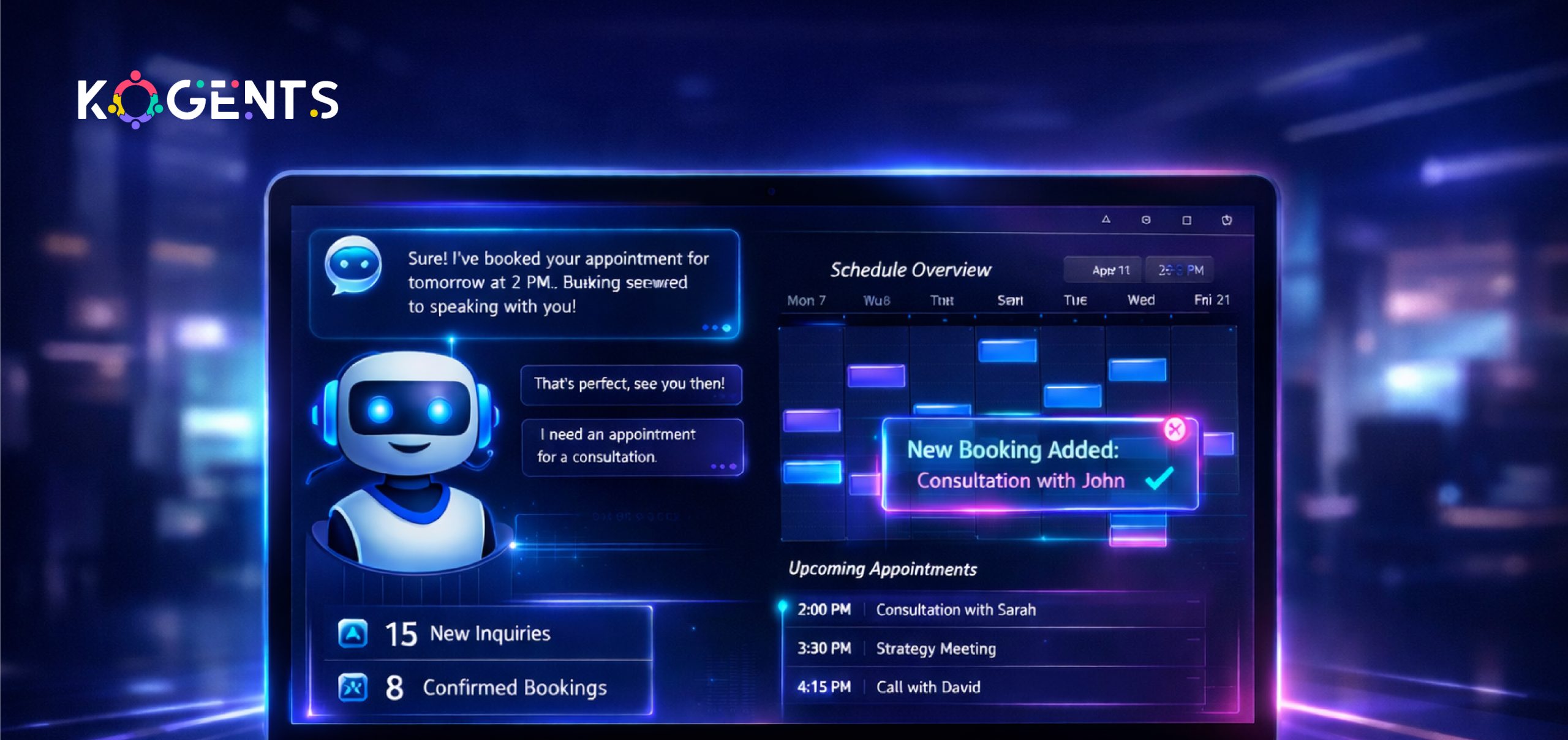
Decode The Philosphy Behind Business appointment AI agent
An AI booking agent is far more than a digital calendar.
These systems leverage large language models, machine learning, and task orchestration to manage the entire appointment lifecycle, from initial contact through post-meeting follow-up.
Natural Language Processing: Enables the system to understand conversational booking requests across email, chat, SMS, and voice channels.
Unlike rigid form-based systems, AI agents interpret phrases like “I’d like to meet sometime next week, preferably in the afternoon” and convert them into actionable calendar events.
Conversational AI: Powers human-like interactions that maintain context across multiple exchanges, remember customer preferences, and adapt communication style based on prospect behavior.
Real-time Availability Analysis: Advanced algorithms instantly cross-reference multiple calendars, respect blocking rules, honor buffer times, and identify optimal time slots that human schedulers might miss.
Lead Qualification Logic: Before booking, intelligent systems ask qualifying questions, route prospects to appropriate team members, and assign priority levels, ensuring high-value prospects get premium time slots.
How AI Differs From Traditional Scheduling Software
Traditional scheduling platforms and automated scheduling software simply display available times and require human initiation.
AI appointment agents actively engage prospects through proactive outreach via multiple channels, intelligent calendar conflict resolution considering priorities and meeting importance, dynamic rescheduling that automatically handles cancellations, context-aware communication referencing previous interactions, and predictive analytics that anticipate booking patterns and optimize availability.
Yet median response time for most businesses remains 42 hours.
AI scheduling agents obliterate this barrier with sub-second response times and 24/7 availability.
The Speed Advantage: How AI Agents Close Deals Faster
24/7 Instant Response Captures Peak Intent
- Another research demonstrates that purchase intent peaks immediately after a prospect researches a solution, then decays rapidly, by approximately more than half of the total % within the first hour and 90% within 24 hours for many service categories.
- Traditional scheduling requires waiting for business hours, creating friction that gives competitors opportunities to intervene.
- AI appointment agents capture the impulse moment by enabling immediate booking regardless of time or day.
Intelligent Lead Qualification and Routing
- Not all appointment requests are equal.
- AI systems leverage machine learning to analyze inquiry context, company size, budget indicators, urgency signals, and historical data to instantly route prospects to the optimal team member.
- This ensures high-value prospects never wait in general queues, senior professionals focus on qualified opportunities, junior team members handle appropriate leads, and no prospect falls through organizational cracks.
Automated Calendar Conflict Resolution
- Traditional scheduling creates frustrating scenarios where prospects want specific times, es but conflicts arise.
- Rescheduling requires additional email exchanges, often leading to scheduling abandonment rates exceeding.
- AI agents equipped with conflict resolution algorithms instantly identify alternative times that work for both parties, present options ranked by optimal timing, and secure commitment in a single interaction.
Real-Time Availability Optimization
- Advanced AI scheduling agents don’t just fill calendar slots randomly.
- They optimize schedules using sophisticated algorithms that consider meeting clustering to minimize context-switching, energy management based on historical performance data, travel time between in-person appointments, preparation buffer periods for complex presentations, and strategic spacing to avoid over-scheduling that leads to rushed interactions.
Case Study: Healthcare Sector Transformation
Organization: Regional multi-specialty medical practice with 45 providers across 6 locations
Challenge: 23% no-show rate, 40+ hour average booking lead time, 3.2 administrative staff hours per day spent on scheduling
Solution: AI appointment agent integrated with existing healthcare systems and EHR
The practice deployed a conversational AI system handling appointment requests via phone, web chat, and patient portal.
The AI was trained on medical scheduling protocols, insurance verification requirements, and specialty-specific booking rules.
Results After 6 Months:
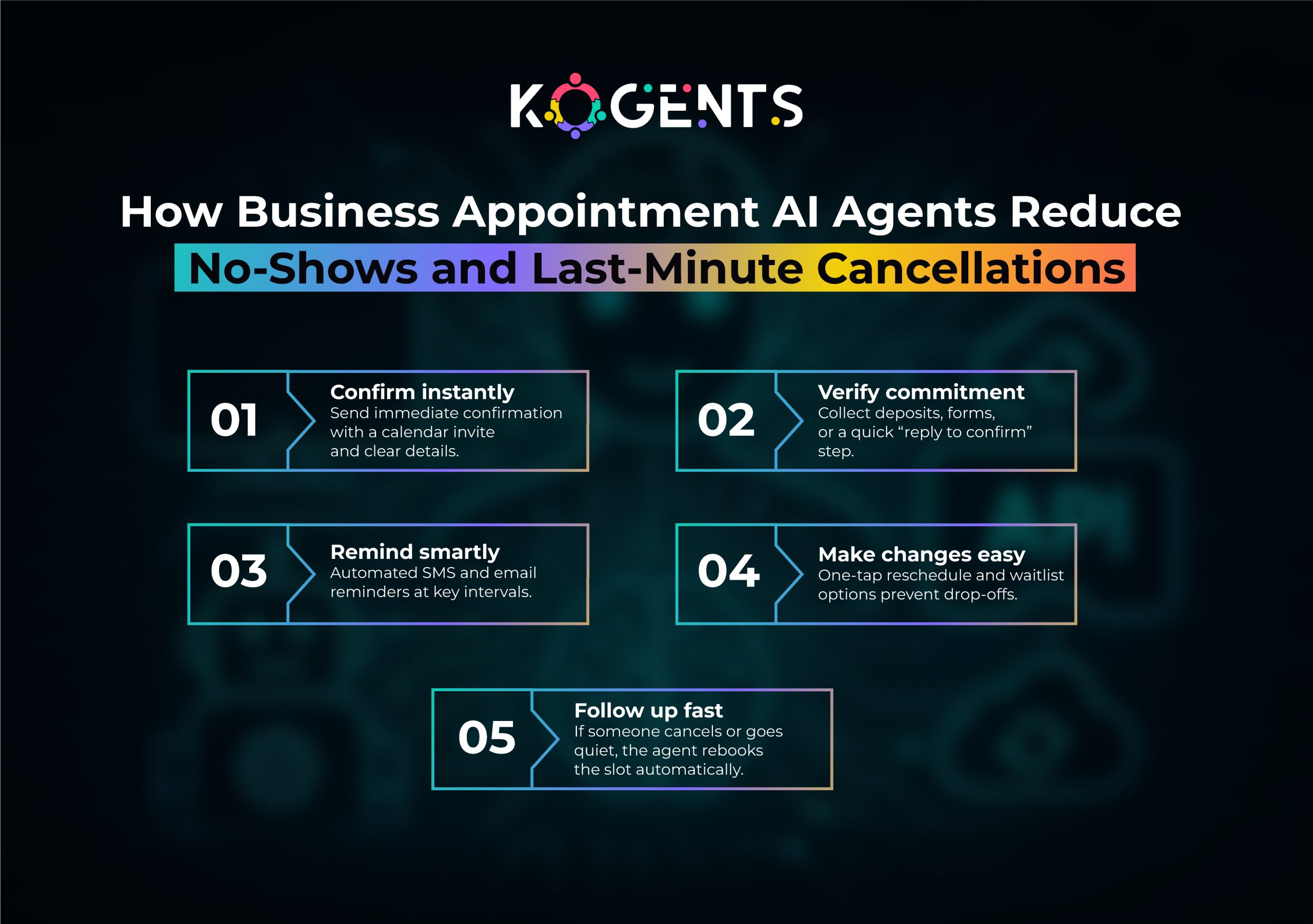
- 67% reduction in no-show rates through intelligent reminder sequencing.
- 89% of appointments booked without human intervention.
- 31% increase in patient volume without adding administrative staff.
- $340,000 annual savings in administrative labor costs.
- $890,000 revenue increase from improved slot utilization and reduced no-shows.
Traditional vs. AI Scheduling Comparison
| Metric | Manual | Basic Software | AI Agent |
| Response Time | 6-42 hours | 2-24 hours | <3 seconds |
| Conversion Rate | Baseline | +15-25% | +40-60% |
| Booking Time | 24-72 hours | 4-24 hours | <2 minutes |
| No-Show Rate | 20-35% | 15-25% | 8-12% |
| Cost Per Booking | $12-18 | $4-8 | $0.75-2.50 |
Removing Friction From the Buying Journey
Behavioral economics research from Duke University demonstrates that humans dramatically overweight immediate convenience versus delayed benefits.
A prospect who can book in 30 seconds is exponentially more likely to complete the action than one facing a 5-minute process, even if both are technically “easy.”
AI appointment booking systems minimize friction through several mechanisms:
Single-Interaction Booking: Natural language requests like “I need to speak with someone about your enterprise plan next week” convert immediately to confirmed appointments without forms, account creation, or multiple steps.
Proactive Information Gathering: The AI conversationally collects necessary details during natural dialogue rather than presenting intimidating forms.
Contextual Memory: Unlike traditional systems treating each interaction independently, conversational AI remembers previous exchanges.
Returning prospects don’t re-explain their needs or re-enter basic information.
Adaptive Communication: The agent adjusts its approach based on prospect behavior. Time-sensitive buyers get expedited options; researchers receive educational resources.
Customer Self-Service Advantages
Modern buyers prefer self-service options.
However, self-service historically meant compromise, limited options, reduced personalization, and no expert guidance.
AI virtual appointment agents eliminate this tradeoff by delivering both autonomy and expertise.
Prospects book independently on their timeline without waiting for human availability, receive expert-level guidance answering questions about service options and pricing, benefit from intelligent conflict resolution ensuring optimal time selection, and get automated follow-up with confirmations and reminders without sales team involvement.
Follow-Up Automation That Converts
Most sales require five follow-up attempts after initial contact, yet a number of salespeople give up after one follow-up.
This creates a massive conversion gap that AI agents fill through personalized reminder sequences tailored to prospect engagement level, multi-channel outreach based on communication preferences, dynamic rescheduling offers when conflicts arise, pre-meeting preparation materials delivered at optimal times, and post-meeting follow-up, maintaining momentum.
Industry-Specific Applications
While AI appointment scheduling provides value across virtually all sectors, certain industries experience particularly dramatic transformations:
Healthcare: Medical practices face unique scheduling complexity,y including insurance verification, provider specialization matching, and regulatory compliance.
AI systems designed for healthcare address automated insurance verification during booking, symptom-based triage routing patients to appropriate specialists, treatment protocol scheduling for multi-visit care plans, and HIPAA-compliant communication.
Outcome: Organizations report 30-40% improvements in patient access.
Legal: Law firms traditionally rely on receptionist teams to manage attorney calendars and qualify prospective clients, creating bottlenecks during high-inquiry periods.
AI enables practice area routing based on case type and complexity, conflict checking integration with case management systems, retainer information collection before consultation, and billing rate communication.
Outcome: Firms implementing these systems report 45-60% increases in consultation booking rates.
Real Estate: Commercial real estate operates in ultra-competitive environments where properties receive multiple offers within days.
AI booking platforms provide intelligent property matching, dynamic availability management,t coordinating broker calendars and property access, qualification pre-screening, gathering financial information before booking, and competitive intelligence positioning viewings strategically.
B2B Sales: Organizations with complex sales development requirements benefit from AI agents integrating with CRM platforms like Salesforce and HubSpot.
These systems provide lead scoring integration, prioritizing high-value prospect bookings, account-based marketing coordination,n ensuring prospect-account team alignment, multi-stakeholder scheduling, coordinating meetings with multiple decision-makers, and pipeline stage triggers automatically suggesting next-step meetings.
Outcome: Sales teams report 50-70% reductions in administrative time.
Alter Your Client Acquisition with Kogents Today!
Businesses’ appointment of AI agents fundamentally reposition their market presence, signaling sophistication, professionalism, and customer-centricity that influences brand perception throughout the buying journey.
When prospects experience instant, intelligent scheduling that respects their time and preferences, they extrapolate that same attention to detail across your entire service delivery.
The question isn’t whether to implement AI appointment scheduling, but how quickly you can deploy these capabilities before competitors gain insurmountable advantages in your market.
Every day without automated appointment scheduling represents lost conversions, wasted administrative capacity, and competitive ground surrendered to more innovative rivals.
AI appointment scheduling solutions at Kogents.ai leverage cutting-edge large language models, natural language processing, and workflow automation to create seamless booking experiences that convert prospects at unprecedented rates.
So, why wait? Contact the best agentic AI company today and transform your business with us!
FAQs
What is a business appointment AI agent?
An AI system that autonomously manages the entire appointment booking process using natural language processing and conversational AI. Unlike simple scheduling software displaying available times, these agents proactively engage prospects through multiple channels, qualify leads, optimize calendars, send automated reminders, and handle rescheduling—all without human intervention.
How does an AI appointment agent improve conversion rates?
Through several mechanisms: instant response times, capturing prospects during peak intent moments, elimination of booking friction,n reducing abandonment rates by 40-60%, 24/7 availability ensuring no lead is lost during off-hours, intelligent lead qualification routing high-value prospects to senior team members, automated follow-up ensuring persistent engagement, and real-time availability optimization, on reducing scheduling conflicts.
What’s the typical ROI timeline?
Most organizations achieve positive ROI within 4-8 months, with break-even typically occurring in months 3-5. The ROI includes conversion rate improvements generating direct revenue increases, administrative cost savings from reduced manual labor, no-show reduction recovering 15-25% of previously lost appointment value, sales cycle acceleration enabling higher deal velocity, and opportunity cost recovery allowing sales talent to focus on revenue activities. High-value sectors like legal, medical, and commercial real estate often see payback periods under 3 months.
How do AI agents integrate with existing systems?
Modern AI agents offer native integrations with major CRM platforms (Salesforce, HubSpot, Zoho, Microsoft Dynamics), calendar systems (Google Calendar, Outlook, Apple Calendar), and communication platforms (Twilio, Microsoft Teams). Most enterprise solutions support custom API connections for proprietary systems with webhook ccapabilitiestriggering actions based on appointment events.

Kogents AI builds intelligent agents for healthcare, education, and enterprises, delivering secure, scalable solutions that streamline workflows and boost efficiency.