Achieving Business Process Workflow Automation through AI Agents and Intelligent Orchestration
Summary:
Do you know that the traditional approach of manual workflows, while still common, is quickly becoming outdated?
It’s simply not fast enough, and it can’t keep up with the demands of modern businesses. This is where Business Process Workflow Automation (BPWA) comes into play, a technological revolution that transforms how businesses handle day-to-day operations.
At the core of workflow automation is the ability to replace human effort with smart technology, reducing bottlenecks and ensuring processes are carried out seamlessly.
But automation doesn’t end with simple task execution. Enter AI agents and intelligent orchestration, technologies that take automation to the next level by integrating artificial intelligence (AI) and smart decision-making capabilities into your workflows.
These innovations don’t just complete tasks; they optimize and improve them, ensuring that business processes are as efficient and agile as possible.
In this blog, we’ll dive deep into how AI agents and intelligent orchestration can help you achieve optimal Business Process Workflow Automation now!
Key Takeaways
- Workflow automation examples that are notable have been transforming industries by replacing manual processes with automated, intelligent systems.
- AI agents not only automate tasks but also enhance decision-making, providing businesses with real-time data-driven insights.
- Intelligent orchestration ensures seamless integration and real-time task coordination across different systems and processes.
- Businesses face significant challenges in adopting workflow automation, but there are clear strategies to overcome them.
- RPA (Robotic Process Automation) plays a crucial role in streamlining repetitive tasks, freeing up human resources for more complex work.
What Exactly is Business Process Workflow Automation?
Before diving into the specifics of AI agents and intelligent orchestration, it’s essential to clarify what Business Process Workflow Automation actually entails.
Simply put, workflow automation refers to using technology to automate the steps of a business process.
Whether it’s routing documents for approval, managing customer inquiries, or executing financial reports, automation tools take care of these tasks without human intervention.

A Step Beyond Automation: The Core of Modern Business Efficiency
While automation traditionally focused on repetitive tasks, workflow automation AI agents add an extra layer of intelligence.
It’s not just about reducing human labor BUT improving the overall flow of work and allowing businesses to scale efficiently.
These systems intelligently manage tasks, route them to the right people, and continuously optimize based on performance data, ensuring every part of the workflow operates at peak efficiency.
The Role of AI Agents in Revolutionizing Workflow Automation
AI agents are at the core of intelligent workflow automation. These virtual assistants or automation bots go beyond simple rule-based task execution; they’re learning systems capable of improving over time.
Leveraging machine learning, natural language processing (NLP), and other AI technologies, AI agents can carry out a variety of business tasks with increasing sophistication and autonomy.
Businesses using workflow automation save an average of $46,000 annually.
From Simple Tasks to Smart Decisions: AI’s Role
Traditional business automation systems simply execute predetermined commands based on rigid algorithms. AI agents, however, are dynamic.
They analyze historical data, identify patterns, and continuously refine their processes for greater accuracy and efficiency.
Example: in a customer service scenario, an AI-powered chatbot can initially handle simple queries.
- Over time, it can learn from past interactions, becoming more adept at handling complex customer issues without human intervention.
- This constant learning improves the customer experience and reduces the burden on human agents.
- In more sophisticated settings like financial transactions, AI agents can help with fraud detection.
- In this way, AI doesn’t just perform tasks; it enhances business processes by making smarter, data-driven decisions.
How AI Increases Business Agility and Efficiency
Business agility refers to a company’s ability to quickly adapt to changes in the market, environment, or internal operations. AI agents provide the flexibility that traditional systems can’t.
For instance, consider a scenario where demand suddenly spikes due to unforeseen circumstances.
- An AI system can analyze market trends, real-time data, and historical patterns to suggest shifts in production or staffing needs.
- AI’s ability to make fast, data-driven decisions ensures that businesses can adapt to changes quickly without waiting for human intervention.
- This efficiency is crucial for staying competitive in fast-paced industries.
- Moreover, AI agents are never bound by working hours. They can work 24/7, processing large datasets and continuously optimizing workflows without the need for breaks or rest.
- This makes AI agents essential for operations that require constant monitoring or processing, such as logistics, inventory management, or supply chain optimization.
Practical Examples of AI in Workflow Automation
- Retail Industry: In e-commerce, AI can automate inventory management by analyzing sales trends, predicting demand, and automatically reordering stock. This reduces stockouts and ensures that businesses don’t overstock items that are not selling well.
- Healthcare: AI-powered systems can automatically schedule appointments based on patient needs and doctor availability, reducing administrative load. They can also prioritize patients based on urgency, helping hospitals handle a large volume of patients more efficiently.
- Finance: In the finance industry, AI agents can automatically process loan applications by analyzing credit scores, transaction histories, and other factors.
Intelligent Orchestration: The Magic Behind Seamless Integration!
Where AI agents focus on automating specific tasks and decision-making, intelligent orchestration ensures that all parts of the automation ecosystem work together harmoniously.
Think of it as the conducting system of a large orchestra, ensuring that each instrument (or task) plays its part at the right time, in the right order, and in sync with everything else.
What Is Intelligent Orchestration?
At its core, intelligent orchestration refers to the automated coordination and integration of multiple systems, tasks, and processes across an organization.
Unlike traditional automation, which simply linearly executes tasks, orchestration is about coordinating a range of automated workflows, AI agents, and business applications to work together in real-time.
Example: In e-commerce, intelligent orchestration seamlessly coordinates order management, inventory, shipping, and payments, automatically resolving issues like low stock through real-time actions and alerts.
Key Benefits of Intelligent Orchestration
- End-to-End Visibility: Intelligent orchestration provides a holistic view of all processes within a workflow.
Example: In manufacturing, it ensures that all stages of production, from raw materials to shipping, are tracked in real-time, offering full visibility for stakeholders and managers.
- Real-Time Problem-Solving: Orchestration platforms continuously monitor processes and can reroute workflows if any delays or problems are detected.
For instance, if a payment gateway is down, the orchestration system could automatically switch to a backup provider without human intervention.
- Dynamic Task Assignment: Intelligent orchestration doesn’t just rely on pre-set rules. It can adapt to real-time data.
Example: if a customer requests an urgent change to an order, the orchestration system can adjust workflows instantly, rerouting tasks based on priority levels and real-time data analysis.
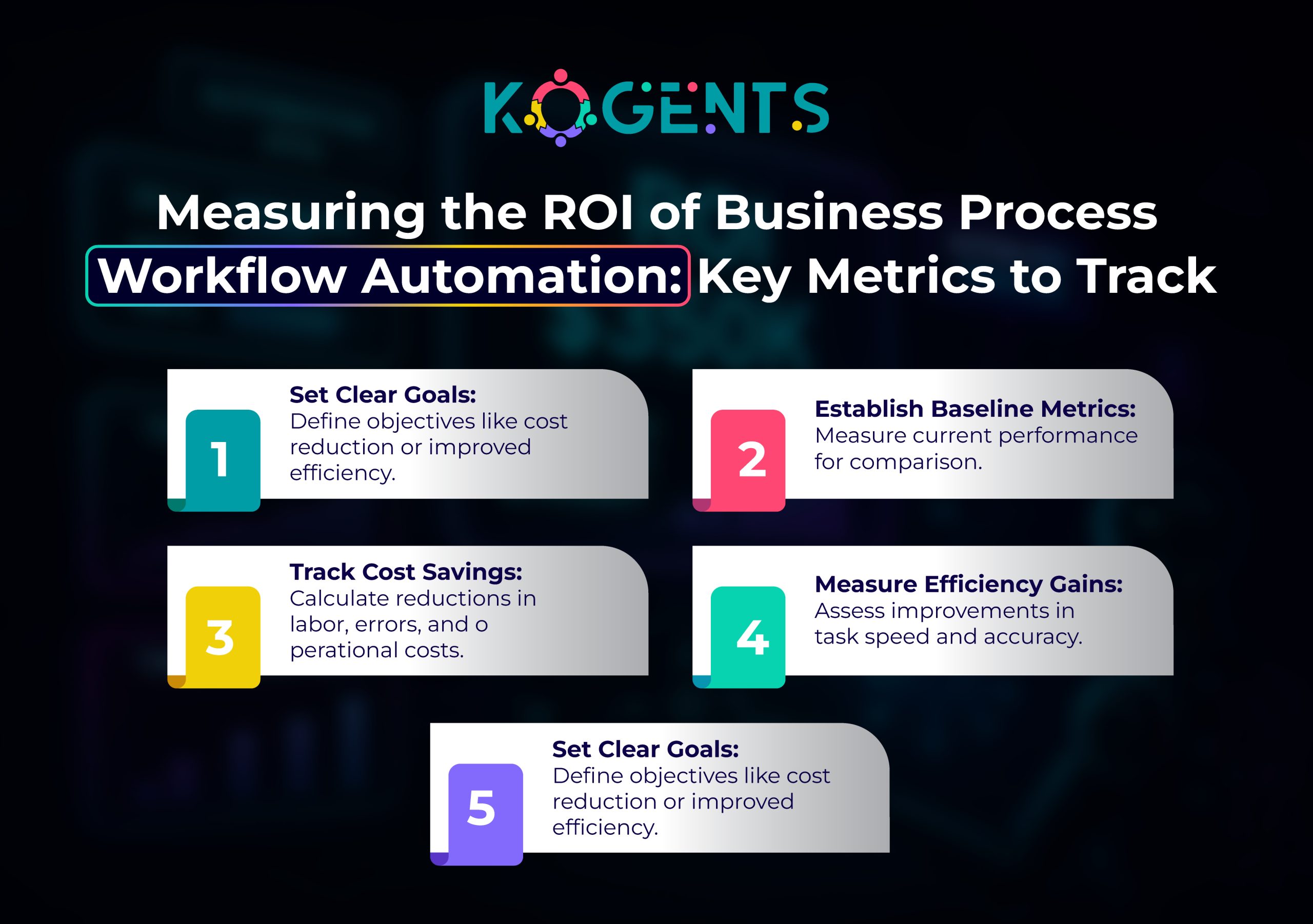
Table: Key Statistics on Business Process Workflow Automation (2024–2025)
| Metric / Insight | Value / Finding | Source |
| Businesses achieving ROI within 12 months of automation implementation | 54–60% | Kissflow & Pointstar Consulting |
| Average annual savings from workflow automation | $46,000 per company | DocuClipper |
| Productivity increases after adopting automation | 66% improvement | Kissflow |
| Share of knowledge workers who report improved job satisfaction due to automation | 90% | Kissflow |
| Global AI agents market growth forecast (2024–2030) | US $5.4 B → US $50.3 B (CAGR ~ 45.8%) | TypeDef AI |
| Business leaders who believe automation improves team efficiency | 70% | Cflow Apps |
| Increase in data accuracy from automation adoption | 88% | Pointstar Consulting |
How Intelligent Orchestration Works with AI Agents?
Intelligent orchestration and AI agents work symbiotically to deliver seamless automation across the business.
Orchestration coordinates the flow of tasks between systems and ensures smooth integration, while AI agents make intelligent decisions at each stage.
Let’s take the example of customer support automation:
- AI Agents: Handle incoming customer queries, analyze customer data, and provide real-time responses. If the query requires human intervention, the AI agent escalates it to the appropriate department.
- Orchestration: If the AI agent needs to access multiple systems (such as CRM, customer order history, and product availability), the orchestration platform ensures these systems work together, ensuring the AI agent has all the data it needs at the right time.
Note: Together, they enable real-time optimization of workflows that are adaptive, scalable, and efficient.
Challenges in Automating Business Processes
Despite the compelling benefits of workflow automation, many businesses face obstacles in implementing these systems effectively.
Why Businesses Struggle to Adopt Workflow Automation?
- Legacy Systems: Many businesses still rely on outdated software that doesn’t integrate easily with modern automation tools.
- Employee Resistance: Some workers fear that automation may replace their jobs, even though it is more about enhancing their roles.
- Cost and Complexity: Implementing workflow automation tools can be costly, especially for smaller companies without the resources to invest in high-end technologies.
Real-World Barriers and Solutions
To address these challenges, companies need a step-by-step strategy for implementing automation.
This includes investing in cloud-based automation tools to avoid the burden of heavy infrastructure, starting small with pilot programs to demonstrate the value of automation, and providing training for employees to ease the transition.
Case Studies: Real Businesses & Real Results
Case Study 1: How a Retail Giant Transformed Its Supply Chain
One of the largest retail companies in the world implemented AI-driven automation to streamline its supply chain management.
Outcome: By using intelligent orchestration and AI agents, they reduced inventory stockouts by 20%, cut lead times by 30%, and significantly improved order fulfillment speed.
Case Study 2: Streamlining HR Operations in a Fortune 500 Company
A leading financial institution, Fortune 500 company automated its HR processes using Robotic Process Automation (RPA) and AI.
Outcome: This resulted in a 40% reduction in administrative tasks, enabling HR to focus on higher-level employee engagement and strategic initiatives.
Case Study 3: Healthcare Workflow Automation and Patient Care Efficiency
A major healthcare provider used workflow automation to optimize patient scheduling and data entry.
Result: By automating these processes, they reduced appointment booking errors by 15% and improved patient throughput by 20%.
Future-Proofing Your Business with AI-Powered Workflow Automation
The future of business relies on business process workflow automation powered by AI agents and intelligent orchestration.
As businesses look to stay competitive, those who invest in these technologies will gain significant advantages in efficiency, agility, and cost savings.
Automation isn’t just a buzzword; it’s a necessity for modern businesses to thrive.
By embracing these technologies, with the help of kogents.ai by your side, your business can unlock new efficiencies, improve customer satisfaction, and scale operations with ease.
FAQs
How does AI-powered workflow automation differ from traditional automation?
AI-powered workflow automation not only automates tasks but also analyzes and optimizes them over time. Traditional automation simply follows predefined rules, while AI-based automation can make real-time decisions based on evolving data.
What industries benefit the most from workflow automation?
Industries like healthcare, e-commerce, finance, manufacturing, and logistics all benefit from workflow automation. AI and orchestration can streamline operations, improve customer experiences, and reduce operational costs across these sectors.
Can AI agents replace human workers entirely?
AI agents are designed to augment human work, not replace it. While they automate repetitive tasks and improve decision-making, human judgment is still essential for complex decision-making and creative processes.
What is the difference between RPA and intelligent orchestration?
RPA (Robotic Process Automation) automates specific tasks or processes that follow clear, defined rules. In contrast, intelligent orchestration coordinates multiple automated systems, managing how tasks and data flow between different systems to create a cohesive, real-time process.
How can small businesses implement workflow automation with AI?
Small businesses can start by identifying high-impact, repetitive tasks—like invoicing, scheduling, or customer support- and introducing affordable, cloud-based tools that use AI to automate these tasks. This allows small businesses to streamline operations without a massive upfront investment.
Is AI-driven workflow automation difficult to implement?
AI-driven workflow automation requires thoughtful planning and integration, but it doesn’t have to be difficult. With cloud-based solutions and modular tools, businesses can gradually automate parts of their workflow, starting with simple tasks and expanding as they become more comfortable with the technology.
How do I measure the success of automation?
Key performance indicators (KPIs) such as time savings, cost reduction, accuracy improvement, and customer satisfaction can help measure the success of automation. You should also monitor how automation impacts employee productivity and whether it leads to more effective decision-making.
What are the risks of automating business workflows?
While automation offers great benefits, risks include system integration failures, data security issues, and employee resistance to change. Proper planning, training, and secure systems are essential to mitigate these risks.
Can AI-driven workflow automation scale with business growth?
Absolutely. AI agents and intelligent orchestration are highly scalable, allowing businesses to automate more processes as they grow, without significant increases in infrastructure or overhead costs.
What is the future of workflow automation with AI?
The future of workflow automation will likely include greater personalization, self-learning systems, and cross-industry collaboration, with AI agents becoming more intelligent and able to handle even more complex tasks.

Kogents AI builds intelligent agents for healthcare, education, and enterprises, delivering secure, scalable solutions that streamline workflows and boost efficiency.