How AI is Used in Recruitment to Break the 30 Year Old Hiring Loop
Summary:
A hiring manager opens the same shared document for the fifth time in one week.
Still no shortlist.
The role has been open long enough for the team to feel it. Customer tickets are stacking up. The founder is stepping into interviews between investor calls. The recruiter is doing everything right on paper: searching, messaging, screening, nudging, scheduling, chasing feedback, and trying to keep candidates warm.
But the process feels strangely old.
There are better job boards now. Better applicant tracking systems. Better dashboards. Better email templates.
Still, the daily rhythm of recruitment often looks like it did decades ago: humans manually search, manually sort, manually compare, manually follow up, and manually remember who needs attention next.
That is why how AI is used in recruitment is no longer just a software question. It is a question about wasted time, missed talent, and whether hiring teams can finally stop treating speed and care like opposites.
Key Takeaways
- AI helps recruitment most when it removes delays, not when it replaces recruiters.
- The biggest gains come from sourcing, screening, matching, scheduling, and candidate engagement.
- Human oversight still matters for fairness, context, and final hiring decisions.
- The smartest teams start small, measure carefully, and keep candidates informed.
Hiring Looks Modern, But Runs on Old Habits
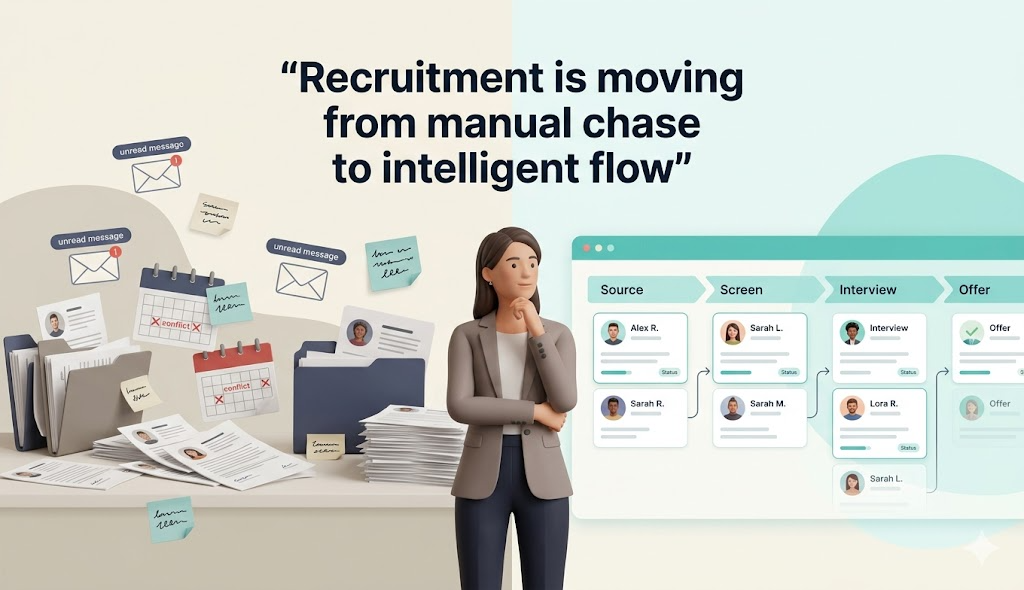
Many hiring teams already use software. That does not mean the work itself has changed.
An ATS can store candidates, but it does not automatically understand urgency. A sourcing tool can show profiles, but it does not decide which ones deserve human attention first. A scheduling tool can remove back-and-forth, but only after someone remembers to move the candidate forward.
This is why recruiters burn out. Not because they dislike people. Usually, it is the opposite. They entered the field because they are good at reading people, building trust, and helping teams make hard decisions.
But the job often buries them in work that does not require their best judgment:
- searching the same talent pools repeatedly
- scanning resumes for basic signals
- Chasing hiring managers for feedback
- rewriting outreach messages
- updating candidates manually
- comparing notes across interviews
- trying to remember which strong candidate is about to go cold
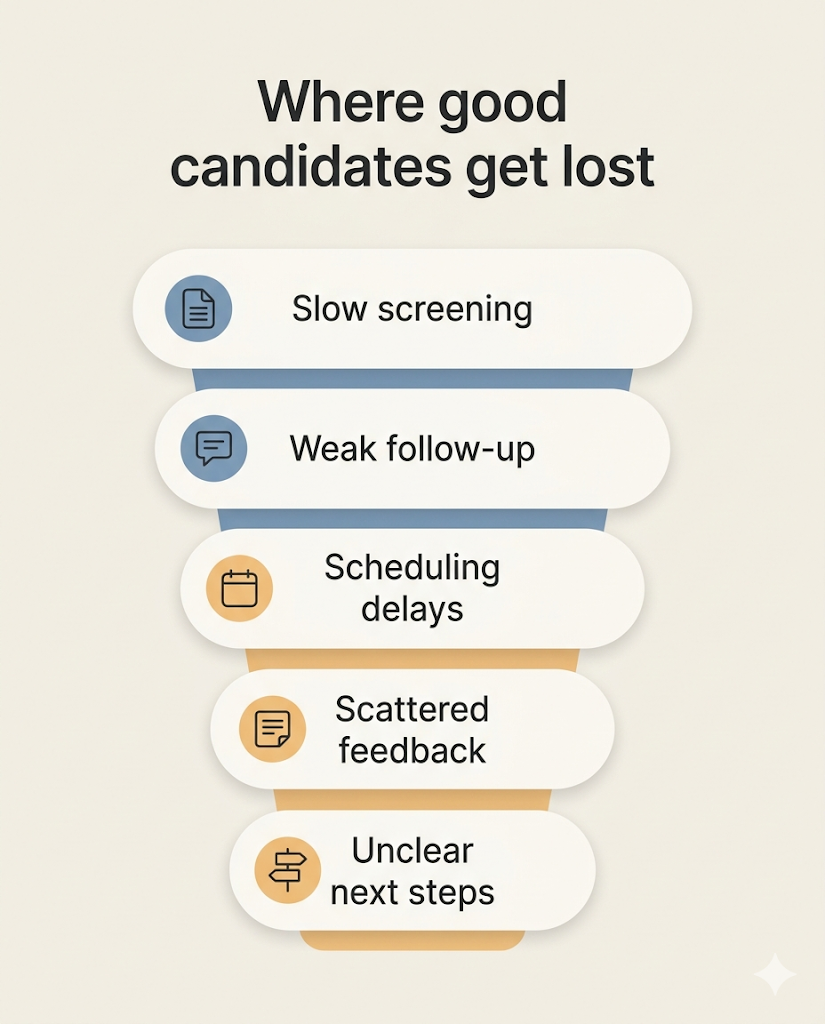
The result is a hiring process where good people get wasted. Not always rejected. Wasted.
They sit in the system too long. They get a generic email. They wait for a second round. They answer the same question twice. They accepted another offer because the process was too slow to feel serious.
AI Recruitment: Faster Shortlists, Clearer Decisions
AI recruitment is the use of artificial intelligence to help companies find, screen, match, communicate with, and organize candidates across the hiring process.
In simple terms, AI does not make hiring “automatic.” Used well, it makes hiring less clogged. It helps teams see qualified people sooner, compare candidates more consistently, reduce manual admin, and keep the process moving before the best applicants lose interest.
That distinction matters.
AI hiring is not valuable because it sounds futuristic. It is valuable when it helps a recruiter spend less time doing spreadsheet work and more time asking better questions. It is valuable when a hiring manager gets a usable shortlist in days instead of weeks. It is valuable when a candidate receives a clear update instead of silence.
How Does AI Help Recruiters Engage Candidates?
AI in recruitment usually shows up in practical places, not dramatic ones.
It helps with the tasks that slow teams down before a meaningful human conversation even happens.
- AI sourcing finds people faster
AI sourcing can search talent databases, past applicants, professional profiles, and internal records to identify people who may fit a role. It can help recruiters find passive candidates, rediscover old applicants, and spot skills that traditional keyword searches may miss.
For example, a recruiter searching for a customer success leader may normally look for the exact title. AI can also surface candidates with account management, onboarding, retention, or implementation experience if those skills match the role.
That is where talent discovery becomes more flexible.
- AI candidate screening creates a better first pass
AI candidate screening can review resumes against job-related criteria and help recruiters prioritize applicants. It can summarize experience, extract skills, compare qualifications, and flag profiles that deserve attention.
The goal should not be blind rejection. The goal should be better triage.
A thoughtful process uses AI to organize the pile, then keeps human review for context. Career changers, people returning from breaks, and candidates with nontraditional paths can be easy to miss when systems are too rigid.
- AI matching connects skills to roles
Candidate matching helps compare job requirements with candidate profiles. Instead of relying only on titles or keywords, AI can look at skills, experience patterns, and role fit.
This is especially helpful as more teams move toward skills-based hiring. A degree, title, or company name may tell part of the story, but skills often tell the more useful part.
- AI scheduling removes unnecessary waiting
Interview scheduling sounds small until it delays a hire by a week.
AI scheduling can coordinate calendars, send reminders, reduce no-shows, and help candidates book the next step without three rounds of email. That keeps momentum alive.
For a strong candidate, momentum is trust.
- AI recruiting assistants keep candidates warm
An ai recruiting assistant can answer common candidate questions, send status updates, explain next steps, collect basic information, and remind people about interviews.
This is where AI can improve candidate experience without pretending to be human. The best candidate communication is clear, timely, and honest. AI can help with the timing. Humans should still own the moments that require empathy, persuasion, negotiation, or nuance.
Responsible AI Recruitment Starts With Accountability
AI can help recruiters move faster. It should not remove accountability.
The U.S. Equal Employment Opportunity Commission has noted that AI and automated technologies can be involved in recruiting, screening, and hiring activities, but employers still need to comply with employment discrimination laws.
That means companies cannot hide behind software. If a tool screens candidates unfairly, applies criteria inconsistently, or disadvantages protected groups, the employer still has a responsibility to understand and manage that risk.
NIST’s AI Risk Management Framework is useful here because it encourages organizations to build trustworthiness considerations into the design, development, use, and evaluation of AI systems.
In recruitment, that means asking practical questions:
- What data is the tool using?
- What criteria does it apply?
- Can the decision logic be explained?
- Can candidates ask for human review?
- Are outcomes being checked for bias?
- Is the tool improving the process or just making bad decisions faster?
Peter Drucker is often credited with the line,
“There is nothing so useless as doing efficiently that which should not be done at all.”
That quote belongs in every AI hiring conversation. Speed is not the same as progress.
The 5-Lever Framework for Better AI Hiring
The best way to use AI in recruitment is to focus on friction. Where is the process slow, repetitive, inconsistent, or unclear?
A simple framework helps.
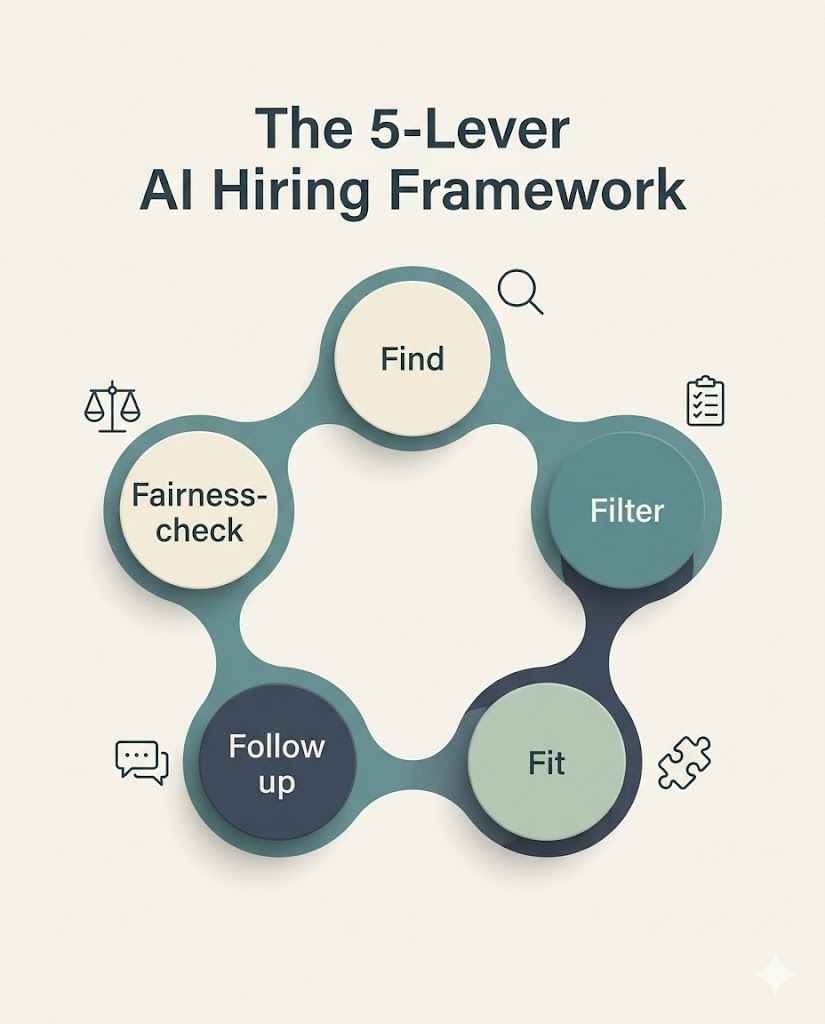
- Find: Use AI sourcing to identify qualified candidates faster.
- Filter: Use structured screening to organize applicants consistently.
- Fit: Match candidates to role requirements using skills and context.
- Follow up: Keep candidates informed with timely updates and reminders.
- Fairness-check: Review outcomes, monitor bias, and keep humans accountable.
Where Can AI Help, and Where Should Teams Slow Down?
| Recruitment area | Where AI helps | What humans should keep | Common mistake |
|---|---|---|---|
| Sourcing | Finds profiles and past applicants faster | Deciding who deserves personal outreach | Treating every AI suggestion as equal |
| Resume screening | Summarizes and organizes applications | Reviewing context and exceptions | Rejecting unusual backgrounds too quickly |
| Candidate matching | Connects skills to job requirements | Judging potential and team needs | Confusing keyword match with true fit |
| Scheduling | Reduces calendar delays | Handling sensitive timing issues | Making the process feel robotic |
| Communication | Sends reminders and basic updates | Trust-building conversations | Hiding behind automation |
| Compliance | Supports logs and consistency checks | Accountability and policy decisions | Assuming the vendor owns the risk |
Where Do Teams Go Wrong With AI Recruiting?
The first mistake is buying tools before fixing the process.
If the hiring team has unclear criteria, AI will not solve that. It may simply apply unclear criteria faster.
The second mistake is using AI only as a filter. That can make hiring feel colder. Strong AI recruitment software should also improve engagement, follow-up, and visibility.
Pew Research Center found that 66% of Americans would not want to apply for a job with an employer that uses AI to help make hiring decisions, and 71% oppose AI making final hiring decisions, which shows why AI recruiting should support human review, communication, and fairness instead of becoming a silent filter.
The third mistake is leaving hiring managers out. If managers still take a week to review profiles, the process is not truly faster. AI can create a shortlist quickly, but humans still need to respond.
The fourth mistake is treating fairness as a one-time vendor promise. Fairness has to be monitored. Hiring teams should review candidate outcomes, rejection patterns, appeal requests, and feedback loops.
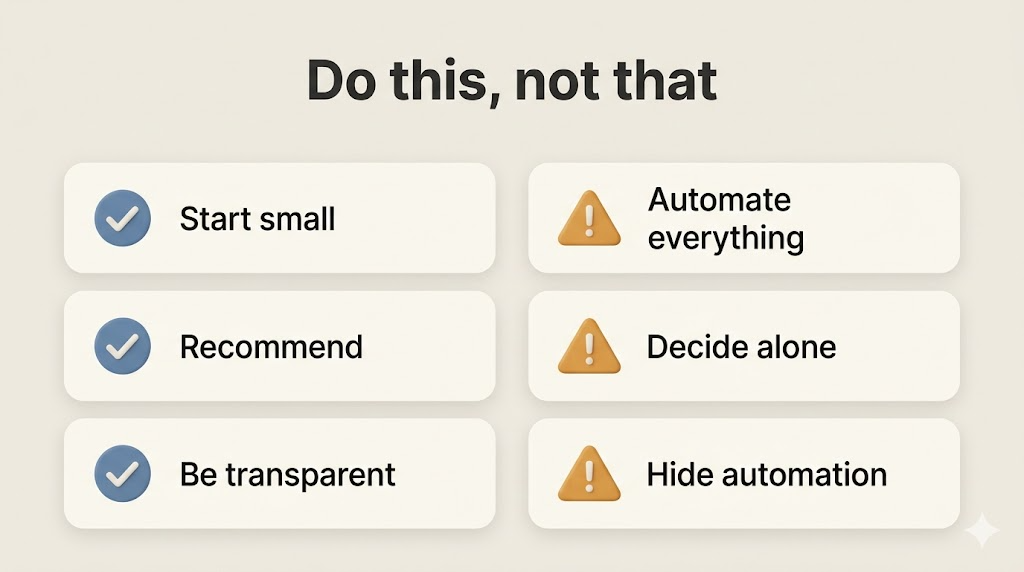
Do this, not that
Do this: Start with one hiring bottleneck.
Not that: Automate the whole funnel at once.
Do this: Use AI to recommend and summarize.
Not that: Let AI make final decisions without review.
Do this: Tell candidates when automation is part of the process.
Not that: Pretend every message is manually written.
Do this: Measure speed, quality, fairness, and candidate experience.
Not that: Measure only time saved.
How Does Slow Hiring Cost You Good Candidates?
Picture a growing company hiring a customer success manager.
There are 380 applications. The recruiter spends the first two days removing obvious mismatches. Then a few more days comparing resumes. Then another day waiting for feedback. By the time five candidates are ready for first-round calls, two have gone quiet and one has already accepted another offer.
Nobody failed dramatically.
The process simply moved too slowly.
Now imagine the same search with AI used carefully. The system groups applications by relevant skills, flags strong transferable experience, summarizes each profile, helps schedule calls, and sends candidates clear updates. The recruiter still reviews the shortlist. The hiring manager still makes the decision. But the team gets to the human conversation sooner.
That is the practical promise of AI in recruitment and selection. It does not need to be dramatic. It needs to be useful.
How Can Teams Start Without Overcomplicating AI?
A smart AI recruitment strategy starts with one pain point, not a giant transformation project.
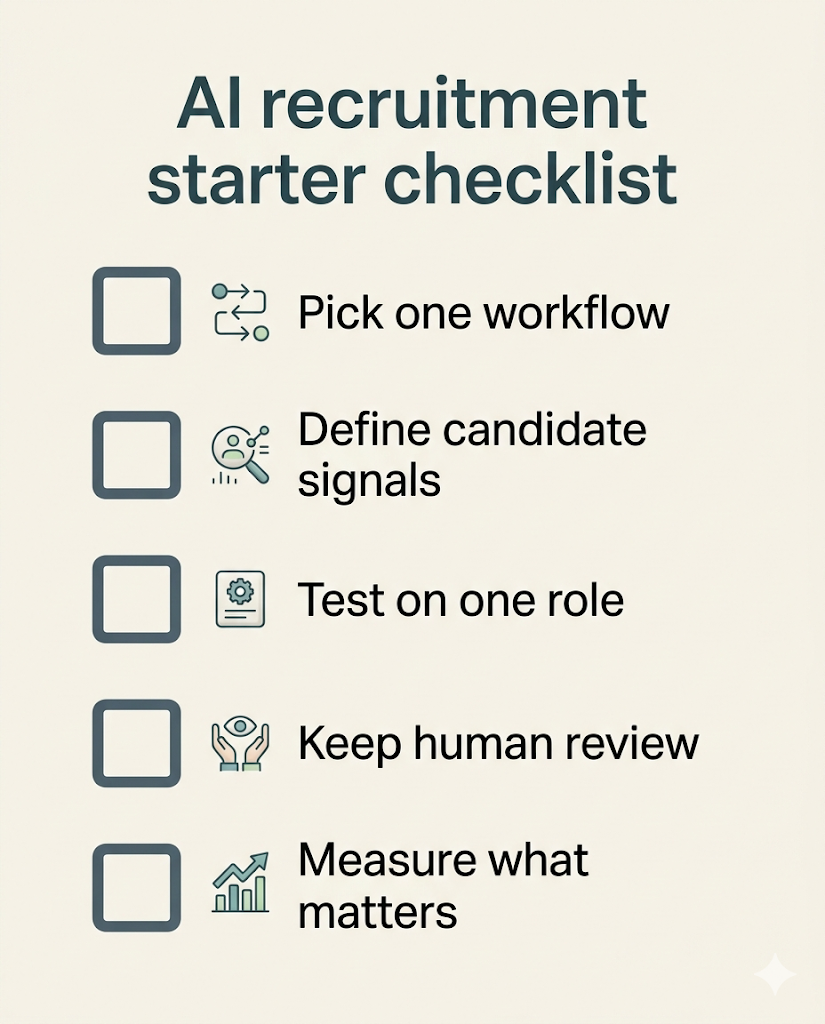
Use this simple checklist:
- Choose one hiring workflow that is slow or repetitive.
- Define what a good candidate signal actually means for that role.
- Test AI on a small group of roles before expanding.
- Keep human review at key decision points.
- Measure speed, candidate experience, quality, and fairness together.
How Should Teams Measure AI Recruitment Success?
If the only metric is “time saved,” AI can push teams toward shallow automation.
A better scorecard includes four categories.
Speed: time to shortlist, time to interview, time to feedback.
Quality: hiring manager satisfaction, role fit, early performance signals.
Experience: candidate response time, drop-off points, clarity of communication.
Fairness: review patterns, selection consistency, demographic impact where legally and appropriately measured.
This is where AI hiring becomes more mature. The question is not “Did the system move faster?” The better question is, “Did the process become faster, clearer, fairer, and more useful?”
AI Support for Recruiters, Managers, and Candidates
AI helps HR teams by reducing repetitive hiring work and creating more consistent workflows. It can support resume screening, candidate sourcing, interview scheduling, status updates, structured notes, and reporting.
For recruiters, that means fewer hours lost to admin.
For hiring managers, it means fewer long waits for usable shortlists.
For candidates, it can mean faster replies and a clearer path through the process.
But there is a human lesson here: people do not want to feel processed. They want to feel seen. AI should help teams create more space for real attention, not less.
Can Teams Keep Candidate Trust While Using AI?
This is the part many teams underestimate.
A candidate may accept automation if it is fast, clear, and respectful. They may resent it if it feels secretive, careless, or impossible to question.
Trust improves when companies:
- explain when AI is used
- keep communication plain and human
- offer a path to human review
- avoid over-claiming what AI can know
- use structured criteria tied to the role
- protect candidate data carefully
Candidate experience is not a soft issue. It affects whether strong people stay in the process.
The Next Era of AI in Recruitment
The future of AI recruitment is likely to be more agentic, more skills-based, and more integrated.
AI may help recruiters draft outreach, recommend candidates, update pipelines, prepare interview guides, analyze hiring bottlenecks, and surface internal mobility opportunities. Generative AI in recruitment will likely make communication and content creation faster, while talent intelligence tools will help companies understand skills gaps before roles even open.
But the strongest teams will not be the ones that automate the most.
They will be the ones that know what to automate and what to protect.
The human parts of hiring are still hard to replace: trust, persuasion, judgment, context, negotiation, and the ability to see potential where a profile looks imperfect.
AI Shows What Human Recruitment Still Does Best
Recruitment has not been stuck because recruiters lack effort. It has been stuck because too much of the process depends on manual memory, manual sorting, and manual follow-up.
AI changes that.
Used well, it helps teams find stronger candidates faster, screen more consistently, keep people informed, and reduce the waiting that causes great applicants to disappear. Used poorly, it can make hiring colder, faster, and less accountable.
That is the line HR leaders and operators need to walk.
The goal is not to hand hiring over to machines. The goal is to stop wasting human judgment on tasks that software can support, so people have more time for the work that actually decides a hire.
That is the real answer to how AI is used in recruitment: it helps remove the drag from the process, while humans keep responsibility for the decision.
Ready to make hiring faster, clearer, and more human?
Discover how Kogents can help your team build a smarter recruitment workflow that keeps great candidates moving and gives recruiters more time for the conversations that matter.
Start the conversation today:
Phone: +1 (267) 248-9454
Email: [email protected]
Audio Summary (Separate Voice Version)
Recruitment has changed on the surface, but many teams still rely on slow manual sourcing, screening, scheduling, and follow-up. AI helps by removing the bottlenecks that cause good candidates to disappear before the next round. The best approach is not to replace recruiters, but to use AI for repetitive work while humans keep responsibility for judgment, fairness, and trust. Start small, measure carefully, and make the process faster without making it feel less human.
FAQ
What is AI recruitment?
AI recruitment is the use of artificial intelligence to help source, screen, match, communicate with, and organize candidates during the hiring process.
How is AI used in recruitment?
AI is used for candidate sourcing, resume screening, skills matching, interview scheduling, chatbot communication, structured notes, and hiring workflow analysis.
How does AI screen resumes?
AI reads resumes by identifying skills, experience, qualifications, job history, and role-related keywords, then organizing candidates based on the criteria set by the hiring team.
Can AI reject a resume?
AI can recommend that a candidate is not a strong match, but responsible hiring teams should avoid fully automated rejection without clear criteria, testing, and human review.
What are the benefits of AI in recruitment?
The main benefits are faster shortlists, less manual admin, more consistent screening, better candidate communication, and stronger visibility into hiring bottlenecks.
What are the risks of AI in recruitment?
The biggest risks are bias, poor transparency, weak data privacy, over-automation, and missing candidates with nontraditional but valuable backgrounds.
Will AI replace recruiters?
AI may automate repetitive tasks, but recruiters are still needed for judgment, relationship-building, candidate trust, negotiation, and final hiring decisions.
How can companies implement AI in recruitment?
Start with one workflow, define role-related candidate signals, test the tool on a small hiring process, keep human review, and measure speed, fairness, quality, and candidate experience.
How can kogents help with AI recruitment?
Kogents can be positioned as a partner for teams that want faster, more consistent hiring workflows without removing human oversight from important decisions.
What should companies ask Kogents before using AI hiring tools?
They should ask how the system supports transparency, candidate communication, human review, data privacy, integration with current workflows, and fair screening practices.

Kogents AI builds intelligent agents for healthcare, education, and enterprises, delivering secure, scalable solutions that streamline workflows and boost efficiency.