Cost And Pricing Models for Legal AI Agents
Summary:
Well, you presented the business case perfectly.
You showed the managing partners how your team wastes 340 hours monthly on contract redlines.
You demonstrated how competitors cut legal spending by using legal automation software. You even got three vendor quotes.
Then came the board meeting.
“So… why does Vendor A charge $18,000 annually, Vendor B wants $127,000, and Vendor C won’t give us a number without a six-week ‘discovery process’? Are they even selling the same thing?”
You froze. Because honestly? You weren’t sure either.
Here’s what’s really happening: Three salespeople are describing fundamentally different business models using identical buzzwords.
One is selling you document automation templates.
Another is pitching enterprise workflow orchestration.
The third is actually staffing an entire digital transformation consulting engagement disguised as software licensing.
This guide delivers the forensic breakdown of how the legal automation pricing actually works, the pricing model structures, the hidden fees that double your first-year costs, the negotiation tactics that save 30%, and the TCO calculations that get CFO approval in one meeting.
Ready to turn that budget rejection into approval? Let’s decode the pricing game together.
Key Takeaways
- Per-user licensing costs law firms with high turnover significantly more than workflow-based pricing over three years.
- Onboarding costs and integration work often exceed annual subscription pricing in a year.
- Hidden scalability limits trigger mid-contract price jumps, as most legal automation pricing models include usage caps that require tier upgrades as adoption grows.
- ROI calculation requires 18-month minimum horizons: Legal process automation pricing pays back faster than contract lifecycle management due to lower implementation complexity.
- Enterprise licensing saves per-seat pricing at 50+ users: Enterprise legal automation pricing provides better total cost of ownership for larger legal departments.
What Drives Legal Automation Pricing Structures?
Legal automation pricing operates at the intersection of software licensing economics and professional services complexity.
Unlike consumer SaaS, legal workflow automation pricing must account for:
Regulatory compliance requirements force vendors to maintain ISO 27001 certification, SOC 2 Type II compliance, and GDPR compliance infrastructure; costs are passed to customers through base platform fees.
Gartner predicts legal technology spending will increase to approximately 12% of in-house budgets by 2025, a threefold increase from 2020 levels.
Integration depth determines implementation fees. A no-code / low-code platform connecting to existing CRM, billing, and case management systems requires less custom development than API-based pricing models demanding bespoke integrations.
Legal tech stack consolidation projects typically budget $40,000-$180,000 for integration work alone.
Workflow customization complexity directly impacts pricing.
Rule-based automation for standardized NDAs costs less than AI-powered workflows analyzing merger agreements.
The Anatomy of Legal Automation Pricing Models
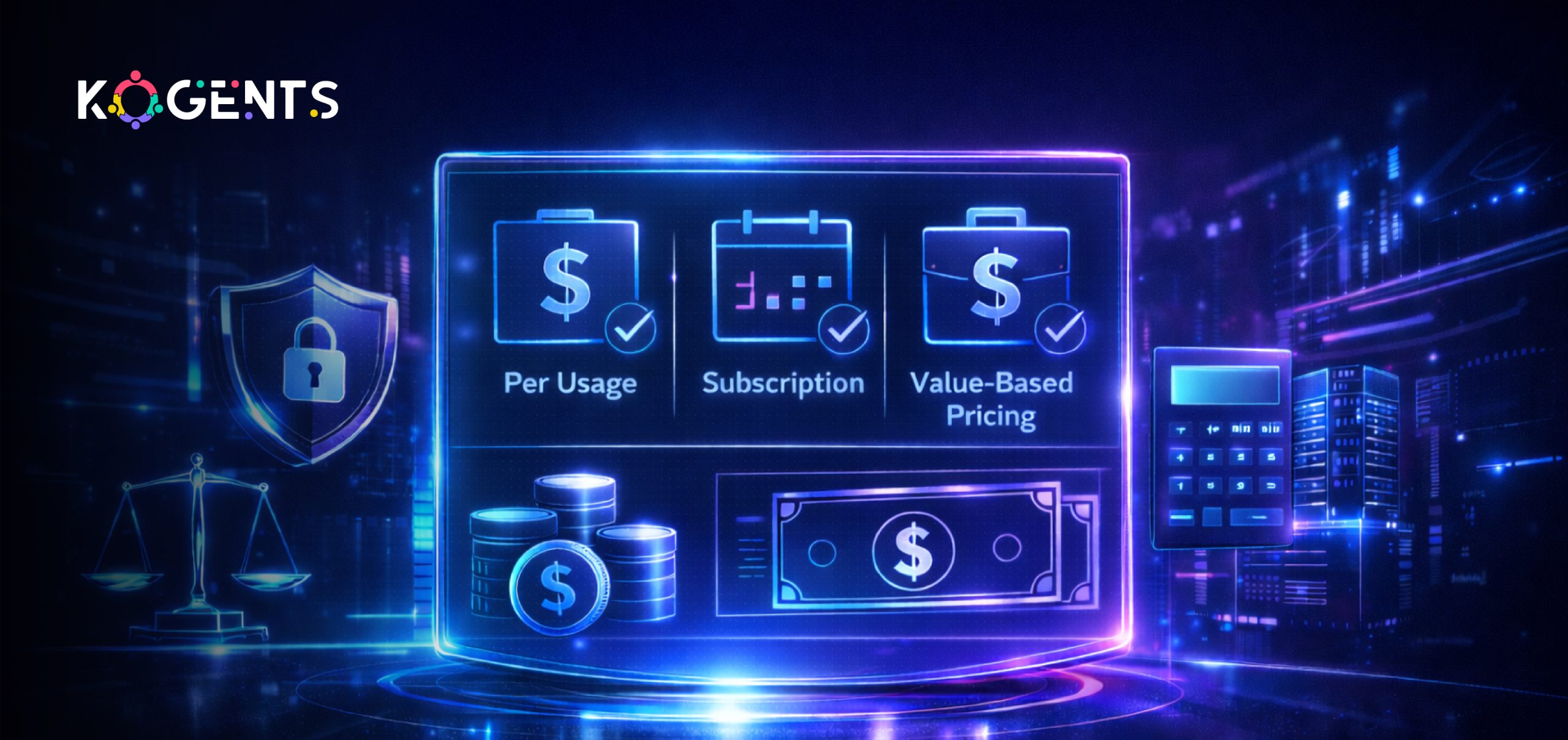
Modern legal automation tools’ pricing employs six primary structures: Per-user pricing ($40-$250/user/month) suits firms with stable attorney headcounts.
Ironclad and DocuSign favor this model, charging for each credentialed user regardless of usage intensity.
Hidden trap: Most contracts define “users” as anyone accessing documents, not just power users, inflating actual costs.
Per-workflow pricing ($500-$5,000/workflow/month) aligns costs with process automation value.
Appian pioneered this for legal process optimization, billing based on automated workflow types (contract approvals, compliance checks, litigation holds).
Advantage: Predictable scaling as you add workflow orchestration capabilities. Usage-based pricing ($0.05-$2.00 per transaction) charges for actual automation events.
UiPath applies this to document automation tasks; every contract generated, clause extracted, or signature collected triggers a micro-charge. Best for high-volume, low-touch processes.
Enterprise licensing (flat $50,000-$500,000 annually) provides unlimited access within negotiated parameters.
ContractPodAi offers this for organizations exceeding 100 users or 10,000 contracts annually. Includes support SLAs and priority training & onboarding.
Modular pricing combines base platforms ($15,000-$40,000/year) with optional modules ($3,000-$15,000 each) for contract lifecycle management, compliance automation, or analytics.
Provides flexibility but complicates total cost of ownership calculations.
API-based pricing charges per API call or data volume.
Developer-focused platforms bill $0.001-$0.10 per API request, suitable for firms building custom legal operations tools atop automation infrastructure.
Comprehensive Cost Breakdown: Beyond Sticker Prices Initial Implementation Investment
Legal automation pricing discussions fixate on annual subscriptions, while implementation complexity determines first-year reality:
| Cost Component | Typical Range | % of First-Year
Cost |
Duration |
| Platform License | $20,000-$180,000 | 25-40% | Recurring |
| Implementation &
Setup |
$15,000-$120,000 | 30-45% | One-time |
| Integration Work | $8,000-$75,000 | 15-25% | One-time |
| Training & Onboarding | $5,000-$35,000 | 10-15% | One-time |
| Data Migration | $3,000-$25,000 | 5-10% | One-time |
| Total First Year | $51,000-$435,000 | 100% | Mixed |
Support & maintenance fees (15-22% of license cost annually) become recurring expenses often excluded from initial quotes.
Enterprise SLA frameworks providing 24/7 support add $8,000-$40,000 yearly but prevent costly downtime.
Hidden Costs That Destroy Budgets
Scalability limits buried in contracts trigger surprise invoices.
A firm licensed for “up to 50 users” pays overage fees of $75-$150 per additional user when hiring expands headcount.
Usage-based pricing models include “fair use” thresholds; exceeding 10,000 monthly documents might double per-document costs.
Customization fees for legal process automation beyond templates run $150-$350 hourly. Building a custom AI-powered workflow for specialized litigation discovery could cost $25,000-$80,000 beyond base licensing.
Integration maintenance requires ongoing investment.
Training refreshers for staff turnover or platform updates add $1,200-$5,000 per session.
Operational efficiency gains depend on user adoption; inadequate training undermines ROI analysis.
Best legal automation pricing depends on organizational context:
Enterprise-grade platforms (Ironclad, ContractPodAi) target legal departments managing 5,000+ contracts annually.
Enterprise legal automation pricing starts at $75,000-$150,000 but includes unlimited users, advanced workflow orchestration, and dedicated implementation & setup teams.
These platforms emphasize compliance risk reduction through built-in regulatory libraries.
Mid-market solutions (DocuSign CLM, Appian) balance functionality and affordable legal automation software positioning.
Pricing ranges $30,000-$90,000 annually for 25-100 users.
Strong contract lifecycle management capabilities with moderate customization fees. Gartner rates these as optimal cost vs manual processes alternatives for regional firms. Real-World Pricing Benchmarks
A legal automation pricing comparison of comparable 50-attorney firm deployments:
- Vendor A (per-user model): $125/user/month = $75,000 annual license + $32,000 implementation = $107,000 first year
- Vendor B (workflow model): $2,800/workflow/month × 4 workflows = $134,400 annual + $48,000 implementation = $182,400 first year
- Vendor C (enterprise license): $95,000 flat annual + $55,000 implementation = $150,000 first year
By year three, assuming 10% user growth and stable workflows:
- Vendor A: $247,500 total (license inflation + user growth)
- Vendor B: $403,200 total (added 2 workflows in year two)
- Vendor C: $314,700 total (flat licensing, modest increases)
The “cheapest” option depends on growth trajectory and automation maturity. Case Studies: ROI in Action
Case Study 1: Regional Law Firm’s Per-User Pivot
Challenge: 35-attorney insurance defense firm spending $180,000 annually on contract management inefficiencies.
Solution: Implemented legal workflow automation pricing model at $95/user/month ($39,900 annual license) with $28,000 implementation.
Results: Achieved legal automation ROI of 340% by month 18. Reduced contract review time by 14 hours weekly (worth $126,000 annually at $175/hour rates).
Total cost of ownership over three years: $147,700 versus projected $540,000 in manual labor costs.
Case Study 2: Fortune 500 Legal Department’s Enterprise License
Challenge: A 200-person legal team across 12 jurisdictions needed unified compliance automation and contract lifecycle management.
Solution: Negotiated enterprise legal automation pricing at $220,000 annually (unlimited users) with $140,000 implementation covering process standardization and legal tech stack integration.
Results: Consolidated seven disparate systems, saving $85,000 in redundant software licensing.
Improved operational efficiency by reducing contract approval cycles from 11 days to 2.3 days. The ROI calculator showed a 28-month payback period despite high upfront costs.
Building Your Legal Automation Pricing Strategy Accurate legal automation cost assessment requires 36-month TCO modeling:
TCO Formula: (Annual License × 3) + Implementation + (Annual Support × 3) + Integration Maintenance + Training + (Scalability Buffer × 3) = True 3-Year Cost
Scalability buffer (15-25% of annual license) accounts for user growth, workflow additions, and usage-based pricing overages.
Example: $60,000 annual license + $45,000 implementation + ($12,000 support × 3) + ($8,000 integration × 3) + $15,000 training + ($12,000 buffer × 3) = $276,000 true TCO vs. $180,000 naive calculation (license only).
Negotiation Strategies for Better Pricing
Multi-year commitments unlock 15-30% discounts on legal automation pricing models. Vendors prefer predictable revenue, offering 36-month contracts for reduced per-seat pricing. Bundled services reduce implementation complexity costs.
Negotiate fixed-price implementation, including training & onboarding, data migration, and first-year support SLAs rather than hourly services.
Phased rollouts spread costs while proving value.
Start with high-ROI workflow automation (contract approvals), generating savings that fund later digital transformation in law phases (compliance risk reduction, case management systems).
Competitive bidding leverages vendor evaluation dynamics.
Transparent legal automation pricing comparison forces vendors to sharpen pencils; one client secured a 34% reduction by presenting competing quotes.
Right-Sizing Your Investment
Automation maturity assessment prevents over-buying.
Firms in the process standardization phase need different capabilities than those pursuing AI-powered workflows:
- Early-stage (digitizing paper): $15,000-$40,000 document automation tools ● Growth-stage (automating repeatable workflows): $40,000-$120,000 workflow orchestration platforms
- Mature-stage (predictive analytics, AI): $120,000-$350,000 legal operations suites Making Informed Legal Automation Investment Decisions
Legal automation pricing complexity shouldn’t paralyze digital transformation in law initiatives.
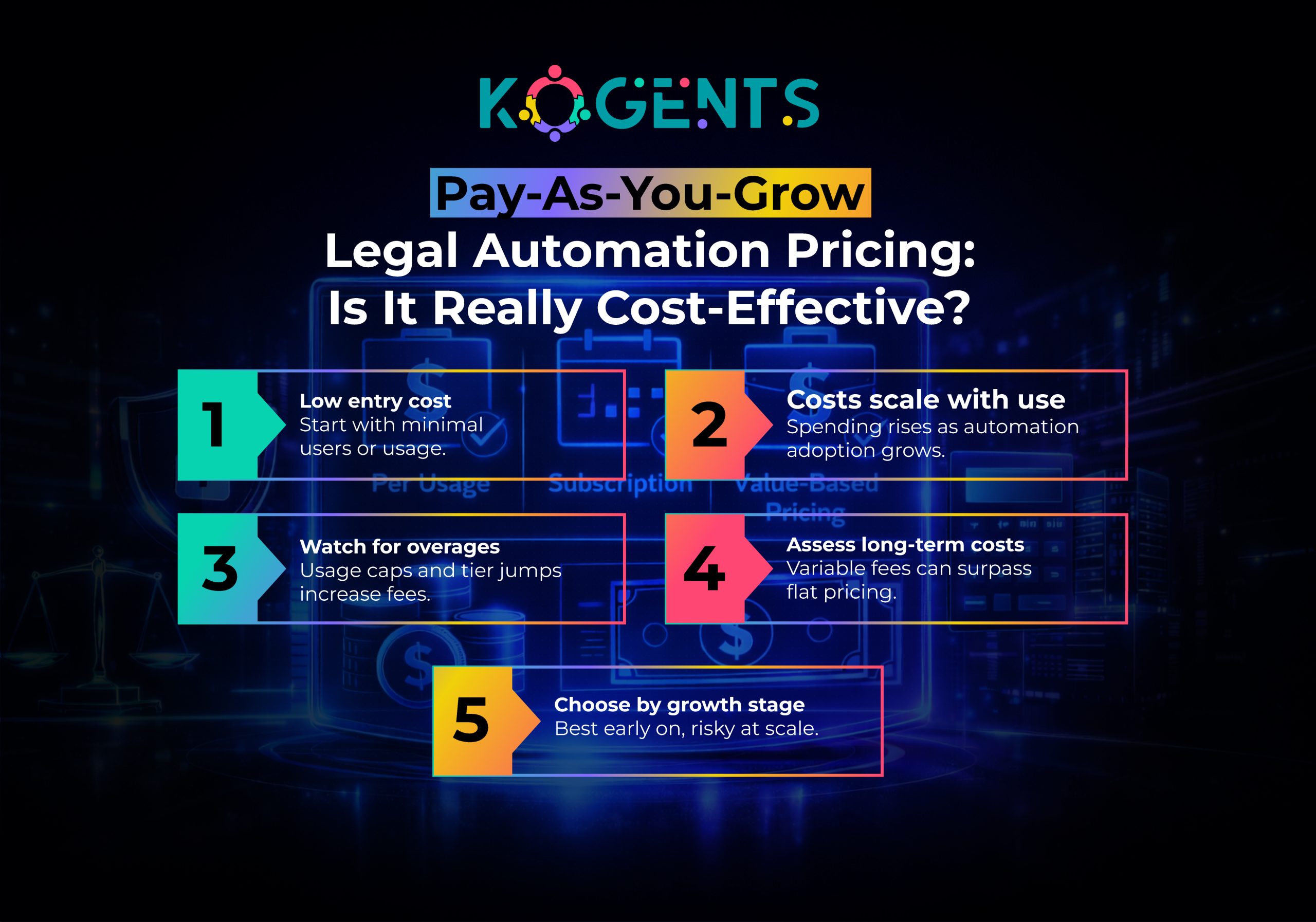
The firms achieving operational efficiency gains understand that pricing models serve different automation maturity stages: per-user pricing for broad adoption, workflow-based licensing for targeted process optimization, and enterprise legal automation pricing for scaling organizations.
Successful deployments prioritize total cost of ownership over sticker prices, accounting for implementation fees, integration depth, and scalability limits.
Kogents.ai delivers enterprise-grade legal AI agents with transparent, scalable legal automation pricing models.
Our consultative approach includes upfront total cost of ownership modeling, fixed-price implementation & setup, and ROI guarantees tied to your workflow orchestration goals.
Whether you need document automation, full contract lifecycle management, or custom AI-powered workflows, Kogents eliminates pricing surprises while accelerating your digital transformation in law.
FAQs
How much does legal automation typically cost for a small law firm?
Small firms (5-20 attorneys) typically invest $12,000-$45,000 annually for legal automation software pricing, including per-user pricing models ($60-$180/user/month) and basic implementation fees ($8,000-$25,000 one-time). Affordable legal automation software options using usage-based pricing can start at $8,000 annually for limited document automation capabilities.
What are the hidden costs in legal automation pricing that buyers overlook?
The most expensive oversights include integration maintenance ($5,000-$15,000 annually), scalability limits triggering overage fees (20-40% of base license when exceeded), ongoing customization fees ($150-$350/hour), staff training refreshers ($1,200-$5,000 per session), and support & maintenance fees beyond basic SLAs (15-22% of license cost). These add 40-60% to advertised pricing over three years.
Is per-user pricing or per-workflow pricing better for law firms?
Per-user pricing suits firms with stable headcounts and broad user needs, offering predictable budgeting at $40-$250/user/month. Per-workflow pricing ($500-$5,000/workflow/month) benefits firms automating specific, high-volume processes like contract approvals or compliance checks. For firms exceeding 50 users, enterprise licensing typically provides better total cost of ownership (52% savings versus per-seat pricing according to Gartner).
How long does it take to see ROI from legal automation investments?
Legal automation ROI timelines average 14-28 months, depending on implementation scope. Simple document automation pays back within 8-14 months due to immediate efficiency gains, while comprehensive contract lifecycle management requires 18-36 months, given higher implementation complexity. The American Bar Association reports a median ROI of 412% over three years for mid-market deployments.
What pricing model do enterprise legal departments typically use?
Enterprise legal automation pricing overwhelmingly favors flat annual licensing ($75,000-$500,000), providing unlimited users within negotiated parameters. This model eliminates per-seat unpredictability and includes robust support SLAs, training & onboarding, and customization fees within base pricing. Forrester data shows 78% of Fortune 1000 legal departments use enterprise licenses versus consumption-based models.
Can I negotiate legal automation software pricing?
Yes, vendor evaluation creates leverage. Multi-year commitments (36+ months) unlock 15-30% discounts, competitive bidding reduces prices 20-35% on average, and bundling implementation & setup with licensing saves $15,000-$45,000 versus à la carte services. Vendors offer end-of-quarter/year-end concessions; timing negotiations accordingly improves outcomes. One legal tech stack buyer saved $73,000 (34% reduction), presenting three competing quotes.
What factors most significantly impact legal automation costs?
Implementation complexity drives first-year costs (30-45% of total), integration depth with existing case management systems and legal tech stack platforms adds $8,000-$75,000, regulatory compliance requirements (ISO 27001 certification, SOC 2 Type II compliance) inflate base pricing 18-23%, and workflow customization beyond templates costs $150-$350 hourly. User count, contract volume, and automation maturity determine appropriate pricing models.
How do legal automation pricing models compare to contract lifecycle management (CLM) pricing?
Legal process automation pricing generally costs 30-50% less than full contract lifecycle management platforms ($15,000-$80,000 vs $40,000-$180,000 annually) but offers narrower functionality. CLM includes contract lifecycle management, analytics, risk scoring, and
obligation tracking, while legal workflow automation pricing focuses on process automation and document automation. Organizations needing comprehensive contract governance justify CLM premiums; those automating discrete workflows prefer leaner tools.
Are there affordable legal automation options for solo practitioners or very small firms?
Affordable legal automation software targeting solo/small practices includes usage-based pricing models starting at $50-$200/month with no implementation fees, no-code / low-code platforms offering free tiers (limited workflows), and specialist document automation tools ($8,000-$15,000 annually). Cloud-based solutions eliminate infrastructure costs. However, onboarding costs reduction depends on the willingness to self-implement versus professional training & onboarding services.
What should be included when calculating the total cost of ownership for legal automation?
Comprehensive total cost of ownership includes: annual software licensing (36-month horizon), one-time implementation & setup fees, integration with existing systems plus ongoing integration maintenance, initial and refresher training & onboarding, support & maintenance fees beyond basic tiers, customization fees for specialized workflows, scalability buffer (15-25% annually) for user/volume growth, and potential migration costs if switching vendors. This typically adds 180-240% to year-one license costs across three years.

Kogents AI builds intelligent agents for healthcare, education, and enterprises, delivering secure, scalable solutions that streamline workflows and boost efficiency.