How AI Agents Accelerate Low-Code Workflow Automation in Enterprise Environments
Summary:
In the modern enterprise, innovation moves at the speed of change, and agility determines who leads.
That’s why the combination of low-code workflow automation and intelligent AI agents has emerged as a game-changer for businesses looking to fast-track digital transformation.
Imagine this: instead of waiting months for IT to code a workflow from scratch, a business user drags and drops workflow blocks, then an AI agent reasons across systems, triggers tasks, adjusts on the fly, and reports analytics, all while adhering to enterprise governance.
That’s the future-now of how workflows get automated.
If you’re in charge of operations, transformation, business process automation (BPA) or IT infrastructure in an enterprise environment, you’ll want to stay ahead of this wave.
Key Takeaways
- Empower business users while reducing IT backlog and accelerating time-to-value.
- Fuse low-code visual workflow design with AI-agent reasoning to achieve adaptive, context-aware automation and workflow orchestration.
- Achieve enterprise scalability, governance, security, and integration via a low-code automation platform for workflows that support AI agents and analytics.
- Overcoming legacy systems, shadow IT, compliance/regulation, and maintaining lifecycle monitoring & analytics are critical success factors.
- Selecting the right vendor means choosing one that offers a drag-and-drop workflow builder, pre-built templates, integration connectors, a business rules engine, governance, and supports agentic automation.
What is Low-Code Workflow Automation?
Low-code workflow automation refers to platforms that enable users to design, deploy, and manage workflows visually rather than through extensive coding.
These systems combine drag-and-drop workflow builders, pre-built templates, and modular, reusable components to streamline process automation while maintaining flexibility for developers to extend functionality with code when needed.
Modern low-code platforms typically include:
- Visual workflow design: Build and modify processes through a graphical interface.
- Pre-built templates and components: Accelerate common use cases like onboarding, invoicing, or contract approvals.
- Integration connectors: Seamlessly connect with existing systems such as CRM, ERP, or databases.
- Business rules engine: Define and manage decision logic independently from process flow.
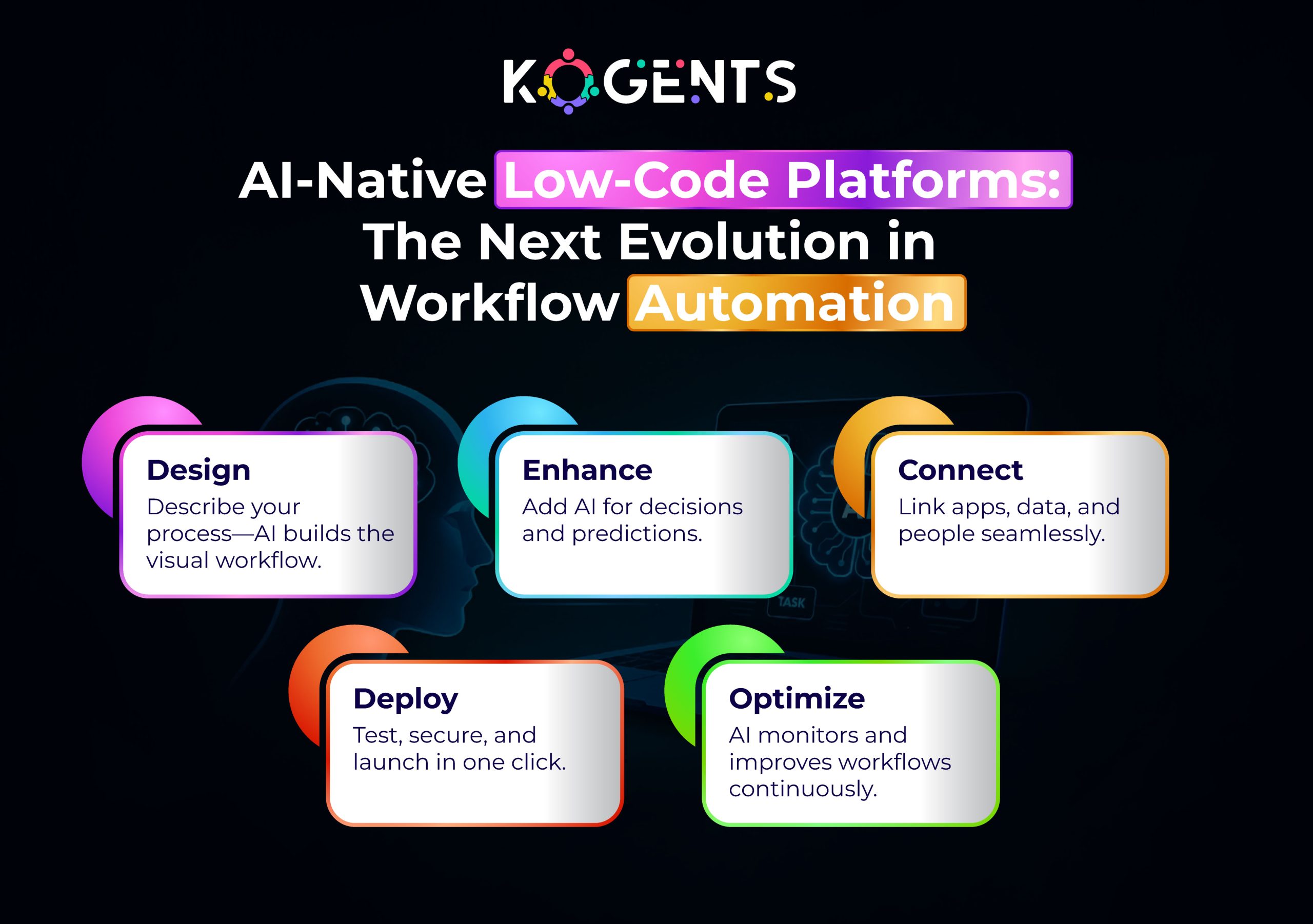
- Workflow orchestration & lifecycle management: Coordinate tasks across systems, monitor performance, and optimize workflows.
Low-Code vs No-Code Workflow Automation
- Low-code platforms allow for visual workflow creation with the option for developers to extend functionality using code, ideal for mixed technical and business teams.
- No-code platforms are designed entirely for non-technical users, offering only drag-and-drop tools and pre-defined options without the need to code.
The Rise of AI Agents in Enterprise Automation
AI agents in an enterprise context refer to software entities that can act autonomously or semi-autonomously: they interpret goals or triggers, reason through decisions, trigger workflows, integrate across systems, and learn/adapt over time.
They go beyond traditional rule-based workflows or bots; these are intelligent, context-aware agents.
Example: An AI agent workflow is a process where AI agents make decisions and complete tasks with little to no human input to streamline complex operations.
Why Enterprises are Adopting them Now?
There are several drivers:
- The backlog of IT projects and manual workflows is enormous; enterprises need faster time-to-value.
- Traditional workflow engines and automation tools struggle with complexity, exceptions, and unstructured data.
- AI agents enable adaptive automation: they can reason, orchestrate, collaborate across systems and humans.
- When combined with low-code platforms, you enable citizen developers to build workflows, then deploy AI agents that coordinate them, giving enterprise scale and intelligence.
How AI Agents Accelerate Low-Code Workflow Automation in Enterprises?
Let’s break down how.
a) Faster time to value, citizen developer empowerment, business user automation
- With a true low-code workflow automation platform, business users (not just IT) can build workflows using drag-and-drop, visual workflow design, and pre-built templates.
- Now add an AI agent: the agent can monitor workflow triggers, invoke tasks, handle exceptions, and even reason when new conditions arise.
This means:
- Workflows can be deployed more quickly (reducing time-to-value).
- Business users and citizen developers can iterate on workflows faster.
- The IT backlog is reduced, and IT teams can focus on strategic initiatives rather than routine workflows.
- Workflow automation becomes truly collaborative between business and IT.
b) Integration, orchestration, and adaptive behaviour
Consider:
- The workflow engine triggers tasks; the AI agent understands context, chooses which sub-workflow or human intervention is needed, and triggers connectors to legacy systems.
- The modular workflow components built in the low-code platform can be composed dynamically.
- The AI agent monitors analytics (workflow monitoring & analytics) and can suggest optimisations, or re-route tasks when anomalies appear.
- With process orchestration, business process automation (BPA) becomes more intelligent and less brittle.
c) Visual modelling + AI reasoning: bridging the gap
- One of the pain points of workflow automation is the gap between business process mapping/design and execution.
- Low-code platforms with visual modelling (drag-and-drop) allow business users to design workflows; AI agents bridge the gap by executing, monitoring, adapting, and learning.
Example: recent academic work on “Causal-Visual Programming” for agentic environments shows how agent reasoning anchored to visual workflow graphs improves the robustness of agents in low-code environments.
d) Real-time monitoring, analytics, and lifecycle management
- Low-code workflow automation solutions often provide monitoring & analytics dashboards for workflows.
- With AI agents, you get proactive insights: anomaly detection, auto-scaling workflows, dynamic branching, exception handling, and predictive decision logic.
Thus, the entire workflow lifecycle — design, build, deploy, monitor, optimise — becomes accelerated.
e) Putting it together: A sample workflow scenario
Imagine an enterprise HR onboarding workflow:
- Business users in HR use a low-code workflow builder to drag-and-drop onboarding stages (form submission, approval, equipment request, training scheduling).
- The workflow invokes an AI agent when anomalies happen (for example, a candidate enters a special category, triggers extra compliance checks).
- AI agent integrates with multiple systems (HRIS, asset management, LMS) using pre-built connectors in the automation platform.
- AI agent monitors the workflow analytics in real-time: sees stalled approvals, sends notifications, and reroutes tasks.
- The lifecycle dashboard shows HR and IT the time-to-onboard metrics; the AI agent suggests optimisations.
- Over time, with modular components, the enterprise replicates this workflow across geographies using the low-code platform and fine-tunes it with AI agent support.
The result: faster onboarding, fewer manual handoffs, better compliance, greater transparency, all built faster because of the low-code + AI agent combination.
Case Studies
Here are three credible workflow automation examples in the form of case studies.
Case Study A: HR/Onboarding – Low-Code Automation Success
Although not explicit about AI agents, a suite of low-code case studies across industries shows dramatic improvements.
Relevance to our topic: When an HR onboarding workflow built on a low-code automation platform is extended with an AI agent to handle exceptions, the acceleration effect intensifies.
Lessons: Use a low-code platform for rapid workflow deployment; overlay an AI agent for exception logic, decisioning, and optimization; combine for enterprise value.
Case Study B: Customer Service / Ticket Automation – Hybrid Low-Code + Agentic AI
Industry analyst article “AgentOps: AI Agents Take Command of Workflow Automation” highlights how AI agents are supplanting static rule-based automation (e.g., in customer service workflows) and how enterprises are adopting “agent-based” models.
Highlights:
- AI agents connect with legacy systems, CRM, and ticketing; they monitor, reason, and re-route tasks dynamically.
- Many organisations report deployment ROI in as little as two weeks.
Lessons: Combining low-code workflow orchestration with AI agents that supervise, adapt, and optimise leads to agile, high-impact automation in enterprise settings.
Implementation Considerations, Challenges & Governance
With workflow automation AI agents in enterprise environments require careful attention to several factors:
Enterprise security & compliance
- In enterprise settings, workflows often touch regulated data, multiple systems, and must meet governance requirements.
- Platforms must provide enterprise security (authentication, RBAC, audit trails).
- AI agents add additional risks: bias, incorrect reasoning, land ack of traceability.
- Good platforms provide human-in-loop, traceable reasoning, and governance controls.
Workflow governance and avoiding shadow IT
- One of the benefits of low-code is citizen developer empowerment, but the flip side is potential shadow IT risk.
- Organisations should implement governance frameworks that can build workflows, who monitors them, how changes are controlled, and how the AI agent logic is supervised.
- Low-code platforms often include governance features and monitoring dashboards.
Legacy systems & hybrid workflows
- Many enterprises have legacy systems, disparate applications, and manual processes.
- Transitioning to low-code workflow automation means connecting via integration connectors, handling exceptions, and often layering AI agents to bridge gaps.
- Architectures must support this hybrid environment.
Monitoring, lifecycle management & analytics
Automation isn’t “set and forget”. You need lifecycle management: design, deploy, monitor, optimize.
- With AI agents, you also need feedback loops, continuous learning, and handling drift.
- Workflow monitoring & analytics dashboards are vital.
- Low-code platform plus agentic management is required.
Dealing with AI-agent-specific risks
- Model bias and errors: AI agents may make incorrect decisions; human oversight must be present.
- Auditable reasoning: Enterprises typically demand clear audit trails and decision rationales.
- Governance of agents: define scope, triggers, human hand-offs, fail-safes.
- Security: Agents may interact widely across systems; ensure permissions and data boundaries.
Traditional Workflow Automation vs Low-Code Workflow Automation + AI-Agent
| Dimension | Traditional Workflow Automation | Low-Code Workflow Automation + AI-Agent Enhanced |
| Development speed | Months to years | Weeks to months |
| Developer/IT dependency | High (IT & devs required) | Moderate (business & citizen developers primarily) |
| Visual modelling & drag-and-drop | Limited or none | Native visual workflow builder |
| Adaptability to change | Low | High — rapid iteration, agile change |
| Integration across systems | Often complex & bespoke | Built-in connectors, modular components |
| Intelligence / decisioning | Rule-based, static | AI agents provide learning, context-aware reasoning |
| Governance & citizen control | IT-centric | Balanced: business users empowered + IT governance |
| Monitoring & analytics | Basic | Real-time monitoring, analytics, proactive optimisation |
| Cost/maintenance | High | Lower maintenance, reusable components, and more efficient |
| Time to value | Longer | Shorter, faster ROI |
The Future: What’s Next in Low-Code Workflow Automation with AI Agents?
Looking ahead, several trends are shaping the future of this space:
- Process mining + generative AI: identifying workflow bottlenecks and generating workflow improvements automatically.
- Hyperautomation: combining low-code, AI agents, RPA, and advanced analytics into unified automation platforms.
- AgentOps: a formal discipline of managing AI agents’ lifecycle — design, deployment, monitoring, governance.
- No-code vs low-code evolution: more advanced citizen developers, more accessible platforms; choosing the right balance between ease and extensibility.
- Composable enterprise / modular workflow design: Building blocks of workflows that can be assembled, reused, and changed quickly.
- Increased regulatory/ethical focus: As AI agents control more automation, enterprises will focus more on explainability, audit trails, and responsible AI.
- Multi-cloud, hybrid deployment, edge workflows: Platforms will support workflows across on-prem, cloud, edge, with AI agents embedded across.
Conclusion
Today, the world demands speed, agility, transparency, and governance to lead. The fusion of low-code automation workflow and AI agents delivers a powerful edge.
But, how would it be possible for you? With Kogents.ai , you can get enterprise-ready automation solutions uniting low-code workflows, AI orchestration, integrations, and governance.
Our approach drives intelligent orchestration across systems and ensures operational excellence. So, partner with us to enable the next wave; smarter, rapid, and truly adaptive.
FAQs
How does low-code workflow automation work?
Business users or developers use a low-code platform to visually design the workflow (e.g., forms, approvals, tasks), integrate connectors to existing systems (CRM, ERP, database), define business rules, and then deploy the workflow. The platform executes the workflow via a workflow engine, and monitoring/analytics provide insights. When AI agents are added, they handle decision logic, exceptions, and adapt over time.
Low-code vs no-code workflow automation: what’s the difference?
While both minimize traditional coding, no-code typically restricts users to totally visual tools with no coding; low-code allows for minimal coding/customisation when needed, offering more flexibility and power. Thus, low-code is often preferred in enterprise settings where custom logic, extensions, governance, and integration matter.
How do AI agents accelerate low-code workflow automation?
AI agents overlay intelligent decisioning, orchestration, exception handling, and learning on top of the visual workflows built through low-code. They monitor workflows, trigger tasks across systems, adapt when unexpected conditions occur, and optimize workflow execution. This accelerates deployment, improves flexibility, and drives higher ROI.
How to choose a low-code workflow automation platform for an enterprise?
The decision criteria include: platform usability (drag-and-drop, citizen developer friendly); integration connectors; customisation/extensibility; governance/security; monitoring & analytics; scalability; vendor track record and case studies; support for AI agents or intelligent workflows; ability to accommodate enterprise low-code workflow automation at scale.

Kogents AI builds intelligent agents for healthcare, education, and enterprises, delivering secure, scalable solutions that streamline workflows and boost efficiency.