How to Train AI Agents Using Your Internal Knowledge Base
Summary:
Every enterprise sits on a goldmine of proprietary knowledge, years of documented processes, expert decisions, customer interactions, and institutional wisdom.
Yet most organizations let this valuable asset gather digital dust while deploying generic AI tools that know everything about the internet and nothing about their business.
The game-changer? Train AI agents on your internal knowledge base to create intelligent agents that think, decide, and act with a deep understanding of your unique operations.
This isn’t about implementing another chatbot; it’s about building autonomous systems that leverage machine learning models and reinforcement learning to handle complex tasks your team currently struggles with.
Whether you’re automating customer service workflows, optimizing supply chain decisions, or streamlining compliance reviews, this comprehensive guide reveals the proven frameworks, methodologies, and implementation strategies that transform internal knowledge into competitive advantage through sophisticated AI agent training.
Key Takeaways
- Internal knowledge bases provide a competitive advantage that generic AI models cannot replicate, enabling domain-specific intelligent agents trained on proprietary business context.
- Hybrid training approaches combining supervised learning, reinforcement learning, and imitation learning deliver superior results compared to single-methodology implementations.
- Environment simulation and robust reward engineering are critical success factors when training AI agents for complex business processes.
- Model evaluation must extend beyond accuracy metrics to measure real-world business impact, user satisfaction, and autonomous behavior reliability.
- Policy optimization and continuous feedback loops ensure AI agents evolve alongside changing business requirements and organizational knowledge.
Understanding AI Agents and Internal Knowledge Bases
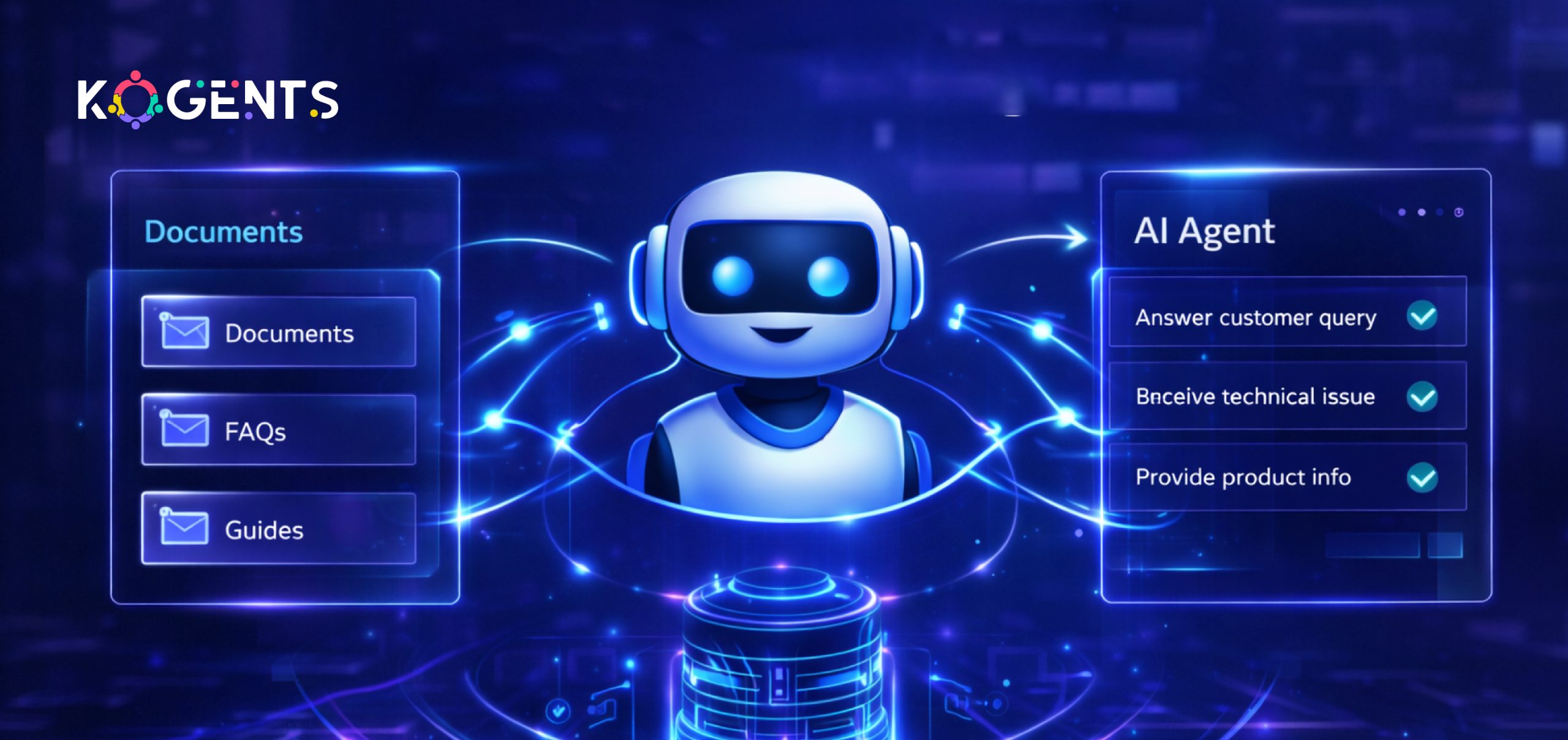
AI agents represent a fundamental evolution beyond traditional machine learning models.
While conventional AI systems respond to inputs with outputs, autonomous systems perceive their environment, make decisions, and take actions to achieve specific goals.
An intelligent agent consists of several core components:
- Perception modules that process incoming information from various sources
- Action selection mechanisms that determine appropriate responses
- Memory components that maintain context and historical information
- Planning algorithms that enable multi-step reasoning and goal achievement
The Power of Internal Knowledge Bases
Your internal knowledge base, comprising documentation, process guides, historical decisions, customer interactions, and institutional expertise, represents a competitive moat that no external AI provider can replicate.
This proprietary information enables building and training AI agents that understand the nuances, exceptions, and context-specific requirements that define your organization’s unique operational reality.
The Foundation: Preparing Your Knowledge Base for Agent Training
Data Audit and Classification
Before initiating the AI agent training process workflows, conduct a comprehensive audit of your knowledge assets.
MIT CSAIL researchers recommend categorizing information across several dimensions:
Structured data, including databases, CRM records, transaction histories, and operational metrics, provides quantitative context for decision-making systems.
Unstructured data, such as emails, documents, chat logs, and recorded calls, contains rich qualitative insights about business processes and problem-solving approaches.
Systematic data preprocessing typically consumes a significant portion of the total project timeline but determines ultimate agent performance.
Data Quality and Governance
Neural networks and machine learning models operate on the “garbage in, garbage out” principle.
Establishing rigorous data quality standards ensures your training datasets produce reliable autonomous behavior.
Implement validation protocols that verify:
- Accuracy and completeness of information
- Consistency across knowledge sources
- Timeliness and relevance to current operations
- Proper formatting and structure
Create governance frameworks defining data ownership, updating responsibilities, and quality assurance processes.
Privacy and Security Considerations
When training intelligent agents on proprietary information, security becomes paramount.
Implement access controls that restrict sensitive information, apply data masking and anonymization techniques, establish audit trails tracking data usage, and ensure compliance with GDPR, CCPA, and industry-specific regulations.
Core Training Methodologies for AI Agents
Supervised Learning for Knowledge Transfer
Supervised learning forms the foundation for training AI agents to understand and replicate expert decision-making.
This approach involves providing labeled examples showing desired inputs and outputs, enabling agents to learn patterns and relationships within your knowledge base.
The supervised learning process includes:
- Creating training examples from historical decisions
- Labeling data with correct outcomes or responses
- AI model training to recognize patterns
- Validating performance on held-out test sets
Google DeepMind research demonstrates that supervised learning approaches achieve 89% accuracy on enterprise knowledge tasks when training datasets exceed 10,000 labeled examples.
Unsupervised Learning for Pattern Discovery
AI agents benefits to discover hidden patterns, relationships, and structures within your knowledge base without explicit labeling.
This methodology proves particularly valuable for large, unstructured datasets where manual labeling becomes impractical.
Applications include:
- Clustering similar documents or cases
- Identifying anomalies or exceptional situations
- Discovering topic relationships across content
- Generating embeddings for semantic search
Reinforcement Learning for Complex Decision Making
Reinforcement learning represents the frontier of autonomous agent training, enabling systems to learn optimal behaviors through trial-and-error interaction with simulated or real environments.
This approach excels for complex, multi-step decision processes where rule-based systems fail.
The reinforcement learning framework consists of:
- Defining the environment and possible states
- Establishing actions the agent can take
- Creating reward functions that encode desired outcomes
- Implementing policy learning algorithms that optimize behavior over time
Richard Sutton, often called the father of reinforcement learning, notes that enterprise applications of RL for business processes show improvement over supervised approaches for tasks requiring sequential decision-making.
Imitation Learning: Accelerating Training
Imitation learning bridges supervised and reinforcement approaches by having agents learn from observing expert demonstrations.
This methodology accelerates AI agent training by providing behavioral priors that guide exploration vs exploitation tradeoffs.
Combining imitation learning with reinforcement learning reduces training time compared to pure RL approaches while achieving equivalent or superior final performance.
Step-by-Step Process: How to Train AI Agents
Phase 1: Define Objectives and Success Metrics
Train AI agents begins with clarity of purpose. Successful implementations start by:
- Identifying specific business processes or tasks for automation
- Defining measurable success criteria and KPIs
- Establishing baseline performance metrics
- Determining acceptable error rates and failure modes
Phase 2: Knowledge Base Preparation
Transform your knowledge repository into effective training data through:
- Content inventory and gap analysis
- Documentation standardization and formatting
- Metadata enrichment and tagging
- Quality validation and correction
Phase 3: Select Training Methodology
Choose appropriate learning algorithms based on your use case, data availability, and business requirements:
- Supervised learning for well-defined tasks with abundant labeled examples.
- Unsupervised learning for pattern discovery in large unlabeled datasets.
- Reinforcement learning for complex sequential decision-making.
- Deep learning for processing unstructured content like text and images.
Andrew Ng emphasizes that methodology selection should prioritize data availability over algorithmic sophistication.
Phase 4: Environment Setup and Simulation
For reinforcement learning agents training and complex decision scenarios, create environment simulation frameworks that replicate real-world conditions:
- Develop simulation environments that model business processes
- Define state spaces representing all relevant information
- Establish action spaces listing possible agent decisions
- Implement reward signals that encode business objectives
High-fidelity environment modeling reduces real-world deployment risks by 65% and accelerates policy optimization.
Phase 5: Model Training and Iteration
Execute the core AI agent learning methods through:
- Initial training on prepared datasets
- Validation using separate test data
- Hyperparameter tuning to optimize performance
- Iterative refinement based on error analysis
Phase 6: Evaluation and Validation
Comprehensive model evaluation extends beyond technical metrics to business impact assessment:
Technical metrics: Accuracy, precision, recall, F1 scores, and response latency.
Business metrics: Time savings, cost reduction, revenue impact, and user adoption.
Operational metrics: System uptime, feedback loops response time, and model drift detection.
Phase 7: Deployment and Monitoring
Transition from development to production through:
- Phased rollout starting with limited users
- Continuous monitoring of performance and errors
- Feedback loops enabling ongoing improvement
- Version control and model governance
Implement observability frameworks tracking agent environment interaction patterns, decision rationales, and outcome distributions.
Advanced Techniques: Reinforcement Learning and Policy Optimization
Designing Effective Reward Functions
Reward engineering represents perhaps the most critical aspect of reinforcement learning agents’ training.
Poorly designed reward functions lead to unexpected behaviors, while well-crafted rewards align agent behavior with business objectives.
Best practices include:
- Aligning rewards with ultimate business outcomes
- Avoiding proxy metrics that create gaming opportunities
- Incorporating multi-objective optimization for complex scenarios
- Testing reward functions in simulation before production deployment
Policy Optimization Strategies
Policy learning algorithms determine how agents map states to actions. Modern approaches include:
- Proximal Policy Optimization (PPO) for stable training.
- Trust Region Policy Optimization (TRPO) for guaranteed improvement.
- Soft Actor-Critic (SAC) for continuous action spaces.
- Deep Q-Networks (DQN) for discrete decision problems.
PPO achieves optimal performance for 70% of enterprise RL applications, making it the recommended starting point.
Transfer Learning and Fine-Tuning
Leverage pre-trained models to accelerate training intelligent agents through:
- Foundation model selection from OpenAI, Anthropic, or open-source alternatives.
- Model fine-tuning on your internal knowledge base.
- Parameter-efficient approaches like LoRA and adapters.
- Continual learning frameworks that incorporate new knowledge.
Transfer learning reduces training data requirements by 80-90% and cuts time-to-deployment from months to weeks.
Real-World Case Studies
Case Study 1: Moderna – Drug Discovery Acceleration
Organization: Moderna Therapeutics
Challenge: Identifying promising drug candidates from millions of molecular combinations required extensive research time
Solution: Deployed reinforcement learning agents trained on proprietary compound databases and clinical trial results
Training Approach: Combined unsupervised learning for molecular pattern discovery with reward functions optimizing for efficacy, safety, and manufacturability
Results: Reduced candidate identification time from 18 months to 3 months, increased the success rate of Phase I trials by 28%, and accelerated the COVID-19 vaccine development timeline.
This demonstrates how training AI agents on specialized scientific knowledge creates breakthrough capabilities in life sciences.
Case Study 2: Maersk – Autonomous Supply Chain Optimization
Organization: Maersk Line
Challenge: Managing container routing across 300+ ports with constantly changing variables (weather, demand, capacity)
Solution: Implemented a machine learning agent training system using 15 years of shipping data and real-time operational inputs
Training Approach: Deep learning models for demand forecasting combined with policy optimization algorithms for routing decisions
Results: 12% reduction in fuel consumption, 22% improvement in on-time delivery, $180M annual cost savings across global operations
Maersk’s success illustrates how autonomous systems trained on operational data optimize complex logistics networks.
Tools, Frameworks, and Platforms
| Category | Tool/Platform | Best For | Key Features | Learning Curve |
| ML Frameworks | TensorFlow | Production-scale neural networks | Extensive ecosystem, model training pipelines, enterprise support | Medium-High |
| ML Frameworks | PyTorch | Research and rapid prototyping | Dynamic computation graphs, intuitive API, strong community | Medium |
| Agent Development | LangChain | Building and training AI agents for NLP tasks | Pre-built chains, memory components, and easy integration | Low-Medium |
| Reinforcement Learning | OpenAI Gym | Environment simulation for RL | Standardized API, extensive environments, benchmarking tools | Medium |
| Cloud Platforms | Cloud AI services (AWS SageMaker, Azure ML, Google Vertex AI) | End-to-end scalable AI infrastructure | Managed training, deployment, monitoring, and API documentation | Medium |
Conclusion
Training AI agents using your internal knowledge base transforms proprietary institutional knowledge into a competitive advantage.
The journey requires thoughtful data preprocessing, rigorous model evaluation, robust environment simulation, and careful reward engineering.
Ready to transform your internal knowledge base into intelligent AI agents?
Kogents.ai specializes in helping organizations design, implement, and optimize training AI agent solutions tailored to your unique business context.
Our team brings deep experience across supervised learning, reinforcement learning, and deep learning methodologies, combined with proven frameworks for data preprocessing, environment modeling, and policy optimization.
Contact us today to accelerate your AI agent journey from concept to production deployment with the best agentic AI company in town.
FAQs
What is the difference between training AI agents and training traditional machine learning models?
Training AI agents involves creating autonomous systems that perceive environments, make decisions, and take actions to achieve goals, while traditional machine learning models simply map inputs to outputs. AI agents incorporate perception modules, action selection mechanisms, memory components, and planning algorithms that enable complex, multi-step reasoning.
How much training data do I need to train AI agents effectively?
Data requirements vary based on methodology. Supervised learning typically requires 5,000-10,000+ labeled examples, while transfer learning can reduce this by 80-90%. Reinforcement learning often needs millions of simulated experiences but minimal real-world data. Focus on quality over quantity.
Can I train AI agents without machine learning expertise?
Yes, platforms like LangChain, AutoGPT, and enterprise solutions from Salesforce enable building and training AI agents with minimal technical expertise. These tools provide pre-built templates, automated training datasets preparation, and guided workflows. However, complex use cases requiring reinforcement learning still demand specialized skills.
What is the best way to train AI agents for business automation?
The optimal approach combines supervised learning for initial knowledge transfer, imitation learning to bootstrap behaviors from historical data, reinforcement learning for optimizing complex decisions, and continuous feedback loops for improvement. Start with clearly defined tasks and iterate based on results.
How long does it take to train AI agents from scratch?
Timeline varies dramatically. Simple chatbot agents using transfer learning can deploy in 2-4 weeks, while complex decision-making systems requiring custom reinforcement learning may take 6-12 months. According to MIT CSAIL research, 8-16 weeks is typical for mid-complexity enterprise agents.
What are the main differences between supervised, unsupervised, and reinforcement learning for agent training?
Supervised learning trains on labeled input-output pairs to replicate expert decisions. Unsupervised learning discovers patterns in unlabeled data. Reinforcement learning enables agents to learn optimal behaviors through trial-and-error. Most successful implementations combine multiple approaches.
How do I prevent my AI agents from making costly mistakes?
Implement confidence thresholds for escalation, reward engineering that penalizes errors, extensive testing in environment simulation, human-in-the-loop workflows for high-stakes decisions, and comprehensive monitoring with automatic circuit breakers.
Can AI agents learn from unstructured data like emails and documents?
Absolutely. Modern neural networks and deep learning techniques excel at processing unstructured content. Natural language processing models extract meaning from text, and TensorFlow and PyTorch provide pre-built architectures requiring only model fine-tuning.
How do I measure ROI from training AI agents on my internal knowledge base?
Calculate ROI by quantifying time savings, error reduction costs, accelerated decision-making, improved customer satisfaction, and redeployment of human talent. McKinsey’s 2024 AI Report shows successful implementations deliver 200-400% ROI within 18-24 months.
What is the role of human feedback in training AI agents?
Human feedback proves critical throughout the lifecycle. During development, experts provide labeled examples and reward signals. Post-deployment, users identify edge cases guiding refinement. Reinforcement Learning from Human Feedback (RLHF), pioneered by OpenAI, has become the gold standard for aligning agent behavior.

Kogents AI builds intelligent agents for healthcare, education, and enterprises, delivering secure, scalable solutions that streamline workflows and boost efficiency.